Deep Dive into RuoYi-Vue-Pro: Enterprise Java Development Platform with 36K+ Stars

RuoYi-Vue-Pro is a full-featured enterprise open-source admin platform built on Spring Boot + Vue
RuoYi-Vue-Pro is an enterprise open-source project led by YunaiV with 36K+ GitHub Stars. Built on Spring Boot + MyBatis Plus + Vue, it features RBAC permissions, multi-tenancy, Flowable workflow, and integrates complete business modules including e-commerce, CRM, ERP, and MES, plus cutting-edge technologies like AI LLMs and IoT. Suitable for enterprise internal systems, SaaS products, and more, it dramatically lowers development barriers.
Project Overview
RuoYi-Vue-Pro is a brand-new Pro version based on the classic RuoYi-Vue framework, led by developer YunaiV (芋道源码), with all original features optimized and refactored. The project has earned over 36,900 Stars and nearly 8,000 Forks on GitHub, making it one of the most popular open-source projects in the Java backend management system space in China.
The project adopts a mainstream tech stack of Spring Boot + MyBatis Plus + Vue & Element, providing not only a complete backend management system but also a WeChat Mini Program frontend — truly a one-stop enterprise development platform.
Core Technical Architecture
Backend Stack: Spring Boot + MyBatis Plus
The backend is built on Spring Boot as the core framework, paired with MyBatis Plus as the ORM layer. This combination is battle-tested in the Java ecosystem, balancing development efficiency with runtime performance.
Spring Boot, created by the Pivotal team (now VMware Tanzu), dramatically simplifies the setup and deployment of Spring applications through mechanisms like Auto-Configuration, Starter Dependencies, and embedded servers. Developers no longer need to deal with verbose XML configuration files — a single annotation can launch a complete web application. MyBatis Plus, developed by the Chinese team baomidou, is an enhancement tool built on top of MyBatis with the core philosophy of "enhance without changing." It provides generic Mappers, Lambda expression queries, and automatic code generators, making single-table CRUD operations require virtually no SQL writing. The combination of these two has become the de facto standard tech stack for Java enterprise development in China.
Compared to the original RuoYi-Vue's native MyBatis, MyBatis Plus brings cleaner CRUD operations, powerful condition constructors (Wrappers), and built-in pagination plugins, significantly reducing boilerplate code. For example, a simple query that previously required writing Mapper XML files can be completed with a single Lambda expression in MyBatis Plus, multiplying development efficiency several times over.
Frontend Stack: Vue + Element UI
The frontend is built with Vue and Element UI, one of the most mature frontend solutions for admin systems in China.
Vue.js was created by former Google engineer Evan You (尤雨溪) in 2014. Its progressive architecture, low learning curve, and excellent Chinese documentation have earned it extremely high adoption rates in China's frontend community. Element UI, open-sourced by Ele.me's frontend team, is a desktop component library based on Vue 2.x that provides 60+ high-quality components including tables, forms, dialogs, and navigation menus — covering virtually all UI needs for admin systems. Vue's component-based development model combined with Element UI's rich component library enables rapid construction of fully-featured, user-friendly management interfaces.
Notably, with the widespread adoption of Vue 3, Element Plus (the Vue 3 version of Element UI) has become the preferred choice for new projects. RuoYi-Vue-Pro keeps pace with this evolution by offering a corresponding Vue 3 + Element Plus version, allowing developers to choose flexibly based on project requirements.
Complete Feature Landscape
RuoYi-Vue-Pro's feature coverage is remarkably broad, far exceeding typical backend management frameworks, essentially forming a complete enterprise digitalization solution.
Core Permission System: RBAC + Multi-Tenancy
- RBAC Dynamic Permissions: Role-Based Access Control supporting dynamic configuration of menu and button permissions that take effect without restart
RBAC (Role-Based Access Control) is the most classic permission management model in information security, formally proposed by the National Institute of Standards and Technology (NIST) in 1992. Its core concept introduces "roles" as an intermediate layer between users and permissions — users indirectly obtain permissions through assigned roles rather than having permissions bound directly to them. This design dramatically simplifies permission management complexity: when an employee changes positions, only their role assignment needs adjustment, eliminating the need to modify permissions one by one. The RBAC model has four levels: RBAC0 (basic model), RBAC1 (role hierarchy), RBAC2 (constrained model), and RBAC3 (unified model). RuoYi-Vue-Pro implements a complete RBAC system including role inheritance and mutual exclusion constraints.
-
Data Permissions: Supports multi-dimensional data isolation at department and individual levels, ensuring different roles can only see data within their authorized scope
-
SaaS Multi-Tenancy: Built-in multi-tenant architecture support where a single system can serve multiple tenants with completely isolated data — critical for SaaS deployments
SaaS (Software as a Service) multi-tenant architecture is a core technology pattern of the cloud computing era. Its essence is allowing multiple customers (tenants) to share the same application instance while ensuring complete data isolation between tenants. The industry has three mainstream data isolation approaches: Separate Databases (one database per tenant — strongest isolation but highest cost), Shared Database with Separate Schemas (a compromise), and Shared Database with Shared Tables (using a tenant_id field to distinguish tenants — lowest cost but requiring strict data isolation controls at the application layer). RuoYi-Vue-Pro supports flexible configuration of multiple isolation strategies, allowing developers to choose the appropriate approach based on business scale and security requirements, smoothly transitioning from shared-table mode during startup phase to separate-database mode during growth phase.
Business Process Engine: Flowable Workflow
The platform integrates the Flowable workflow engine, supporting visual process design, process approval, process monitoring, and complete workflow capabilities. Developers can implement common business scenarios like leave approvals, procurement processes, and contract approvals without introducing additional workflow components.
Flowable is an open-source workflow engine forked from the Activiti project, created by Activiti's core developer Tijs Rademakers in 2016. It is fully compatible with the BPMN 2.0 (Business Process Model and Notation) international standard, supporting process definition, process instance management, task assignment, gateway routing, event listeners, and complete workflow capabilities. Compared to Activiti, Flowable excels in performance optimization, feature iteration, and community activity, additionally supporting CMMN (Case Management) and DMN (Decision Management) standards.
In enterprise applications, workflow engines are the core infrastructure for business process automation. They liberate complex approval processes from hard-coding, enabling visual configuration and dynamic adjustment. For example, when enterprise approval rules change, administrators simply drag and modify nodes in the process designer without developer intervention, greatly improving business responsiveness.
Enterprise Business Modules
This is the biggest differentiator between RuoYi-Vue-Pro and other backend frameworks:
- E-commerce System: Complete e-commerce functionality including product management, order management, and marketing campaigns
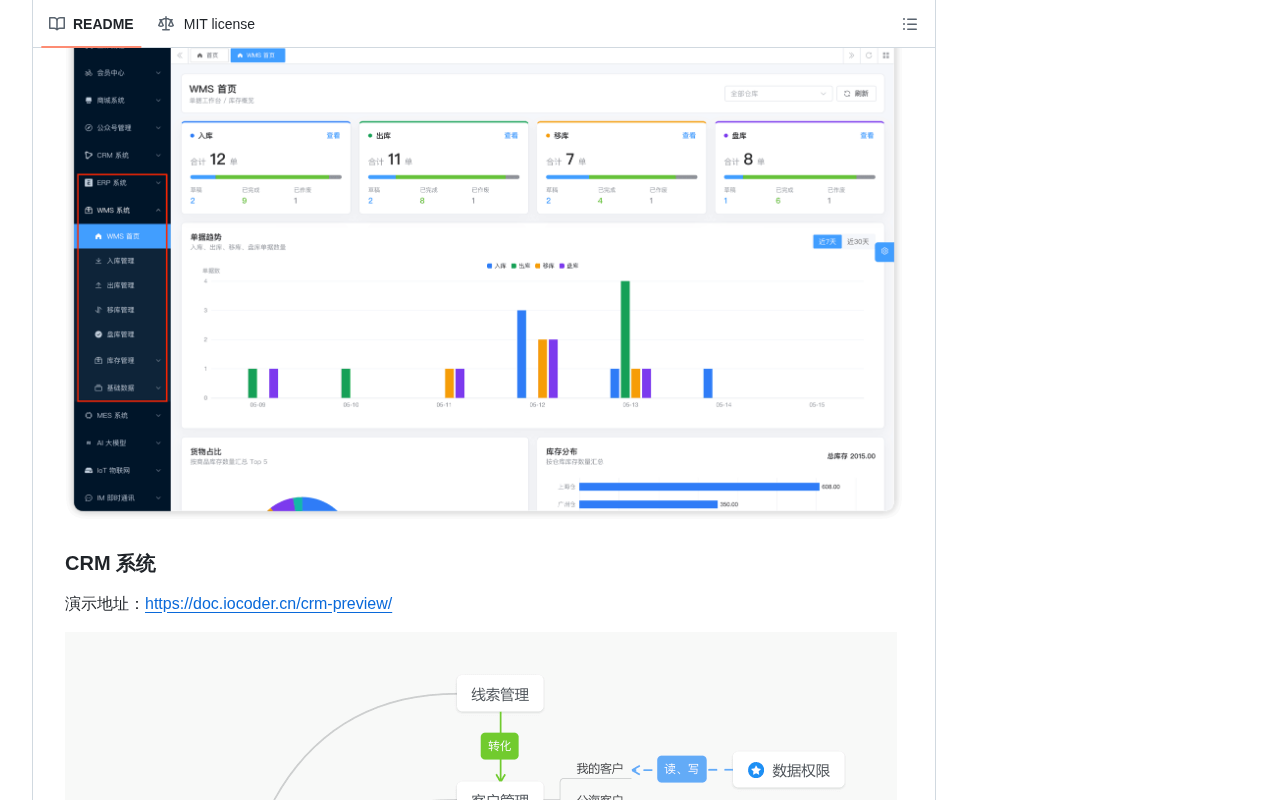
- CRM (Customer Relationship Management): Full sales pipeline with customer management, opportunity tracking, and contract management
- ERP (Enterprise Resource Planning): Covering procurement, inventory, finance, and other core enterprise resource management
- MES (Manufacturing Execution System): Production management modules targeting the manufacturing industry
- Payment System: Integration with mainstream payment channels supporting multiple payment methods
- SMS Service: Unified SMS sending interface connecting with multiple SMS service providers
- Third-Party Login: Support for third-party login via WeChat, DingTalk, and other major platforms
CRM, ERP, and MES are the three core systems of enterprise informatization. CRM focuses on full customer lifecycle management — from lead acquisition and opportunity follow-up to contract signing and after-sales service — helping enterprises improve sales efficiency and customer satisfaction, with Salesforce being the representative product in this field. ERP originated from a concept proposed by Gartner in the 1990s, integrating core business processes including finance, procurement, inventory, production, and human resources. It serves as the "nerve center" of enterprise operations management, with the traditional market dominated by SAP and Oracle, where a single implementation easily costs millions. MES sits between ERP and shop floor automation control systems, responsible for production plan execution, quality traceability, equipment management, and other manufacturing floor management tasks — a key component of smart manufacturing and Industry 4.0.
RuoYi-Vue-Pro integrates these three systems as open-source modules. While their feature depth cannot compare with commercial giants' products, they can cover over 80% of core business needs for small and medium enterprises, dramatically lowering the threshold and cost of enterprise informatization.
Cutting-Edge Technology Integration
-
AI Large Language Models: Keeping pace with technology trends by integrating LLM capabilities to add intelligence to the system. This includes connecting with mainstream LLM APIs like OpenAI and Tongyi Qianwen to implement AI-assisted features such as intelligent customer service, text generation, and data analysis — helping enterprises quickly deploy AI application scenarios without in-house AI R&D capabilities.
-
IoT (Internet of Things): Supporting device access and management, extending the system's applications in IoT scenarios. Through IoT protocols like MQTT, it enables device data collection, remote control, and status monitoring, suitable for smart parks, intelligent warehousing, and similar scenarios.
-
IM (Instant Messaging): Built-in instant messaging functionality meeting enterprise internal communication needs. Based on WebSocket long connections for real-time message push, supporting basic IM capabilities including one-on-one chat, group chat, and read receipts.
Project Value and Use Cases
Why Java Developers Should Pay Attention
The core value of RuoYi-Vue-Pro lies in dramatically lowering the development threshold for enterprise applications. For small and medium teams, building a system from scratch with permission management, workflows, and multi-tenancy typically takes months. Secondary development based on this project can compress that timeline to weeks or even less.
From a technical learning perspective, the project covers virtually all core technology points in Java enterprise development: Spring Security framework, Redis caching strategies, message queue async processing, distributed transactions, API idempotency design, and more. Reading its source code is equivalent to studying a complete set of enterprise architecture best practices.
The 36,000+ Stars also indicate an active community ecosystem — making it easier to find solutions when encountering problems, while the project's continuous maintenance provides long-term reliability assurance. In open-source project selection, community activity is often more important than features themselves, as it directly determines the project's vitality and issue response speed.
Typical Use Cases
- Enterprise Internal Management Systems: Rapid development of internal systems like OA, HR, and finance
- SaaS Product Development: Leveraging multi-tenant architecture to quickly build SaaS products
- E-commerce Platforms: Customized e-commerce development based on the commerce module
- Manufacturing Informatization: Combining ERP and MES modules for production management digitalization
- Java Full-Stack Learning Reference: An excellent learning resource covering most enterprise development technology points
Summary
RuoYi-Vue-Pro has evolved from a simple backend management template into a feature-rich enterprise development platform. Its value lies not only in providing out-of-the-box functional modules but also in its clear architectural design that provides a solid foundation for secondary development. The project adopts a modular design with loose coupling between business modules, allowing developers to selectively import needed modules and avoiding the bloat of an "everything included" approach.
For Java developers, whether for actual project development or technical learning, this is an open-source project worth exploring in depth. Especially in the current context of accelerating enterprise digital transformation, mastering the architectural concepts and implementation details of such enterprise development platforms carries significant practical value for career development.
Key Takeaways
- RuoYi-Vue-Pro is built on Spring Boot + MyBatis Plus + Vue, with 36K+ GitHub Stars, making it one of China's most popular open-source Java backend management projects
- Built-in RBAC dynamic permissions, data permissions, and SaaS multi-tenant architecture meeting enterprise-grade permission management needs
- Feature coverage spans complete business modules including e-commerce, CRM, ERP, MES, and workflow — far exceeding typical backend frameworks
- Integrates cutting-edge technologies including AI LLMs, IoT, and IM, continuously tracking technology trends
- Suitable for enterprise internal systems, SaaS products, e-commerce platforms, and more, significantly reducing development cycles
Related articles
 Product Reviews
The Programmer's Desk Setup Guide: Building a Workspace That Feels Like Home
Discover how programmers build productive, comfortable workspaces. From multi-monitor setups to ergonomic design, explore the desk philosophy that drives focus and flow.
 Product Reviews
Qoder vs Cursor Real-World Comparison: Which $20/Month AI IDE Is Better?
Hands-on comparison of Qoder vs Cursor AI IDEs: Agent autonomy, human interaction count, and architecture decisions. Qoder needed only 2 interactions vs Cursor's 8.
 Product Reviews
Cursor Cloud Agent Demo: Eliminating Bottlenecks Across the Entire Software Development Lifecycle
Deep analysis of Cursor's Cloud Agent demo showing how cloud VMs, automated test artifacts, and a full-chain control plane systematically eliminate human bottlenecks across the software development lifecycle.