Deep Dive into Warren: A Fully Autonomous AI Coding System Where One Person Uses Agents to Handle the Entire Development Workflow

Fully autonomous AI coding system Warren automates the entire pipeline from intent definition to code deployment.
Developer Jim West built Warren, a fully autonomous AI coding system using a multi-agent collaboration architecture that decomposes development tasks into structured plans executed step-by-step by independent Agents. Humans only need to define goals, constraints, and success criteria—the system automatically handles code writing, PR creation, CI validation, and deployment. The system relies on the Mulch memory system to solve cross-Agent context passing challenges, and achieves automatic merging without manual review through deep trust in the CI/CD pipeline.
Introduction: Software Development Is Moving Toward Full Autonomy
Over the past six months, the way top engineers and engineering teams use coding Agents has undergone a dramatic shift. We're approaching a tipping point where software development truly becomes an autonomous process. Developer Jim West recently publicly demonstrated his fully autonomous AI coding system called Warren, showing how a human developer can transform their role from "writing code" to "planning and thinking about direction."
Interestingly, Jim himself emphasizes that Warren doesn't represent the industry's cutting edge—he knows teams operating at even higher levels. But this project gives us a clear glimpse into the future of AI-powered programming.
Warren's System Architecture: End-to-End Automation from Planning to Deployment
Core Philosophy: Plan-Driven Agent Collaboration
Warren's core design philosophy is to decompose large development tasks into structured Plans, where each plan contains multiple steps, and each step spawns an independent Agent to execute it. This Multi-Agent System architecture is one of the most important evolutions in AI engineering over the past two years. Unlike a single large model directly generating code, multi-agent architecture distributes complex tasks across multiple specialized Agents working collaboratively—similar to how different roles collaborate within a software company. Each Agent has its own independent context window, tool-calling permissions, and execution objectives, coordinating through message passing or shared state.
The core advantage of this architecture lies in the fact that individual Agents have limited context length, while complex software projects often involve tens of thousands of lines of code. Through task decomposition, each Agent only needs to handle localized problems, dramatically reducing error rates caused by "attention dilution." Research from Anthropic, OpenAI, and other institutions consistently shows that multi-agent collaboration significantly outperforms single-agent approaches on long-horizon tasks. Warren's "plan → steps → independent Agents" architecture is precisely the engineering implementation of this principle.
The entire system is supported by several key components:
- Mulch: A memory system that provides Agents with contextual memory capabilities
- Seeds: An issue tracking system—essentially a lightweight Issue Tracker based on JSON files
- PI Agent Runtime: The underlying Agent runtime environment
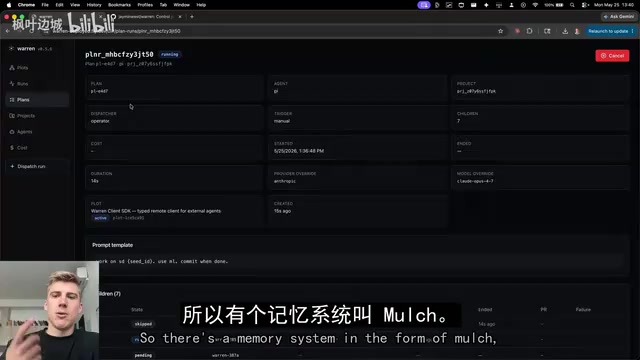
Memory System: Giving Agents a "Historical Sense" of the Project
The Mulch memory system addresses a fundamental challenge with large language models: LLMs are inherently stateless—each invocation starts from a blank context, with no natural ability to remember previous operation history. For long-horizon development tasks that span multiple steps and multiple Agents, this is a critical bottleneck.
From a technical implementation perspective, Agent memory systems are typically categorized into several types: short-term memory (current conversation context), long-term memory (historical information stored in vector databases), episodic memory (specific operation logs), and semantic memory (knowledge like codebase structure and project specifications). Mulch's existence enables subsequent Agents to "know" what preceding Agents did and why, thereby avoiding redundant work or conflicting modifications. This is functionally analogous to "project documentation" and "handoff notes" in human teams, and represents critical infrastructure that enables multi-agent systems to handle real engineering projects.
The Human Role: Only Responsible for Defining Intent
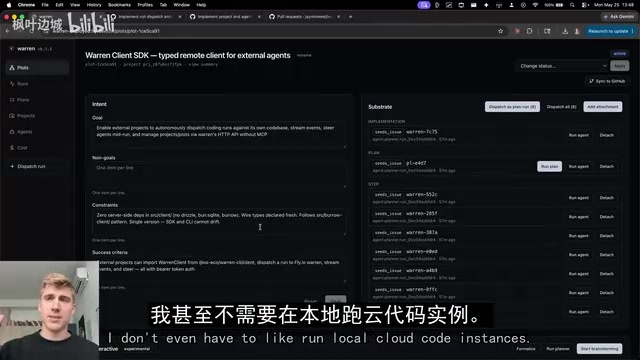
In Warren's workflow, the only thing human developers need to do is fill in the "Intent" section:
- Define the Goal
- Set Constraints
- Specify Success Criteria
They don't even need to fill in "Non-goals." This design of abstracting human input into three elements has deep theoretical roots in Requirements Specification from software engineering. Traditional requirements engineering distinguishes between "functional requirements" (what the system does) and "non-functional requirements" (how the system does it), while Warren's Intent framework essentially encourages humans to define only the former, leaving the latter entirely to Agents to infer and decide.
This elevation of abstraction level is analogous to the evolution of programming languages from assembly to high-level languages—programmers no longer need to manage registers but instead describe business logic. In the AI Agent era, Intent-based Programming is emerging as a new paradigm: humans express "what outcome they want," and AI figures out "how to achieve it." This also places new demands on the roles of requirements engineers and product managers—clearly expressing intent and constraints will become a more core skill than writing code.
Afterward, the Agent automatically examines the codebase, constructs a structured plan, and then executes it step by step.
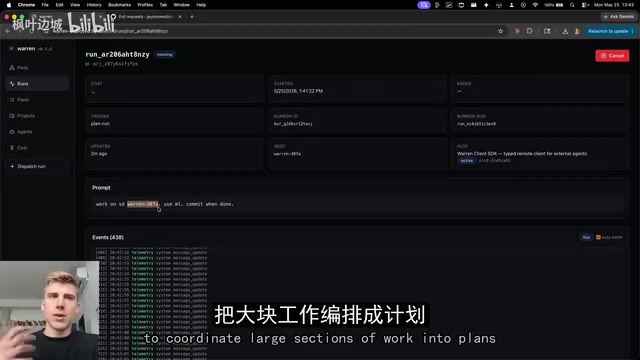
Workflow Demonstration: From Intent to Production Deployment
Fully Automated PR Process and CI/CD Trust Mechanism
Warren's automated workflow is impressive:
- After completing code changes, the Agent automatically creates a Pull Request
- The PR triggers CI checks (linting, tests, type checking, etc.)
- Once CI passes, it automatically merges and deletes the branch
- The next Agent automatically picks up the previous Agent's work and continues
Jim states plainly: "I don't review PRs anymore." This sounds crazy, but his confidence comes from deep trust in the CI/CD (Continuous Integration/Continuous Delivery) pipeline. CI/CD is foundational infrastructure in modern software engineering: the CI stage automatically runs code style checks, unit tests, integration tests, type checks, and other processes to catch errors before code is merged; the CD stage then automatically deploys validated code to production.
Jim has partially transferred the responsibility of manual code review to machine-verifiable quality gates. This approach isn't unfamiliar in the DevOps world: Google's practice of "automated testing replacing manual review" and Netflix's "chaos engineering" philosophy both reflect the trend of replacing human judgment with systematic mechanisms. Warren's innovation lies in seamlessly connecting this mature set of engineering practices with AI Agent-generated code, ensuring that Agent output undergoes the same rigorous quality validation as human-written code—this is precisely the engineering foundation that allows his trust in system infrastructure to reach the level where Agents can "get it right the first time."
Real-time Preview and Rapid Iteration
Warren also has built-in application preview capabilities. Jim demonstrated a practical example: he wanted to move the Warren project to the top of the project list on his personal website jimandwest.com. He simply triggered a new run in Warren, describing "move Warren to the top of the project list."
Related articles
 Product Reviews
The Programmer's Desk Setup Guide: Building a Workspace That Feels Like Home
Discover how programmers build productive, comfortable workspaces. From multi-monitor setups to ergonomic design, explore the desk philosophy that drives focus and flow.
 Product Reviews
Qoder vs Cursor Real-World Comparison: Which $20/Month AI IDE Is Better?
Hands-on comparison of Qoder vs Cursor AI IDEs: Agent autonomy, human interaction count, and architecture decisions. Qoder needed only 2 interactions vs Cursor's 8.
 Product Reviews
Cursor Cloud Agent Demo: Eliminating Bottlenecks Across the Entire Software Development Lifecycle
Deep analysis of Cursor's Cloud Agent demo showing how cloud VMs, automated test artifacts, and a full-chain control plane systematically eliminate human bottlenecks across the software development lifecycle.