Deep Dive Review of the Claude AI Assistant Open-Source Project: Enterprise-Grade Solution or Proof of Concept?

A Claude-based enterprise AI assistant open-source project with a solid vision but questionable maturity.
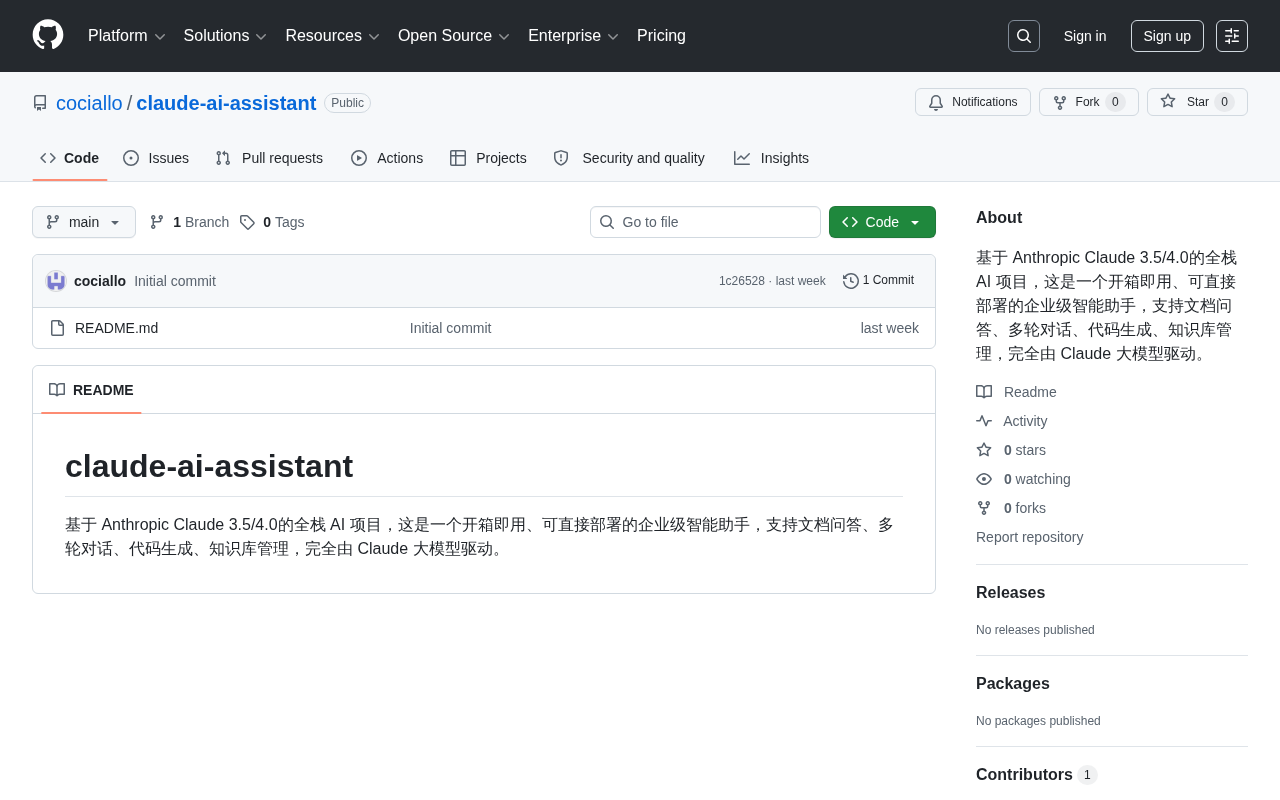
The newly appeared claude-ai-assistant project on GitHub positions itself as a full-stack AI assistant powered by the Claude model, covering document Q&A, multi-turn conversations, code generation, and knowledge base management. However, with zero Stars, zero Forks, and no detected programming language, it remains in a very early stage. Compared to mature competitors like Dify and FastGPT, its single-model lock-in strategy and project completeness present clear shortcomings — worth watching but not recommended for production use.
Project Overview: A Full-Stack AI Assistant Built on Claude
Recently, an open-source project called claude-ai-assistant appeared on GitHub, positioning itself as a full-stack AI intelligent assistant powered by Anthropic Claude 3.5/4.0. The project claims to offer an out-of-the-box, deployment-ready enterprise-grade solution covering core features such as document Q&A, multi-turn conversations, code generation, and knowledge base management.
However, it's important to note that this project is still in an extremely early stage — zero Stars, zero Forks, and no programming language even detected — which suggests the project may have just been created, and the actual completeness of its code and documentation remains to be verified.
Feature Positioning & Technical Architecture Analysis
Four Core Feature Modules
Based on the project description, claude-ai-assistant attempts to cover several mainstream enterprise AI assistant requirements:
-
Document QA: Intelligent Q&A based on uploaded documents — a classic application of the RAG (Retrieval-Augmented Generation) architecture. RAG is one of the most prevalent technical architectures in enterprise AI applications today. Its core approach is to first perform vector retrieval on the user's query — typically by converting text into high-dimensional vectors using an Embedding model, then using vector databases like FAISS, Milvus, or Pinecone for similarity matching — to recall the most relevant document chunks from the knowledge base. These chunks are then injected as context into the LLM's prompt, and the model generates the final answer. This architecture effectively addresses the LLM "hallucination" problem and knowledge currency issues, enabling models to provide accurate answers based on enterprise-proprietary data without requiring fine-tuning of the model itself. The quality of a RAG implementation depends on multiple factors: document parsing and chunking strategies, Embedding model selection, retrieval algorithm precision and recall, and prompt engineering design.
-
Multi-Turn Conversations: Continuous dialogue with context memory, leveraging Claude's excellent long-context processing capabilities.
-
Code Generation: Utilizing Claude's strengths in code comprehension and generation to provide programming assistance.
-
Knowledge Base Management: Building and maintaining enterprise-specific knowledge bases for structured storage and retrieval.
Technical Advantages of the Claude Model
Anthropic's Claude model family is competitive across multiple dimensions. Claude 3.5 Sonnet excels in code generation, reasoning, and long-text processing, supporting a context window of up to 200K tokens (roughly equivalent to 150,000 English words or a 500-page book) — a leading figure among mainstream commercial LLMs. Long-context capability is critical for multi-turn conversations — it means the model can "remember" more conversation history within a single session, reducing information loss caused by context truncation.
Claude 4.0 (Opus/Sonnet) has achieved significant improvements in complex reasoning and tool use. Its "Tool Use" (also known as Function Calling) capability allows the model to proactively call external APIs, execute code, or query databases during the reasoning process, providing a foundation for building complex Agent workflows. Additionally, through its unique Constitutional AI training methodology, Anthropic has made Claude excel in safety and instruction following — particularly important for enterprise deployment scenarios. Choosing Claude as the underlying engine theoretically provides enterprise applications with high-quality language understanding and generation capabilities.
Market Context & Competitive Analysis
How Crowded Is the Enterprise AI Assistant Space?
The enterprise AI assistant space built on large language models is already intensely competitive. Mature open-source projects on the market include:
| Project | Positioning | Community Activity |
|---|---|---|
| Dify | Complete LLMOps platform | Tens of thousands of Stars, mature ecosystem |
| FastGPT | Focused on knowledge base Q&A | Mature community, stable iteration |
| Langchain + Frontend Frameworks | Flexible composable solution | Requires significant custom development |
| LobeChat / ChatGPT-Next-Web | Chat interface, multi-model access | Large user base |
It's worth explaining the technical positioning of these competitors. LLMOps (Large Language Model Operations) is an extension of the MLOps concept into the LLM era, referring to full-lifecycle management of LLM applications — including prompt management, model orchestration, data pipelines, evaluation monitoring, and deployment operations. Dify, as a representative LLMOps platform, provides visual workflow orchestration, multi-model integration, RAG pipeline configuration, and one-stop app publishing capabilities, allowing developers to build AI applications without writing extensive code. FastGPT focuses specifically on knowledge base Q&A scenarios, with deep optimizations in document parsing, chunking strategies, and retrieval. Langchain, as an underlying framework, offers rich Chain, Agent, and Tool abstractions — maximum flexibility but also the steepest learning curve. Together, these projects form the infrastructure layer for current AI application development. For a new project to break through in this ecosystem, it needs a clearly differentiated positioning.
Compared to these projects that already have thousands or even tens of thousands of Stars, claude-ai-assistant as a newcomer needs to demonstrate compelling results in both differentiation and completeness.
Single-Model Lock-In: Feature or Limitation?
The project positions itself as "fully powered by the Claude LLM," which is both a feature and a limitation. Focusing on a single model ecosystem can enable deeper optimization and a better out-of-the-box experience, but it also means users are locked into Anthropic's API ecosystem, lacking the flexibility to switch models.
In enterprise AI applications, vendor lock-in is a widely discussed architectural decision. Binding to a single model means an application's prompt engineering, feature boundaries, and cost structure are deeply coupled with that provider. If the provider adjusts API pricing (as OpenAI has done multiple times with GPT-4's pricing strategy), changes terms of service, experiences service outages, or a competitor launches a more cost-effective model, migration costs can be prohibitively high. The current industry best practice is to adopt a model abstraction layer (such as LiteLLM, OpenRouter, or similar middleware), using a unified API interface to connect with multiple model providers for hot-swapping and load balancing. This architecture not only reduces vendor risk but also allows enterprises to select the most cost-effective model based on the complexity of different tasks.
For enterprise users, multi-model support is often a critical factor in technology selection.
Objective Assessment & Risk Considerations
Clear Questions About Project Maturity
Several warning signs must be candidly pointed out:
- Zero community interaction: No Stars or Forks indicate the project has not undergone any community validation.
- No programming language detected: GitHub has not identified a primary programming language, possibly indicating minimal code or an incomplete project structure.
- Potential gap between claims and reality: Descriptions like "enterprise-grade" and "out-of-the-box" need to be substantiated by actual code and documentation.
When evaluating the maturity and reliability of an open-source project, the industry typically considers multiple dimensions: community metrics (Star count, Fork count, number of contributors, issue response time), code quality (test coverage, CI/CD configuration, coding standards), documentation completeness (API docs, deployment guides, architecture descriptions), release cadence (version iteration frequency, changelog consistency), and ecosystem integration (plugin systems, third-party integration examples). For enterprise-grade projects, it's also important to verify whether the license permits commercial use, whether there's backing from a commercial entity or foundation, and whether an active maintenance team exists. A zero-Star project isn't necessarily without value, but before deploying it in a production environment, a comprehensive evaluation across all these dimensions is essential to avoid technical debt from abandoned maintenance.
How Should Developers Evaluate This Project?
If you're interested in this project, the following verification steps are recommended:
- Review the actual code first: Confirm whether the project includes a complete frontend and backend implementation.
- Test the deployment process yourself: Verify whether it truly delivers on the "out-of-the-box" promise.
- Monitor maintenance activity over time: Watch for subsequent commit frequency and issue response speed.
- Benchmark against mature alternatives: Before investing your time, compare features and stability against mature projects like Dify and FastGPT.
Conclusion: Worth Watching, But Too Early to Adopt
claude-ai-assistant targets a real and valuable use case — building enterprise-grade AI assistants powered by the Claude model. However, based on its current state, it looks more like a nascent proof-of-concept project, still a considerable distance from delivering on its promises of being "enterprise-grade" and "out-of-the-box."
In an era where LLM application development tools are increasingly mature, new projects need to invest significantly more effort in completeness, differentiation, and community building to gain a foothold in this fiercely competitive landscape.
It's recommended to keep an eye on this project's future development, but at this stage, it should not be considered a primary choice for production environments. If you're looking for reliable enterprise-grade AI assistant solutions, Dify and FastGPT remain the safer choices.
Related articles
 Product Reviews
The Programmer's Desk Setup Guide: Building a Workspace That Feels Like Home
Discover how programmers build productive, comfortable workspaces. From multi-monitor setups to ergonomic design, explore the desk philosophy that drives focus and flow.
 Product Reviews
Qoder vs Cursor Real-World Comparison: Which $20/Month AI IDE Is Better?
Hands-on comparison of Qoder vs Cursor AI IDEs: Agent autonomy, human interaction count, and architecture decisions. Qoder needed only 2 interactions vs Cursor's 8.
 Product Reviews
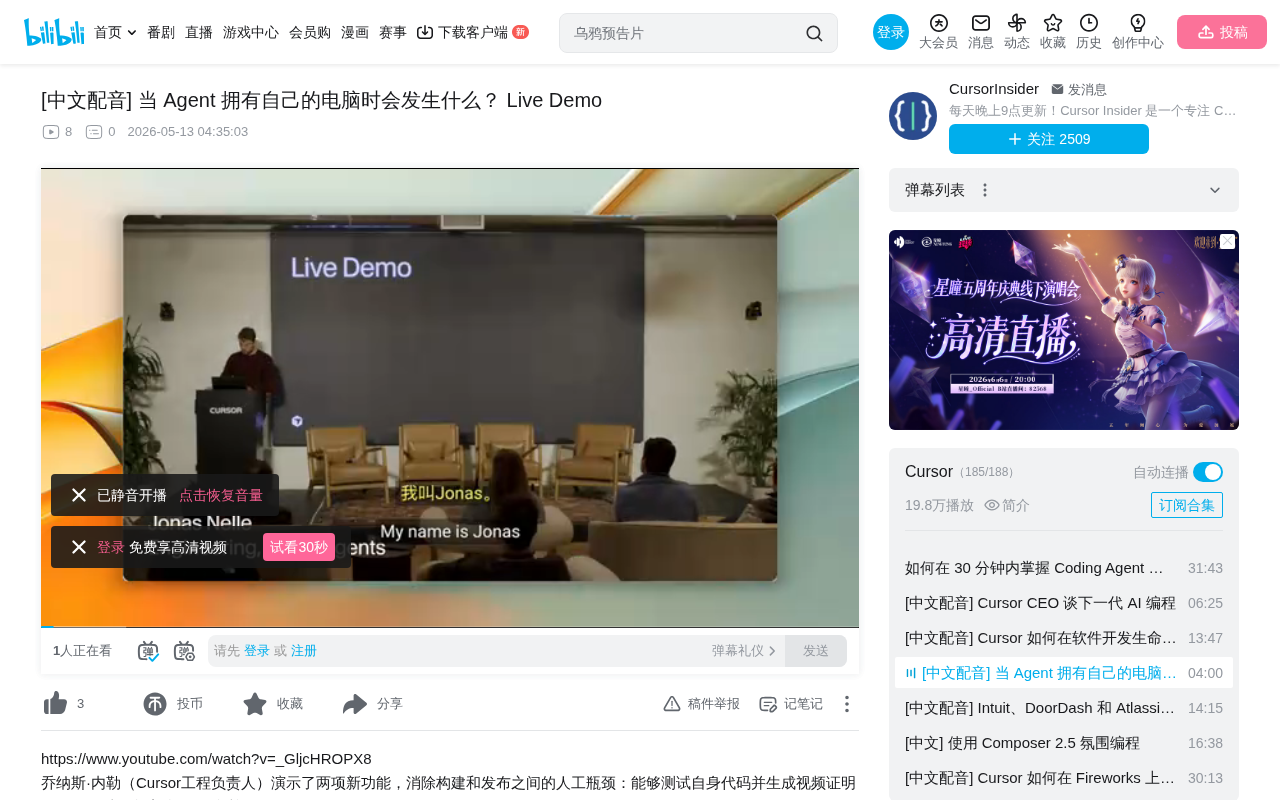
Cursor Cloud Agent Demo: Eliminating Bottlenecks Across the Entire Software Development Lifecycle
Deep analysis of Cursor's Cloud Agent demo showing how cloud VMs, automated test artifacts, and a full-chain control plane systematically eliminate human bottlenecks across the software development lifecycle.