Deep Fission Makes Another IPO Attempt to Raise $157 Million — What Are the Red Flags for This Nuclear Startup?

Deep Fission attempts another IPO to raise $157M amid skepticism over nuclear startup commercialization.
Nuclear startup Deep Fission is making another IPO attempt targeting $157 million. Despite AI data center demand heating up the nuclear sector, the company faces long technology validation cycles, complex regulatory approvals, massive capital requirements, and fierce competition. A previous failed listing attempt intensifies investor skepticism, and the high-risk, long-cycle nature of nuclear startups demands careful evaluation over chasing concept-driven bubbles.
Overview
Deep Fission, a nuclear energy startup, is seeking to raise up to $157 million through an IPO. However, this isn't the company's first attempt at going public, and its repeated listing plans and business model have raised numerous questions among investors and industry observers.
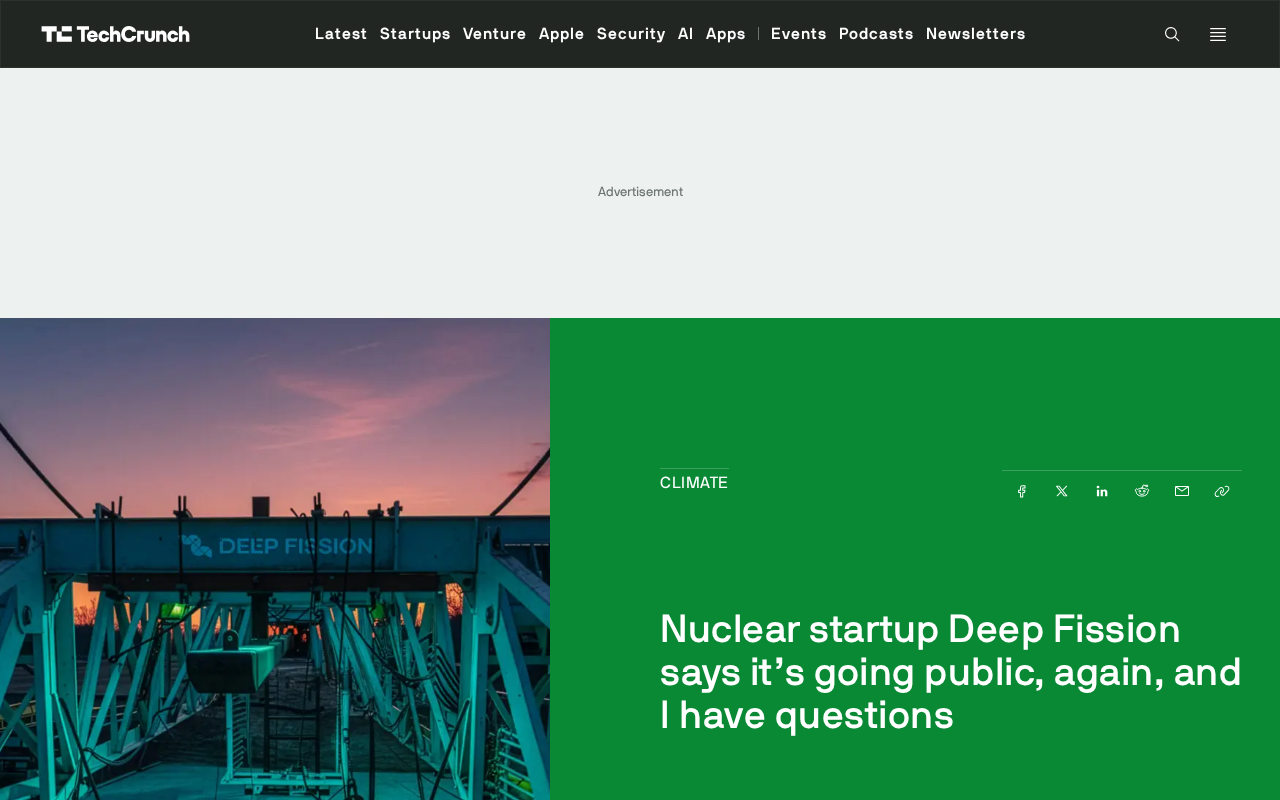
Deep Fission's Second IPO Attempt: $157 Million Fundraising Target Draws Attention
Why "Again"?
Deep Fission's IPO target of $157 million is a fairly bold goal for a nuclear energy startup. Notably, this is not the company's first attempt at going public. The fact that this is a repeat attempt is itself worth pondering — why did the previous listing plan fail? Was the market timing wrong, or does the company have fundamental issues that make it difficult to convince investors?
Against the backdrop of the global energy transition, nuclear energy is experiencing a renaissance. From Microsoft signing power supply agreements with nuclear plants to multiple governments reintegrating nuclear energy into their clean energy strategies, the nuclear sector has indeed attracted significant attention. Notably, this nuclear renaissance is closely tied to the explosive growth of the artificial intelligence industry — the exponentially growing compute demands for AI model training and inference are directly driving a sharp increase in data center power consumption. According to the International Energy Agency (IEA), global data center electricity demand is expected to double by 2026. Tech giants like Microsoft, Google, and Amazon have successively signed long-term Power Purchase Agreements (PPAs) with nuclear operators. Nuclear energy's 24/7 uninterrupted zero-carbon baseload power perfectly matches data centers' extremely high requirements for stable electricity supply. However, this demand tailwind primarily benefits mature nuclear companies with existing operational assets. For startups still in the technology development stage, there's still a long way to go before truly benefiting. Deep Fission clearly hopes to leverage this momentum to achieve its capital market breakthrough.
Why Are Investors Skeptical?
Despite the nuclear energy hype, investors may find it difficult to fully buy into Deep Fission's business narrative. The nuclear industry has its unique challenges:
- Extremely long technology validation cycles: From concept design to actual power generation, nuclear projects typically require a decade or more
- Complex regulatory approvals: Nuclear energy is one of the most heavily regulated industries globally, with extremely high uncertainty in obtaining operating permits
- Massive capital requirements: $157 million may be just a drop in the bucket for the full lifecycle of a nuclear project
- Increasingly fierce competition: Multiple nuclear startups including NuScale and Oklo have already established their presence in capital markets
Taking the United States as an example, new nuclear reactor designs need to obtain Design Certification (DC) and Combined Operating License (COL) from the Nuclear Regulatory Commission (NRC). The entire approval process typically takes 5 to 10 years and requires submitting tens of thousands of pages of technical documentation along with rigorous safety reviews. NuScale's SMR design received NRC design certification in 2022, becoming the first approved SMR design in the U.S., but this process took nearly 6 years. Oklo's Aurora reactor application was rejected by the NRC in 2022, with a request to supplement additional safety data. For early-stage companies like Deep Fission, regulatory approval represents not just a time cost but also enormous capital expenditure — NRC review fees and associated safety analysis work alone could consume tens of millions of dollars in funding.
The IPO Dilemma for Nuclear Startups: An Industry-Wide Analysis
The Capital Market Paradox of the SMR Sector
In recent years, Small Modular Reactors (SMRs) and advanced nuclear technologies have become investment hotspots. SMRs refer to next-generation nuclear reactors with electrical output below 300 megawatts. Their core design philosophy is to modularize and factory-prefabricate traditional large nuclear plant components, thereby significantly reducing construction costs and timelines. Unlike conventional nuclear plants that require billions of dollars and over a decade of construction, SMRs can theoretically be mostly manufactured in factories and then transported to sites for assembly, significantly shortening deployment time. Currently, over 70 SMR design concepts are at various stages of development globally, covering multiple technology pathways including light water reactors, molten salt reactors, and high-temperature gas-cooled reactors. However, SMR commercialization has progressed far more slowly than expected — to date, only a very small number of SMR projects worldwide have actually achieved grid connection, with most still in the design or regulatory approval stage.
These companies face a common paradox: they need substantial funding to advance technology development and obtain regulatory approval, but without actual operating revenue, it's very difficult to achieve reasonable valuations in public markets.
Special Purpose Acquisition Companies (SPACs) were once a popular choice for nuclear startups to bypass the cumbersome traditional IPO process and quickly enter public markets. A SPAC is a "blank check company" that raises funds through an IPO and then seeks a target company to merge with within a specified timeframe, allowing the target company to go public through a reverse merger. NuScale Power experienced dramatic stock price volatility after going public via SPAC, while Oklo only succeeded in listing after its first SPAC merger attempt failed. However, after the SPAC boom subsided, many companies that went public through this route saw their stock prices shrink significantly, and investor tolerance for such high-risk targets has noticeably declined. These precedents show that the path to public listing for nuclear startups is full of obstacles, which is important context for understanding why Deep Fission chose the traditional IPO route but still faces challenges with market trust.
Five Key Questions About Deep Fission's IPO
For Deep Fission's current IPO, the following questions deserve investors' close attention:
- Technology maturity: What stage is the company's core technology at? Is there prototype validation?
- Commercialization timeline: How long is expected from IPO to actual revenue generation?
- Use of funds: How will the $157 million be allocated? Is it sufficient to sustain the company to the next critical milestone?
- Reasons for previous listing failure: Has the company adequately explained why it failed to list previously?
- Differentiated competitive advantage: Compared to competitors like NuScale and Oklo, what is Deep Fission's unique value proposition?
Implications for Nuclear Energy Stock Investors
The nuclear renaissance is a real trend, but not every company flying the nuclear flag deserves investment. Driven by AI data centers' massive demand for clean energy, valuations in the nuclear sector may contain a bubble. Investors need to look beyond concept hype and examine companies' actual technical capabilities, team backgrounds, and commercial viability. It's particularly important to distinguish between mature nuclear companies with existing operational assets that can directly secure PPAs with tech giants, versus startups still in the early stages of technology validation and regulatory approval that are years or even a decade or more away from commercial operations — the risk-return profiles of these two categories are fundamentally different.
Deep Fission's repeated IPO attempt reflects both the capital enthusiasm for the nuclear sector and the trust challenges that early-stage nuclear companies face in capital markets. For such high-risk, long-cycle investment targets, prudent evaluation is far more important than chasing hot trends.
Key Takeaways
- Deep Fission is again seeking an IPO targeting $157 million, but has a previous failed listing attempt
- Nuclear startups face multiple challenges including long technology validation cycles, complex regulations, and massive capital requirements; the NRC approval process alone typically takes 5 to 10 years
- While the SMR sector has over 70 design concepts, very few projects globally have actually achieved commercial grid connection, with commercialization progressing far more slowly than expected
- The AI data center boom has heated up the nuclear demand narrative, but this tailwind primarily benefits mature companies with operational assets, not early-stage startups
- Investors are skeptical of the company's business story, with key questions around technology maturity and commercialization timeline
- While the nuclear sector is hot, early-stage company valuations may contain a bubble and require careful evaluation
Related articles
Meta Muse Hits 900K Downloads in Six D…
Meta Muse Hits 900K Downloads in Six Days: The AI Agent Era Has Officially Arrived
Meta's AI agent Muse hit 902K downloads in 6 days, topping US App Store and Google Play charts above ChatGPT and Claude. A deep dive into Muse's capabilities and the AI Agent race.
 Industry Insights
IRS Fully Embraces Claude AI, Accelerating Federal Government's AI Adoption
The IRS is recruiting staff with 24/7 Claude AI access, marking Anthropic's breakthrough into the federal government. Explore the strategic implications and tax use cases.
 Industry Insights
The IRS Mobile App Debate: A Trust Crisis in Government Digital Transformation
The IRS's proposed mobile app has sparked heated debate. This article analyzes the core arguments, exploring data security, privacy, and the trust crisis in government digital transformation.