Deep Learning FYP Topic Selection Guide: Reddit Community Advice and Practical Strategies

Reddit community highlights: Deep learning FYP topic selection requires balancing academia and career—small but deep, engineering-focused, and pitfall-aware.
This article synthesizes Reddit community discussions to provide deep learning FYP topic selection strategies for computer science graduates. The core principle is balancing academic feasibility with career relevance, choosing small but deep topics, and aligning with professors' research directions. It recommends five popular directions: lightweight vision models and edge deployment, domain-specific NLP fine-tuning, controllable generation and quality assessment, reinforcement learning for simulated decision-making, and interdisciplinary AI applications. It also emphasizes making the FYP a job-hunting asset through engineering practices and quantified comparative experiments, and lists common pitfalls.
Why Is FYP Topic Selection So Important?
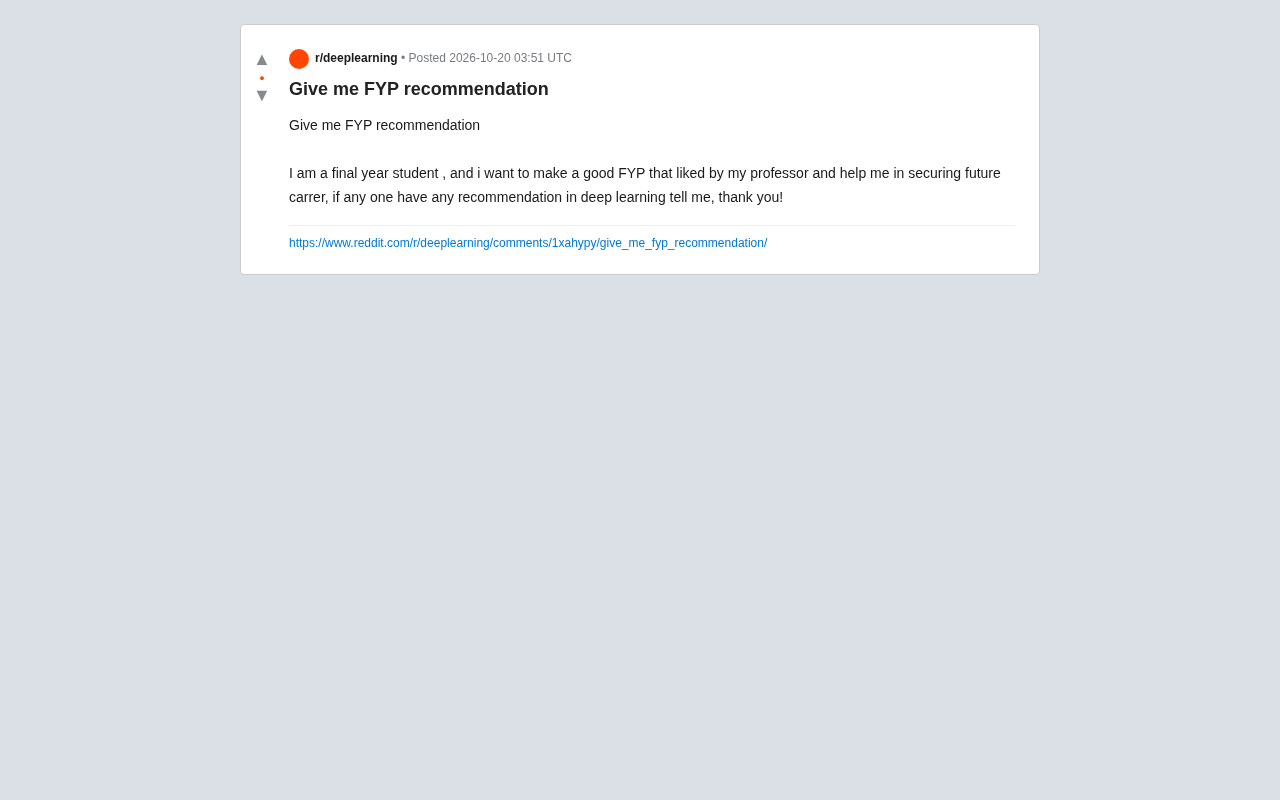
A final-year computer science student posted on Reddit asking for help: "I want an FYP that will both impress my professor and help my future career. I'd appreciate recommendations for deep learning directions." Though brief, this post captures a shared anxiety among many graduating students. The FYP (Final Year Project) is not only a concentrated demonstration of academic ability but also a core portfolio piece when job hunting. A poor topic choice can consume months with little payoff, while a clever one can satisfy both academic evaluation and career needs.
This article synthesizes multiple Reddit community discussions (including replies to that post and common advice from similar threads) to outline topic selection strategies, popular directions, and pitfalls to avoid for deep learning FYPs.
Core Principles of Topic Selection: Professor Satisfaction + Career Empowerment
Multiple experienced upperclassmen and practitioners on Reddit repeatedly emphasize that FYP topic selection must balance two dimensions: academic feasibility and career relevance. Professors typically value novelty, methodological rigor, and reproducibility of results; employers focus more on whether the project addresses real problems, engineering completeness, and alignment with their tech stack.
A common mistake is pursuing "big and comprehensive" topics, such as "general-purpose object detection system." Such topics often struggle to produce convincing results due to data scale and computational resource constraints. Conversely, small but deep topics more easily yield clear results, such as "lightweight Transformer-based defect detection for specific scenarios." Reddit user @DeepLearn_Advice noted: "Professors like to see that you can define clear problem boundaries and reasonably evaluate your methods."
Another consensus: align as much as possible with your professor's research direction or lab resources. This not only yields more guidance but may also give you access to real datasets or computational resources.
Recommended Popular Deep Learning FYP Directions
Based on discussions in the Reddit community (r/MachineLearning, r/learnmachinelearning, etc.), the following directions have been popular in recent FYPs and make it easier to balance academic and career goals:
1. Computer Vision: Lightweight Models and Edge Deployment
Classic tasks like object detection, image segmentation, and pose estimation remain common FYP choices, but it's advisable to focus on model compression and edge deployment. For example: design a real-time face mask detection model for mobile devices and compare the effects of pruning, quantization, and knowledge distillation. Such topics have clear evaluation metrics (mAP, FPS, model size) and demonstrate engineering ability, which is highly valued by employers for embedded AI positions.
Model compression and edge deployment involves three mainstream techniques: pruning reduces parameter count by removing redundant weights or channels; quantization converts floating-point weights and activations to low-bit representations (e.g., INT8), significantly reducing memory footprint and inference latency; knowledge distillation lets a small student model mimic the output distribution of a large teacher model, compressing the model while maintaining accuracy. Edge deployment focuses on achieving real-time inference on mobile or embedded devices, with common tools including TensorFlow Lite, ONNX Runtime, and TensorRT. Evaluation should consider both accuracy metrics (e.g., mAP) and efficiency metrics (e.g., FPS, model size, power consumption), which is highly persuasive for job applications in embedded AI.
2. Natural Language Processing: Domain-Specific Fine-Tuning and Evaluation
In the era of large models, FYPs can revolve around domain-specific text classification, information extraction, or question-answering systems. For example: use LoRA to fine-tune an open-source model for legal document summarization, and design an evaluation framework combining human evaluation with automatic metrics. Reddit user @NLP_Student suggests: "Don't try to train a large model from scratch; focus on fine-tuning strategies and domain adaptation instead. This keeps computational costs manageable and results easy to analyze."
LoRA (Low-Rank Adaptation) is a parameter-efficient fine-tuning method that freezes most parameters of a pretrained model and only injects low-rank decomposition matrices into the attention matrices of Transformer layers for training. Compared to full-parameter fine-tuning, LoRA greatly reduces VRAM requirements and training costs, making it possible to fine-tune large models on a single consumer-grade GPU. In an FYP, LoRA can quickly adapt open-source models (e.g., LLaMA, ChatGLM) to domain-specific data, and you can compare the effects of different ranks and adapter layer choices. For evaluation, automatic metrics (e.g., ROUGE, BERTScore) should be combined with human evaluation, paying particular attention to the accuracy of domain terminology and the faithfulness of generated content.
3. Generative Models: Controllable Generation and Quality Assessment
Diffusion models and GANs still offer ample room for exploration in image and audio generation. FYPs can investigate quality assessment metrics for generated content or conditional control methods. For example: text-guided image editing and comparing the effects of different attention mechanisms. Such topics are highly novel and easily attract professors' interest, but be mindful of computational resource requirements.
Diffusion Models generate data through a gradual denoising process: the forward process adds noise to data until it becomes pure noise, and the reverse process learns to recover data from noise. Conditional control is typically achieved through Classifier-Free Guidance, where condition information is randomly dropped during training and the guidance scale is adjusted during inference to balance generation quality and condition consistency. For quality assessment, FID (Fréchet Inception Distance) is commonly used to measure the difference between generated and real distributions, IS (Inception Score) evaluates the diversity and clarity of generated samples, and CLIP Score measures image-text alignment. In an FYP, you can compare the impact of different attention mechanisms (e.g., Cross-Attention vs. Self-Attention) on controllability, but note that diffusion model training has high GPU memory requirements; prioritize using pretrained models for fine-tuning or inference experiments.
4. Reinforcement Learning: Decision Optimization in Simulated Environments
If you're interested in robotics or game AI, you can study decision algorithms in open-source simulation environments (e.g., PyBullet, Gym). For example: improving PPO-based robotic arm grasping strategies. Such topics have sufficient theoretical depth and demonstrate understanding of core RL concepts, suitable for pursuing further studies or applying for algorithm positions.
PPO (Proximal Policy Optimization) is a policy gradient-based reinforcement learning algorithm that limits policy update magnitude by clipping the importance sampling ratio, balancing stability and sample efficiency. It belongs to the Actor-Critic framework, where the Actor network outputs action probabilities and the Critic network estimates state values. In simulation environments (e.g., PyBullet, MuJoCo, Gym), PPO is commonly used for continuous control tasks (e.g., robotic arm grasping, locomotion). In an FYP, you can study reward function design, hyperparameter sensitivity, or comparisons with algorithms like SAC and TD3. Be mindful of the sim-to-real transfer gap and debugging strategies for training instability (e.g., monitoring value loss and entropy regularization coefficients).
5. Interdisciplinary Applications: AI for Science / Healthcare
Applying deep learning to bioinformatics, medical imaging, materials discovery, and other fields has been a hot topic in recent years. For example: CNN-based skin lesion classification combined with interpretability methods (e.g., Grad-CAM) to analyze model attention regions. Such topics easily win professors' favor but require collaboration with domain experts to obtain data.
How to Make Your FYP a Job-Hunting Asset
In Reddit discussions, multiple graduated practitioners pointed out that the value of an FYP on a resume depends on how you present it. Consider the following during your project:
- Engineering and Reproducibility: Use Git for code management, write a clear README, and provide training scripts and pretrained models. This directly demonstrates engineering competence.
- Quantified Results and Comparative Experiments: Compare against at least one baseline method and report key metrics and ablation studies. Interviewers often ask, "How much better is your method than the baseline? Why?"
- Deployment Demo: If possible, package the model as an API or simple web application (e.g., Gradio) and include a demo link. This makes the project more convincing.
- Documentation and Blogging: Write technical blog posts explaining your project approach and lessons learned. This demonstrates communication skills and increases online visibility.
Pitfall Guide: Hard-Learned Lessons from the Reddit Community
In similar discussions on r/learnmachinelearning, several common mistakes are repeatedly mentioned:
- Overly Broad Topics: Topics like "deep learning-based image recognition" lack focus and are hard to explore in depth.
- Underestimating Data Acquisition Difficulty: Many students assume labeled data is easy to obtain, only to get stuck on data collection. Prioritize public datasets or collaborate with your lab.
- Ignoring Computational Resources: Training large models requires GPUs. If lab resources are limited, choose lightweight models or use free cloud credits (e.g., Colab).
- Lack of Evaluation Plan: Reporting accuracy alone is insufficient; design a reasonable evaluation protocol including cross-validation and error analysis.
Conclusion: Start from Interest, Begin with the End in Mind
The FYP is a rare opportunity for hands-on deep learning practice. Rather than blindly chasing trends, combine your career goals (PhD? Big tech? Startup?) and available resources to choose a topic with a clear problem, feasible methodology, and measurable results. The Reddit community's advice can be summarized as: small scope, deep exploration, engineering focus, frequent communication. May every graduating student find that FYP topic that makes their professor nod and their interviewer take notice.
One-line Summary
Reddit community highlights: Deep learning FYP topic selection requires balancing academia and career—small but deep, engineering-focused, and pitfall-aware.
Paragraph Summary
This article synthesizes Reddit community discussions to provide deep learning FYP topic selection strategies for computer science graduates. The core principle is balancing academic feasibility with career relevance, choosing small but deep topics, and aligning with professors' research directions. The article recommends five popular directions: lightweight vision models and edge deployment, domain-specific NLP fine-tuning, controllable generation and quality assessment, reinforcement learning for simulated decision-making, and interdisciplinary AI applications. It also emphasizes making the FYP a job-hunting asset through engineering practices (Git, README, demos) and quantified comparative experiments, and lists common pitfalls: overly broad topics, underestimating data difficulty, ignoring computational resources, and lacking evaluation plans. Finally, it advises starting from interest and beginning with the end in mind—choosing topics with clear problems, feasible methods, and measurable results.
Related articles

Chain of Thought Isn't Just for AI: How Humans Can Use CoT to Improve Thinking Quality
Chain of Thought isn't just a prompt trick for large models. Starting from a Hacker News discussion, this article analyzes why CoT works for human thinking too, breaks down actionable ways to transfer it, and highlights the key differences between human CoT and machine CoT.
Cloudflare Teams Up with OpenAI: Closi…
Cloudflare Teams Up with OpenAI: Closing the Loop from Vulnerability Discovery to Defense with AI
Cloudflare uses OpenAI Daybreak to investigate security vulnerabilities and generate reviewable remediation plans, while developers use Codex to boost coding efficiency and quality.

Orca Multi-Agent Orchestration in Practice: A Guide to Parallel Collaboration with Claude and Codex
Orca is Stable AI's free open-source agent workbench supporting 34 agents like Claude Code and Codex in parallel. Learn its Git worktree isolation, multi-model orchestration, and mobile management.