Deep Research Web UI: An Open-Source AI Deep Research Assistant with DeepSeek R1 Support
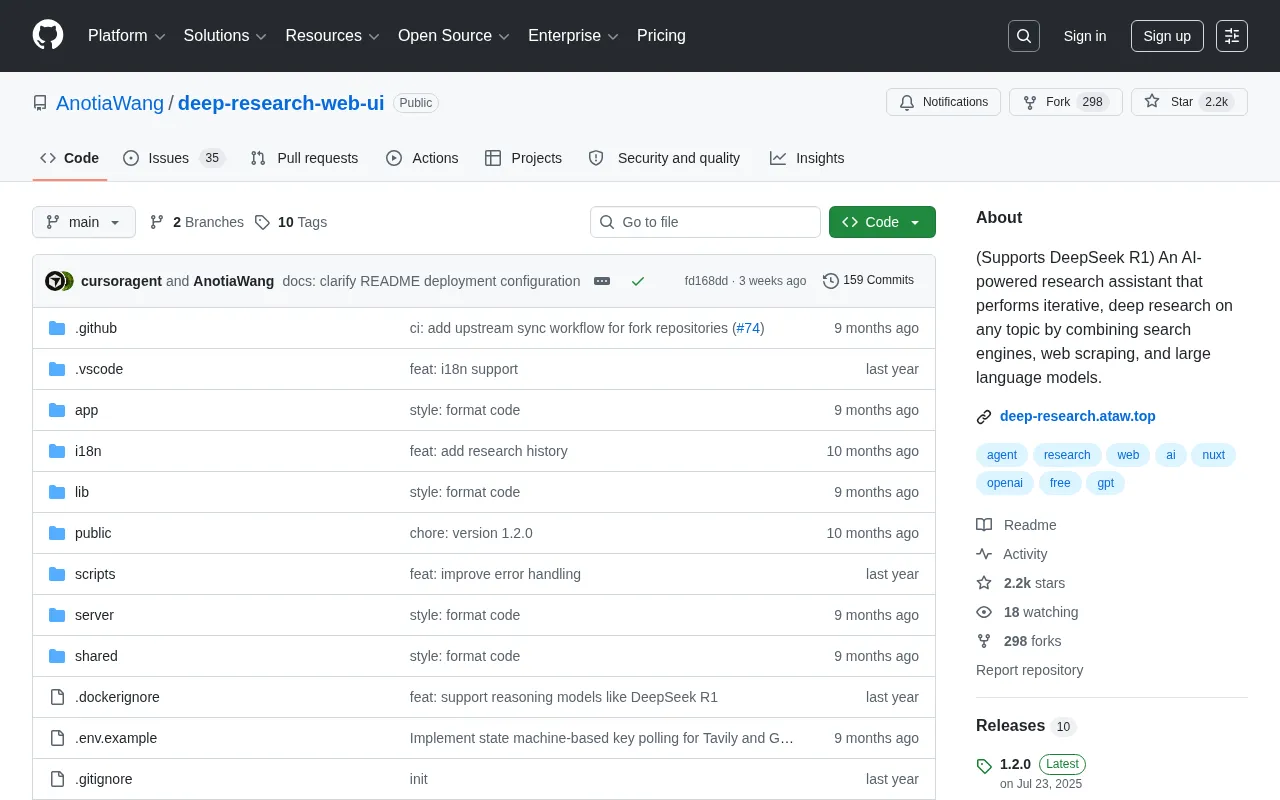
Deep Research Web UI: open-source AI deep research assistant with iterative search and LLM automation.
Deep Research Web UI is a fast-growing open-source project on GitHub that combines search engines, web scraping, and large language models (with DeepSeek R1 support) through an iterative research mechanism, simulating how human researchers repeatedly consult sources and progressively dig deeper to achieve automated deep research. Compared to OpenAI's paid Deep Research feature, this project is free, self-hostable, and suitable for academic research, market analysis, and technology evaluation.
Project Overview
In the field of AI-assisted research, an open-source project called Deep Research Web UI is rapidly gaining attention on GitHub. Created by developer AnotiaWang, it's an AI-powered deep research assistant capable of performing iterative deep research on any topic by combining search engines, web scraping, and large language models for automated information gathering and analysis.
As of now, the project has earned 2,181 Stars and 299 Forks, developed in TypeScript, reflecting strong demand from the developer community for this type of AI deep research tool.
Core Features and Technical Architecture
Iterative Deep Research Mechanism
The core design philosophy of Deep Research Web UI is "iterative research." Unlike traditional single-query searches, it simulates the workflow of a human researcher:
- Asking Questions — Based on the user's research topic, the AI first breaks down complex questions into multiple sub-questions
- Searching & Scraping — It queries search engines for relevant information and scrapes web pages for detailed content
- Analyzing & Summarizing — The LLM analyzes, filters, and synthesizes the collected information
- Iterating Deeper — Based on existing findings, it automatically generates new research directions and repeats the process
This iterative mechanism enables final research results that far exceed what a single search can achieve in both depth and breadth, closely resembling how human researchers repeatedly consult sources and progressively dig deeper.
From a technical perspective, the concept of Iterative Research originates from iterative development methodology in software engineering, with its core idea being to progressively approach optimal solutions through multiple cycles. In the AI research domain, this approach is called "Agentic Research" or "agent-driven research," which fundamentally differs from traditional RAG (Retrieval-Augmented Generation). RAG typically executes only one retrieval-generation cycle, whereas iterative research allows the AI to dynamically adjust its search strategy based on previously acquired information in each round — similar to how human researchers continually discover new leads and follow them deeper while reading literature. In information theory, this is called "Active Information Acquisition," where each iteration reduces the uncertainty (information entropy) of the research question until reaching a preset research depth or information saturation point.
Taking this further, the Agentic Research paradigm represented by Deep Research Web UI is a significant evolution of RAG technology. Traditional RAG architecture consists of two components: a Retriever and a Generator. The retriever finds relevant document fragments from external knowledge bases, and the generator produces answers based on these fragments. However, RAG has clear limitations: it cannot handle complex problems requiring multi-hop reasoning — scenarios where answers are scattered across multiple documents and require correlating information from different sources to draw conclusions. Agentic Research introduces agent capabilities like Planning, Tool Use, and Reflection, enabling AI to formulate research plans, select appropriate information-gathering tools, evaluate the sufficiency of existing information, and decide whether further exploration is needed — just like a human researcher. The theoretical foundation of this paradigm traces back to the BDI (Belief-Desire-Intention) agent architecture and the more recent ReAct (Reasoning + Acting) framework.
DeepSeek R1 Model Support
A key highlight of the project is its native support for the DeepSeekAd R1 model. DeepSeek R1 is renowned for its powerful reasoning capabilities, making it particularly suitable for research scenarios requiring deep thinking and logical reasoning. Leveraging R1's Chain of Thought capability, the research assistant can more accurately understand relationships between complex questions and generate more insightful research reports.
DeepSeek R1 is an open-source reasoning model released by DeepSeek in January 2025. Its greatest technical breakthrough lies in using Reinforcement Learning rather than traditional supervised fine-tuning to elicit reasoning capabilities. R1 employs a large-scale Group Relative Policy Optimization (GRPO) training strategy, enabling the model to spontaneously produce Long Chain-of-Thought reasoning, achieving performance comparable to OpenAI's o1 series models in mathematical reasoning, code generation, and complex logical analysis. Chain of Thought is a technique that lets models show intermediate reasoning steps before giving a final answer, first proposed by the Google Brain team in 2022. R1's reasoning chains typically contain hundreds to thousands of tokens of intermediate thinking, making it particularly effective at handling research problems requiring multi-step logical deduction. Additionally, DeepSeek R1 is released under the MIT open-source license and supports local GPU deployment via frameworks like Ollama and vLLM, providing a viable solution for privacy-sensitive scenarios.
For users concerned about data privacy, DeepSeek R1 can be deployed locally, and combined with Deep Research Web UI's self-hosting capabilities, this enables a fully private AI research environment.
Tech Stack and Architecture Design
The project is developed in TypeScript, offering strong type safety and maintainability. As a Web UI application, users can access it directly through a browser without installing additional clients.
Choosing TypeScript for AI tool development involves several key considerations: First, TypeScript's seamless integration with the Node.js ecosystem allows developers to leverage rich npm packages for web scraping (e.g., Puppeteer, Cheerio), HTTP requests (e.g., Axios), and more. Second, TypeScript's type inference mechanism effectively reduces runtime errors when handling complex JSON structures returned by LLM APIs. Finally, as a Web UI application, TypeScript can be used for both frontend interface and backend service development, achieving a unified full-stack tech stack that reduces maintenance complexity.
The overall architecture integrates three core components:
- Search Engine Integration — Obtains broad information sources from multiple search engines
- Web Scraping Module — Deeply scrapes page content to extract valuable detailed information
- LLM Reasoning Layer — Handles information comprehension, correlation analysis, and report generation
The web scraping module faces numerous technical challenges. Modern websites heavily use JavaScript for dynamic content rendering (pages built with SPA frameworks like React and Vue), meaning simple HTTP requests cannot obtain complete page content — headless browsers like Puppeteer or Playwright are needed to simulate real browser environments, execute JavaScript, and then extract content. Additionally, many websites deploy anti-scraping mechanisms including CAPTCHA verification, IP rate limiting, and User-Agent detection. At the content extraction level, accurately separating body text from noise like navigation bars, ads, and sidebars in HTML is a classic NLP problem, typically requiring DOM tree analysis algorithms (such as the Readability algorithm, originally developed by Mozilla for Firefox's reader mode) to achieve high-quality content extraction.
Typical Use Cases
Academic Research and Literature Review
For researchers, Deep Research Web UI can quickly complete preliminary literature review work. It automatically collects the latest developments, key papers, and core viewpoints in a given field, compressing what would normally take days of preliminary research into just tens of minutes.
Market Analysis and Competitive Research
Business analysts can use this tool for in-depth research on specific industries, competitors, or market trends. The tool automatically collects data from multiple sources and generates structured analysis reports, helping teams quickly grasp the full market landscape.
Technology Selection and Solution Evaluation
When development teams are evaluating technology options, the AI assistant can automatically research the pros and cons of various technical solutions, community activity levels, performance comparisons, and other key information, providing comprehensive reference for technical decisions.
Comparison with Similar Tools
Compared to OpenAI's Deep Research feature (available only to Pro subscription users), this open-source project provides a completely free and self-hostable alternative. Users can freely choose their preferred LLM backend (including DeepSeek R1, GPT-4, etc.) while maintaining full data control.
OpenAI's Deep Research feature, launched in February 2025, is exclusive to ChatGPT Pro subscribers ($200/month), built on its o3 model. The feature can complete a deep research task in 5 to 30 minutes, automatically browsing dozens or even hundreds of web sources, ultimately generating lengthy research reports with complete citations. OpenAI's Deep Research internally uses a complex multi-agent collaboration architecture, including planning agents, search agents, reading agents, and writing agents. However, its closed nature and steep subscription cost limit access for many users. The emergence of open-source alternatives like Deep Research Web UI reflects the trend toward AI tool democratization — the community wants to liberate cutting-edge AI capabilities from commercial walled gardens, enabling more people to access equivalent AI-assisted research capabilities at manageable costs.
Compared to other open-source research tools, Deep Research Web UI's differentiating advantages are twofold: first, the Web UI provides a low barrier to entry; second, the iterative research mechanism delivers information depth. It's not just a simple search result aggregator, but an intelligent agent capable of autonomously planning research paths and progressively exploring deeper.
Summary and Outlook
Deep Research Web UI represents an important evolutionary direction for AI-assisted research tools: deeply integrating LLM reasoning capabilities with internet information retrieval to achieve truly automated deep research. As the project continues to iterate and community contributions grow, there's significant room for improvement in research quality, model compatibility, and user experience.
For developers, researchers, and analysts looking to boost research efficiency, Deep Research Web UI is an open-source project worth following and trying. You can find the complete source code and deployment documentation on GitHub to quickly set up your own AI deep research assistant.
Related articles
 Product Reviews
The Programmer's Desk Setup Guide: Building a Workspace That Feels Like Home
Discover how programmers build productive, comfortable workspaces. From multi-monitor setups to ergonomic design, explore the desk philosophy that drives focus and flow.
 Product Reviews
Qoder vs Cursor Real-World Comparison: Which $20/Month AI IDE Is Better?
Hands-on comparison of Qoder vs Cursor AI IDEs: Agent autonomy, human interaction count, and architecture decisions. Qoder needed only 2 interactions vs Cursor's 8.
 Product Reviews
Cursor Cloud Agent Demo: Eliminating Bottlenecks Across the Entire Software Development Lifecycle
Deep analysis of Cursor's Cloud Agent demo showing how cloud VMs, automated test artifacts, and a full-chain control plane systematically eliminate human bottlenecks across the software development lifecycle.