DeepGEMM Explained: DeepSeek's Open-Source High-Performance GPU Matrix Computation Library

DeepSeek open-sources DeepGEMM, a clean and efficient CUDA GEMM kernel library targeting LLM compute bottlenecks.
DeepGEMM is a CUDA-based GEMM kernel library open-sourced by DeepSeek, designed to be both clean and high-performance. It quickly surpassed 8,500 GitHub stars after launch. GEMM is the most compute-intensive operation in Transformer models, directly affecting training throughput and inference latency. Compared to NVIDIA's cuBLAS, DeepGEMM is deeply optimized for low-precision scenarios like FP8, better matching DeepSeek's own model architectures. The project treats readability and performance as equal priorities, making it useful both as a production kernel and a learning reference for GEMM optimization.
What Is DeepGEMM
DeepGEMM is an open-source GPU matrix computation (BLAS) kernel library developed by the DeepSeekAd team, built around a core philosophy of being "clean and efficient." Written in CUDA, the project has already garnered approximately 8,525 stars and 1,361 forks on GitHub, with a single-day gain of 363 stars — a remarkable growth rate for a highly specialized low-level computation library. This trajectory reflects the developer community's strong appetite for high-performance matrix computation tools.
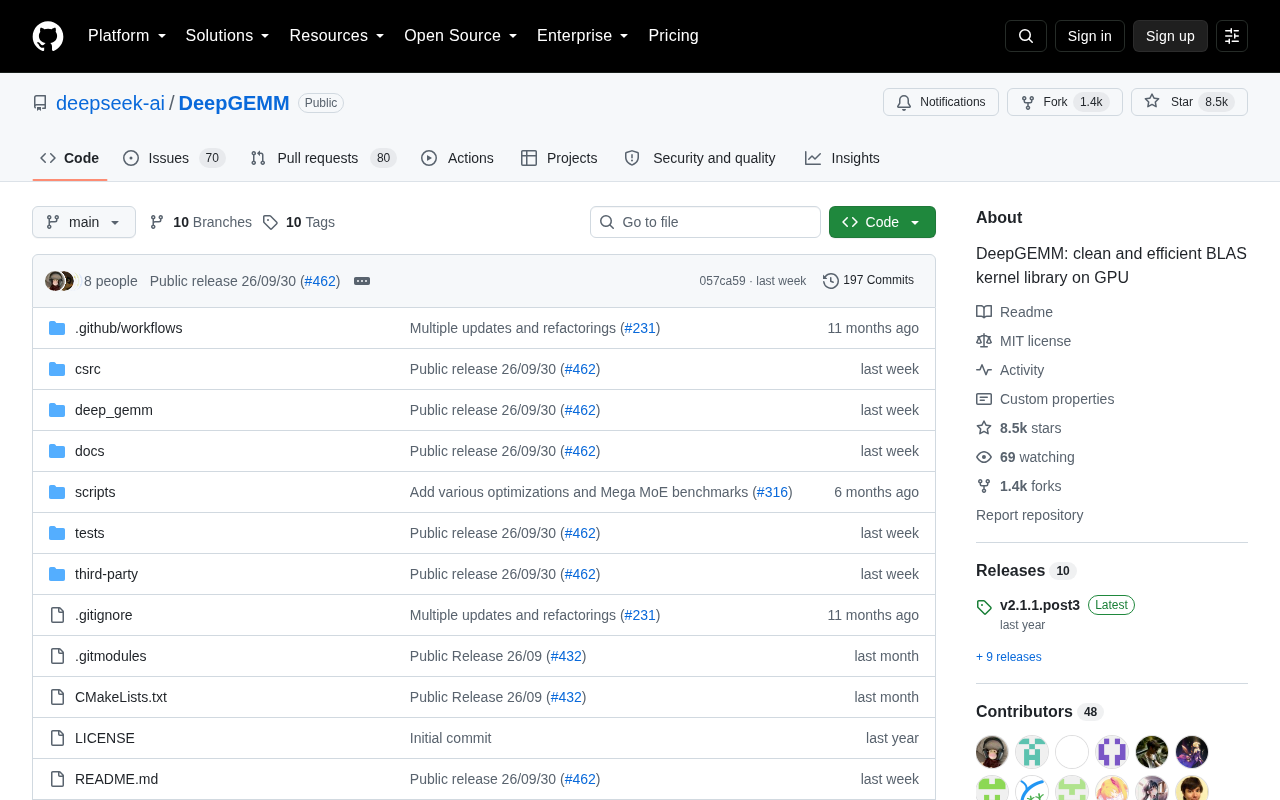
BLAS (Basic Linear Algebra Subprograms) is the foundational layer beneath deep learning and scientific computing. Nearly all neural network training and inference relies on large-scale matrix multiplication (GEMM, General Matrix Multiply). DeepGEMM is purpose-built to deeply optimize this most critical and computationally expensive operation.
Why GEMM Matters So Much
In the era of large language models dominated by the Transformer architecture, the vast majority of floating-point operations during both forward and backward passes are concentrated in matrix multiplications. Whether it's the QKV projections in the attention mechanism or the linear layers in feed-forward networks (FFN), all of these are essentially GEMM operations. As a result, the efficiency of the GEMM kernel directly determines training throughput and inference latency.
From NVIDIA cuBLAS to Custom Kernels
For a long time, NVIDIA's official cuBLAS has been the de facto standard for GPU matrix computation. However, as model sizes have grown and low-precision quantization (such as FP8) has become widespread, general-purpose libraries don't always squeeze every last drop of performance from the hardware in specific use cases. More and more leading teams have begun developing or optimizing their own GEMM kernels to match their model architectures and hardware characteristics. DeepGEMM's open-source release is a milestone moment where DeepSeek shares its internal engineering capabilities with the broader community.
FP8 is an 8-bit floating-point format that, compared to the more common FP16/BF16, can halve memory usage and bandwidth requirements. On NVIDIA GPUs with Hopper architecture (H100), it also leverages dedicated Tensor Cores for higher peak throughput. However, FP8 has a narrower numerical range and lower precision, so using it correctly without degrading model quality requires fine-grained scaling factor management and numerical stability guarantees at the GEMM kernel level. While cuBLAS supports FP8, its implementation targets a broad range of scenarios and leaves limited room for tuning specific model structures — such as the large number of small-batch matrix multiplications common in MoE (Mixture of Experts) architectures. DeepSeek relies heavily on FP8 training in models like DeepSeek-V3 and R1, and DeepGEMM is the kernel implementation forged from that real-world need.
The computation pattern of GEMM can be simply expressed as C = A × B + C, where A, B, and C are all 2D matrices. A single forward pass through a neural network involves dozens to hundreds of such matrix multiplications. In a GPT-style model, for example, the self-attention module in a single Transformer layer requires separate projections for the Query, Key, and Value matrices, and the two linear layers in the feed-forward network each correspond to a large-scale GEMM. For a model with hundreds of billions of parameters, the total GEMM computation in a single inference pass can reach tens of petaFLOPs. This is precisely why the ratio of actual GEMM kernel throughput to peak hardware performance — known as "hardware utilization" or MFU (Model FLOPS Utilization) — is a core metric for measuring the efficiency of training and inference systems. Even a few percentage points of improvement in MFU translates to significant cost savings at scale.
The Engineering Philosophy Behind "Clean and Efficient"
The project description's repeated emphasis on "clean" is worth noting. Many high-performance computing libraries, in pursuit of extreme performance, pile on layers of macro definitions, template metaprogramming, and platform-specific branching, making the code difficult to read and maintain. DeepGEMM treats readability and efficiency as co-equal design goals, making it better suited as a reference implementation for researchers learning GEMM optimization and easier for the community to build upon.
For developers who want to understand how matrix multiplication achieves high throughput on modern GPUs, a clean CUDA implementation is far more instructive than an opaque black-box library. This is one reason it has attracted so many stars in such a short time — it functions as both a production-ready tool and a learning resource.
Practical Value for Developers
From an application standpoint, DeepGEMM's value shows up across several dimensions:
- Performance tuning headroom: Teams building their own training or inference frameworks can directly reuse or adapt its kernel implementations, reducing the cost of writing CUDA kernels from scratch.
- Low-precision compute support: As FP8 and INT8 quantized inference become increasingly important for cost reduction, specialized GEMM kernels can deliver meaningful speedups and memory savings.
- Synergy with the DeepSeek ecosystem: As a member of the DeepSeek open-source family, it complements the models and infrastructure tools the team has previously released, signaling a systematic investment in low-level compute optimization.
It's worth noting that the barrier to using low-level kernel libraries is relatively high — they're typically aimed at engineers and researchers with CUDA development experience. Most application developers are more likely to benefit indirectly through higher-level frameworks.
Summary
DeepGEMM carries on DeepSeek's signature approach to open source and engineering efficiency: focus on the core computational bottleneck of large models, and trade clean implementation for high performance. Against a backdrop of relentless pressure to reduce training and inference costs, open-source projects like this — laser-focused on low-level GEMM optimization — are becoming an important part of improving overall hardware utilization. For developers following AI infrastructure, DeepGEMM is well worth keeping on your radar.
Note: This article is based on publicly available information from the GitHub project. For specific performance data and supported hardware, please refer to the project's official documentation.
Related articles

Felix Rieseberg Personal Homepage
Felix Rieseberg's personal homepage sparks attention on Hacker News. This article covers the Slack engineer's technical background, the rise and fall of nativefier, and the value of a developer homepage as a tech calling card.

@ai-sdk/vue 3.0.306 Patch Release Syncs with [email protected] Update
@ai-sdk/vue 3.0.306 released, synced with [email protected]. A routine patch release for the Vercel AI SDK ecosystem with no public API changes; the Vue adapter layer stays version-aligned with the core package.

Gemini 4 Argon API Launches: The Era of Million-Token Output Begins
Google launches Gemini 4 Argon with sparse MoE architecture, up to 1M output tokens, and a 68.90% Vals Index score, available across API, AI Studio, and the Gemini app.