DeepLearning.AI Launches Data Engineering Professional Certificate Program

DeepLearning.AI and AWS launch a data engineering certificate course taught by Joe Reis, covering the full lifecycle and engineering mindset.
DeepLearning.AI has partnered with AWS to launch a Data Engineering Professional Certificate Program taught by Joe Reis, co-author of Fundamentals of Data Engineering. Built around the data engineering lifecycle, the course covers everything from ingestion and storage to transformation and serving, with hands-on labs in batch/streaming pipelines, Infrastructure as Code, orchestration, and cloud networking and security. It emphasizes engineering thinking — including requirements analysis, architectural trade-offs, and business value delivery — and is open to beginners and professionals transitioning from data analytics, data science, or software engineering.
A New Course Covering the Full Data Engineering Lifecycle
DeepLearning.AI has partnered with Amazon Web Services (AWS) to launch a new Data Engineering Professional Certificate Program. The course is taught by Joe Reis — a well-known author in the data engineering space and co-author of Fundamentals of Data Engineering — with the goal of helping learners systematically master how to build data systems in the cloud.
As Joe Reis explains, the program requires no prior experience building data systems in the cloud. For those just entering the field, it offers a complete learning path from scratch. For practitioners already working in adjacent roles — such as data analytics, data science, or software engineering — the course fills in the cloud data engineering piece of the puzzle.
Hands-On Content Covering the Data Engineering Lifecycle
The curriculum is structured around the data engineering lifecycle, walking through each stage of the journey from data ingestion and storage to transformation and serving. Rather than focusing purely on theory, the course emphasizes hands-on practice — labs expose learners to real-world, complex topics that come up in actual engineering work.
According to Joe Reis, the lab content includes:
- Building batch and streaming data pipelines
- Infrastructure as Code (IaC)
- Orchestration
- Networking and security in the cloud
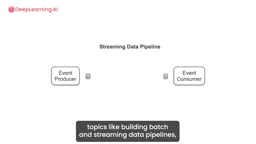
The intent is clear: data engineering isn't just about knowing a handful of tools — it's about getting an entire system running in a cloud environment and handling the security, networking, and operational challenges that are unavoidable in production.
The data engineering lifecycle is the key framework for understanding how this course is structured. The concept was systematically developed by Joe Reis and Matt Housley in Fundamentals of Data Engineering, breaking a data engineer's work into five interconnected stages: data generation (from business systems, IoT devices, APIs, and other sources), data storage (choosing the right storage medium and format), data ingestion (moving data from source to target systems), data transformation (cleaning, aggregating, modeling), and data serving (delivering data to downstream analytics, ML, or application teams). The value of this framework is that it's technology-agnostic — regardless of how tools evolve, the lifecycle stages always exist, helping engineers clarify the problem at hand before committing to any specific technology.
A few of the lab topics mentioned in the course are worth elaborating on:
- Infrastructure as Code (IaC): Describing and automating the deployment of cloud infrastructure using code (e.g., AWS CloudFormation or Terraform) rather than manually clicking through a console. IaC makes environments reproducible and version-controlled — a standard practice on modern cloud data platforms.
- Orchestration: Managing the dependencies, scheduling, and failure-retry logic across steps in a data pipeline. Common tools include Apache Airflow and AWS Step Functions. The orchestration layer is critical to keeping production data pipelines running reliably.
- Batch and streaming data pipelines: Batch processing handles data accumulated over a fixed time window (e.g., every night at midnight); streaming processing responds to data the moment it arrives, making it suitable for real-time monitoring, recommendations, and similar use cases. The two differ significantly in tool selection, cost structure, and operational complexity.
Beyond "How To" — Developing an Engineering Mindset
The course designers repeatedly emphasize that this program is "far more than just teaching you how to use various tools and technologies." The real focus is on developing the ability to think like a data engineer: how to analyze system requirements, how to evaluate trade-offs between different architectural choices, and how to deliver genuine business value through your work.

This is especially critical for data practitioners. Tools will keep evolving, but the core thread of requirements → architecture → trade-offs → value has a much longer shelf life. By calling out architectural trade-offs explicitly, the course addresses the kind of decision-making ability that beginners most often overlook — yet which ultimately determines whether a project succeeds or fails.
Architectural trade-offs in data engineering are particularly complex because a single problem often has multiple viable technical paths. Take data pipelines as an example: batch processing has lower latency costs but less freshness; streaming is real-time but operationally complex. Data warehouses offer excellent query performance but make schema changes costly; data lakes are flexible but harder to govern. Self-hosted open-source solutions offer greater control but carry non-trivial maintenance overhead, while managed cloud services are quicker to adopt but risk vendor lock-in. Beginners often fall into the trap of chasing new tools — following whatever's trending without accounting for the actual constraints of the business context. Embedding architectural trade-offs at the core of the curriculum is designed to help learners build the instinct of "ask why first, then ask what" — and that's the dividing line between a tool user and a true data engineer.
Industry Experts Join as Instructors
In addition to Joe Reis himself, the course features guest appearances from several peers and colleagues in the data engineering community, as well as experts from AWS, who provide deeper insight on specific topics. For learners, this means exposure not only to a structured curriculum, but also to the practical experience and industry perspective of practitioners working on the front lines.
Who Is It For — and Is It Worth It?
Overall, the course has a clear positioning:
- Beginners with no prior experience: No cloud background required — learners can build a complete knowledge framework step by step through the lifecycle structure.
- Professionals transitioning from adjacent roles: An ideal choice for data analysts, data scientists, and software engineers looking to round out their data engineering capabilities.
- Those looking to develop stronger engineering thinking: The course doesn't just teach tools — it trains architectural judgment and the ability to assess business value.
The program is now officially live. For learners who want to systematize their data engineering skill set and put it into practice in the cloud — particularly within the AWS ecosystem — this is a learning path backed by a recognized author and a major cloud provider. Note that the above information is primarily drawn from the official course announcement; specific details on course duration, pricing, and certification should be confirmed on the DeepLearning.AI platform page.
Related articles

Gmod TTT: Boba's Winning Streak and Game Design Insights
An in-depth analysis of Gmod TTT's role system, creative items, and social gameplay mechanics, exploring the relationship between randomness design and game balance through Boba's winning streak phenomenon.

FlexBudget: Fair Comparison of KV Cache Eviction Strategies Under a Unified Compute Budget
AMD engineer proposes FlexBudget at PyTorch Conference: a training-free fair comparison method for KV cache eviction rules using fixed kernels and memory budgets, all in core PyTorch.
