DeepMind Alumni Found Fusionality: How AI Is Accelerating the Commercialization of Nuclear Fusion
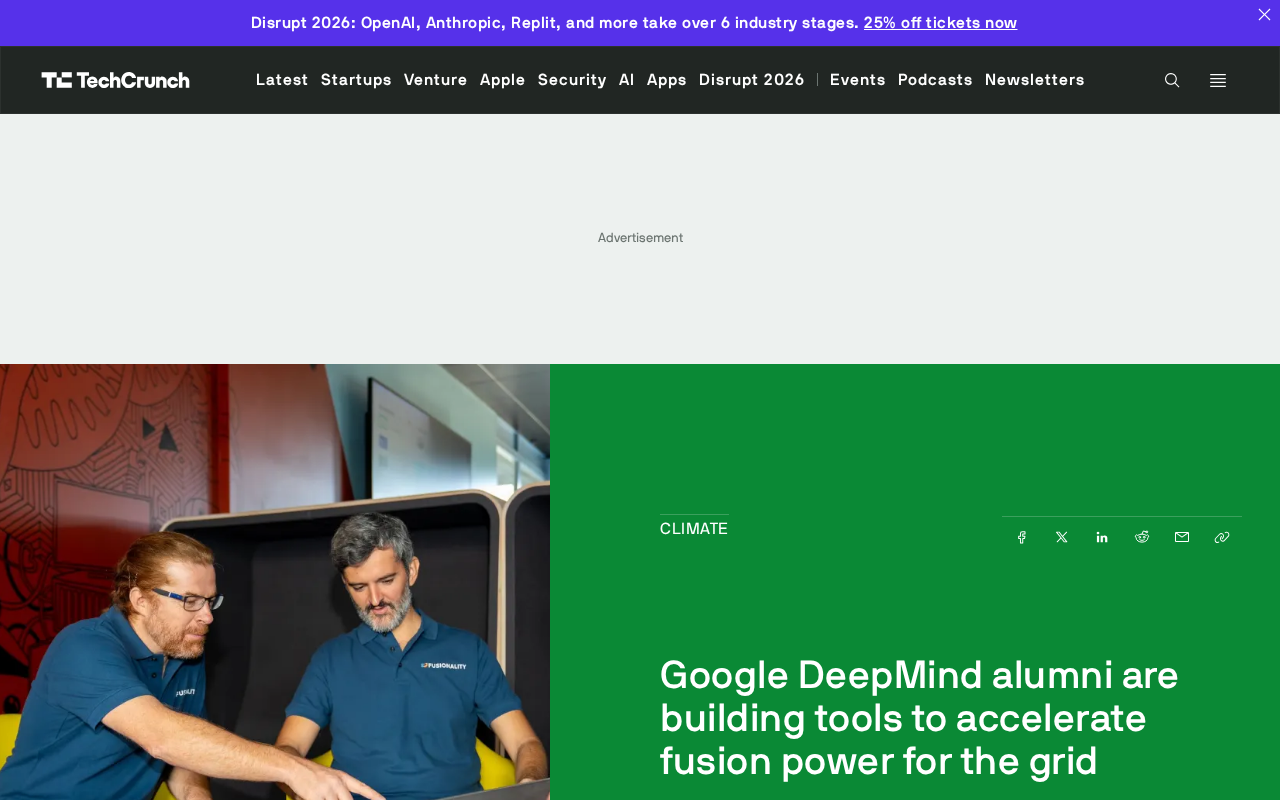
DeepMind alumni launch Fusionality to accelerate nuclear fusion commercialization using AI control and digital twins.
Former Google DeepMind employees have founded Fusionality, a company that brings reinforcement learning and AI control technologies to nuclear fusion. By developing intelligent control systems and high-fidelity digital twin simulations, Fusionality helps fusion startups shorten R&D cycles, reduce experimental costs, and accelerate the path to commercial clean energy. The approach builds on DeepMind's landmark work in tokamak plasma control and represents AI's growing impact on hard engineering domains.
How DeepMind Technology Is Empowering Nuclear Fusion Energy
Former Google DeepMind employees are applying artificial intelligence to nuclear fusion, aiming to solve critical challenges in clean energy commercialization. Their company, Fusionality, focuses on developing AI control systems and high-fidelity simulation environments to help fusion startups accelerate technology iteration.
Nuclear fusion is widely regarded as humanity's ultimate energy solution, but its engineering complexity is extraordinarily high. The basic principle of fusion involves merging light atomic nuclei (such as hydrogen isotopes deuterium and tritium) at extreme temperatures exceeding 100 million degrees Celsius to form heavier nuclei (such as helium), releasing enormous energy in the process — the exact same mechanism by which the Sun generates its energy. Unlike nuclear fission, fusion reactions produce no long-lived highly radioactive waste, and fuel sources are virtually inexhaustible: deuterium can be extracted from seawater, and tritium can be bred from lithium. However, achieving controlled fusion on Earth requires heating plasma to more than ten times the temperature of the Sun's core and maintaining confinement for a sufficiently long period, satisfying the stringent conditions described by the famous Lawson criterion. Challenges such as plasma control, magnetic confinement, and material endurance demand precise real-time control systems. Traditional approaches relying on physics-based modeling and manual parameter tuning are inefficient and struggle to handle complex nonlinear dynamic processes.
AI Control Systems: A Technical Bridge from Fusion Labs to the Power Grid
Fusionality's core product is an AI-based fusion control system capable of optimizing reactor operating parameters in real time. The system draws on DeepMind's deep technical expertise in reinforcement learning and complex system control, particularly the team's hands-on experience with plasma control in tokamak devices.
It's worth highlighting DeepMind's milestone contribution in this domain. In 2022, DeepMind collaborated with the Swiss Federal Institute of Technology Lausanne (EPFL) to successfully deploy a deep reinforcement learning-based plasma control system on the TCV tokamak, with results published in Nature. Traditional tokamak plasma control relies on a complex matrix of manually tuned PID controllers, where the current for each coil must be independently calculated and coordinated. DeepMind's approach instead trained a single neural network policy that maps directly from the plasma state to control commands for all magnetic field coils, achieving simultaneous precise control over plasma shape, position, and current distribution. The system could even stably maintain multiple plasma configurations that were previously difficult to achieve, such as negative triangularity cross-sections and "snowflake" divertor configurations. This work was the first to demonstrate that deep reinforcement learning could achieve end-to-end control in a real physical reactor, rather than remaining confined to simulations.
Reinforcement Learning (RL) is particularly well-suited for fusion control because its core idea — letting an agent learn optimal decision-making strategies through repeated interactions with the environment based on reward signals — naturally aligns with the requirements of plasma control. Unlike supervised learning, RL doesn't require labeled training data; instead, it discovers optimal behavior through trial-and-error exploration. Deep RL uses deep neural networks as function approximators for the policy, enabling it to handle high-dimensional, continuous state and action spaces and make optimal control decisions on microsecond timescales. An agent can experience millions of plasma evolution processes in a simulated environment, accumulating tuning experience far beyond what a human engineer could gain in a lifetime.
Compared to traditional control methods, AI control systems offer the following advantages:
- Rapid adaptation to nonlinear plasma behavior, responding to rapidly changing reaction conditions
- Real-time prediction and avoidance of instabilities, improving operational safety
- Automatic optimization of energy output efficiency, approaching theoretical performance limits
- Dramatically shortened experimental tuning cycles, compressing years of iteration into much shorter timeframes
This is critically important for fusion startups. Currently, dozens of companies worldwide are racing toward commercial fusion, but most face the challenge of long R&D cycles and high experimental costs. As of 2024, there are over 40 private fusion companies globally, having collectively attracted more than $7 billion in private investment. Notable companies include: Commonwealth Fusion Systems (CFS), an MIT spinout pursuing a compact tokamak approach using high-temperature superconducting magnets with over $2 billion raised; TAE Technologies, using a field-reversed configuration (FRC); and Helion Energy, which has signed the world's first commercial fusion power purchase agreement with Microsoft, promising to deliver electricity by 2028. China's fusion industry is also developing rapidly, with CNNC and several startups accelerating their efforts. In such a fiercely competitive landscape, AI-driven control solutions are becoming a key differentiating capability that could determine winners and losers.
Digital Twin Simulation Environments: Accelerating Fusion Innovation at Lower Cost
Another key technology from Fusionality is its high-fidelity digital twin simulation environment. A Digital Twin doesn't merely replicate the geometric structure of a physical object — more critically, it reproduces its physical behavior and dynamic characteristics. In nuclear fusion, building a digital twin faces unique challenges: plasmas involve the coupling of multiple complex physical processes including magnetohydrodynamics (MHD), particle transport, radiation physics, and plasma-wall interactions. Traditional first-principles simulations, while accurate, are computationally prohibitive — a single full-physics simulation may require millions of CPU hours.
Fusionality's innovation lies in using AI surrogate models — neural networks that learn the input-output mapping of physics simulators — to increase computation speed by several orders of magnitude while maintaining sufficient accuracy. These simulators, trained on physics principles and extensive experimental data, can accurately predict reactor behavior under various conditions.
R&D teams can use the digital twin to:
- Test the performance of new high-temperature-resistant materials
- Validate confinement effectiveness of different magnetic field configurations
- Simulate the feasibility of new fuel cycle designs
- Test thousands of parameter combinations in virtual space, avoiding costly physical experiments
This simulation-driven development model is already mature in aerospace and chip design, but remains cutting-edge in nuclear fusion. The unique advantage of the DeepMind alumni team is their dual expertise — they are proficient in AI algorithm design while also deeply understanding the modeling requirements of complex physical systems, effectively bridging the gap between the two domains. With AI surrogate models, researchers can complete parameter sweeps and optimization work in hours that would otherwise take months, dramatically accelerating the design iteration cycle.
Commercialization Prospects and Real-World Challenges for Nuclear Fusion
The fusion industry is at a critical inflection point, transitioning from scientific experimentation to engineering application. ITER (International Thermonuclear Experimental Reactor) is expected to achieve full-power operation by 2035, having already demonstrated the physical feasibility of fusion reactions. However, achieving economically viable power generation still requires overcoming multidimensional challenges in materials, engineering, and control.
Fusionality's technical approach offers three significant advantages:
- High versatility: Adaptable to different types of fusion devices, including tokamaks and stellarators. Tokamaks use a toroidal magnetic field combined with the plasma's own current to confine hot plasma; they are relatively simple in structure but tend toward pulsed operation and are susceptible to dangerous plasma disruption events. Stellarators rely entirely on complex 3D helical magnetic fields generated by external coils to confine plasma; they are theoretically better suited for steady-state operation with no disruption risk, but coil geometries are extremely complex, making manufacturing far more difficult and costly than tokamaks. Germany's Wendelstein 7-X is currently the most advanced stellarator. The versatility of AI control technology enables it to provide value simultaneously across these vastly different technical approaches.
- Lowering the technology barrier: Enabling resource-limited small startups to access world-class AI control technology
- Accelerating R&D iteration: Dramatically compressing development cycles that would otherwise take years
Of course, fundamental challenges remain for fusion commercialization. Materials represent one of the most critical bottlenecks. First-wall materials facing the plasma must simultaneously withstand extremely high temperatures (surface heat flux densities of 10–20 MW/m², several times that experienced during Space Shuttle atmospheric reentry), intense neutron irradiation (fusion neutrons carry energies up to 14.1 MeV, far exceeding fission neutrons), and sputtering erosion from plasma particles. The most promising candidate materials currently include tungsten (for divertor components) and reduced-activation ferritic/martensitic steel (RAFM, for structural materials). However, high-energy neutron irradiation creates displacement damage and helium bubbles in material crystal lattices, leading to embrittlement, swelling, and creep that severely limit service life. Even more challenging is the fact that no facility capable of producing a fusion neutron energy spectrum for materials testing currently exists (IFMIF/DONES is under construction), meaning material service performance is still largely based on simulated projections rather than actual experimental validation.
Even with the most advanced AI control systems, these materials science bottlenecks, engineering manufacturing challenges, and power generation economics must still be overcome one by one. AI can play an important supporting role in accelerating materials screening and performance prediction, but ultimate real-world validation remains necessary. Nevertheless, the deep involvement of AI tools is undeniably injecting powerful new momentum into the field, with the potential to significantly accelerate humanity's path to clean, virtually limitless energy.
The Technology Spillover Effect: AI Penetrating Traditional Engineering Domains
DeepMind alumni entering the nuclear fusion space reflects a broader trend: AI technology is rapidly penetrating traditional heavy engineering domains. Technologies such as reinforcement learning, neural network control, and high-dimensional parameter optimization have proven they can do more than win at Go and video games — they can solve extremely complex real-world engineering problems.
This cross-disciplinary fusion of AI and hard tech may become a defining model for future technological innovation — top AI talent bringing their methodologies into foundational fields like energy, materials, and biology, using computational intelligence to transform traditional R&D paradigms. From DeepMind's AlphaFold revolutionizing protein structure prediction to Fusionality bringing reinforcement learning into fusion control, we are witnessing a clear trend: AI is no longer merely a tool for the digital world — it is becoming a core driving force behind fundamental scientific and engineering breakthroughs in the physical world.
Key Takeaways
Related articles

Complete Guide to Deploying LLMs Locally on Mac: Ollama Integration with AI Coding Tools
Complete guide to deploying LLMs locally on Mac: hardware assessment, model selection, Ollama setup, and AI coding tool integration with Qwen 35B benchmarks and memory optimization tips.

5 Open-Source Tools to Replace $320/Month in AI Subscriptions
Spending $320+/month on AI subscriptions? Use 5 open-source tools — Ollama, 9Router, Headroom, Dify, OpenHands — to build a self-hosted AI stack and drastically cut costs.

LoRA Explained: Principles and Implementation of Efficient Large Model Fine-Tuning
Deep dive into LoRA's core principles, math, and code implementation. Learn why LoRA achieves near full fine-tuning results with just 0.4% of parameters and its advantages over Adapter and Prompt Tuning.