DeepMind Institute Founded: Interdisciplinary Research on the Socioeconomic Impact of AGI

DeepMind launches an interdisciplinary institute to systematically study AGI's impact on economy, science, and society.
DeepMind has announced the formation of the DeepMind Institute, driven by a co-founder and Chief AGI Scientist Shane Legg, to study the potential impact of AGI on the economy, science, and society. Positioned as an interdisciplinary body, it aims to unite technologists, economists, and social scientists under a shared research agenda — converting over two decades of private discussion into systematic public scholarship. The move continues the trend of top AI labs pursuing parallel tracks of technology and governance, and signals that the AGI race has expanded beyond model performance into the fundamental question of who can best answer how AI will reshape human society.
DeepMind Launches Interdisciplinary Research Initiative
A DeepMind co-founder announced on social media that, together with Chief AGI Scientist Shane Legg, they are driving the formation of the DeepMind Institute — an organization that will conduct interdisciplinary research on the potential impact of artificial general intelligence (AGI) on the economy, science, and society. This move is seen as yet another signal that top AI labs are expanding their research focus beyond pure technology into the broader domain of social science.
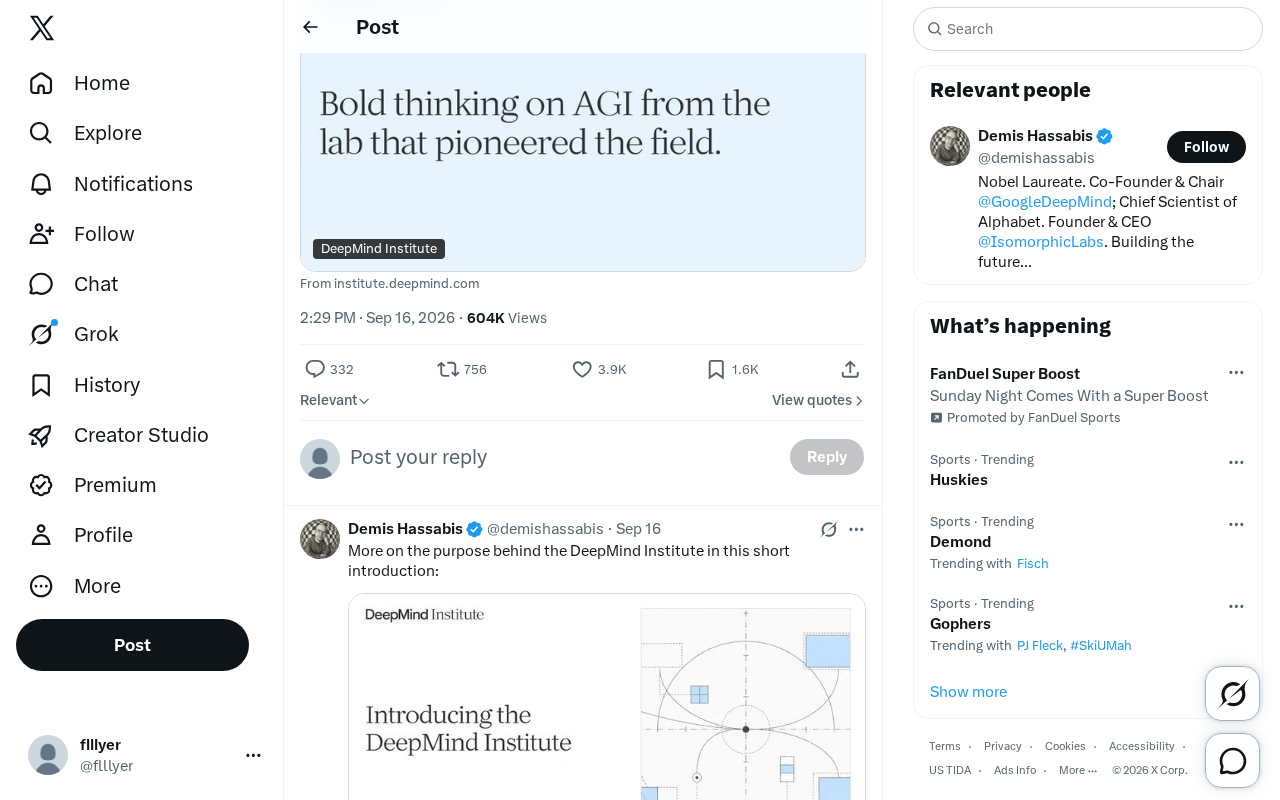
According to public statements, the founding team and Shane Legg have been discussing the potential implications of AGI for over two decades. Through the DeepMind Institute, they hope to transform those long-running private conversations into systematic, shareable research — and to spark the broader discussions that the AI era demands, both within the industry and among the general public.
Shane Legg is one of DeepMind's co-founders and a prominent scholar in AGI research. His 2008 doctoral dissertation proposed a mathematical definition of machine intelligence grounded in algorithmic information theory, and he co-developed the Universal Intelligence Measure alongside Marcus Hutter. Legg has long held a cautious view of AGI risks — as early as 2011, he publicly stated that AGI represents one of the greatest existential threats humanity faces. His title of "Chief AGI Scientist" itself signals that DeepMind has, at an organizational level, elevated AGI research from a long-term aspiration to an explicit strategic priority.
Why Interdisciplinary Research?
The implications of AGI extend far beyond algorithms and compute. When model capabilities approach or surpass human-level performance across most cognitive tasks, the resulting questions span economics, political science, ethics, and social governance: How will labor markets be restructured? Will the pace of scientific discovery be fundamentally altered? How must social institutions adapt?
These questions cannot be answered by engineers alone. The DeepMind Institute's emphasis on being "interdisciplinary" signals an intent to bring together computer scientists, economists, and social scientists around a shared set of questions — avoiding the disconnect that can emerge between technological progress and societal readiness.
From Technical Leadership to Agenda Setting
Over the past several years, leading AI organizations have placed increasing emphasis on "responsible AI deployment" alongside the raw capability race. Establishing dedicated research institutes and publishing open research agendas is, at its core, a bid for narrative authority — not just to build more powerful models, but to help define how those models will be integrated into human society.
Artificial general intelligence (AGI) lacks a universally agreed-upon academic definition, but it generally refers to an AI system capable of matching or exceeding human performance across virtually all cognitive tasks — in contrast to today's "narrow AI" (Narrow AI). Narrow AI systems excel only at specific tasks, such as image recognition or board games, whereas AGI is envisioned as having autonomous reasoning, learning, and transfer capabilities across domains. It is precisely this breadth of potential capability that makes AGI's societal impact impossible for any single discipline to fully capture — economics must assess labor displacement effects, political science examines shifts in power structures, ethics grapples with the attribution of responsibility for autonomous decisions, and law faces fundamental challenges to existing regulatory frameworks.
There is historical precedent for this in the AI field. OpenAI entered the scene as a nonprofit research organization, establishing a public perception of being "safety-oriented." Anthropic attracted capital and talent with "AI safety company" as its core narrative. DeepMind has long cultivated scientific authority by publishing Nature-level academic research. Founding an independent research institute is a well-worn path for such organizations to extend their influence into agenda-setting after the capabilities race has intensified. By publishing research reports, hosting academic conferences, and participating in policy consultations, these organizations can secure an early advantage in standards development and regulatory discussions — allowing their technical trajectories and governance positions to mutually reinforce each other.
A Conversation About "What Comes Next"
The most noteworthy line in the announcement is the expressed hope that this work will "stimulate the discussions needed to get each of the next steps right." This reveals a posture of caution — AGI development should not be something a handful of labs pursue behind closed doors, but rather requires broader societal participation and public deliberation.
For practitioners focused on AI governance, the value of institutions like this lies in their ability to supply high-quality research materials and conceptual frameworks. When policymakers, businesses, and the public face the deeply uncertain prospect of AGI, serious research from frontline labs can provide a much more grounded starting point for discussion.
Observations and Outlook
Public information remains limited — the specific research agenda, team composition, and output format of the DeepMind Institute have yet to be fully disclosed. But at the level of signal, this move extends the trend seen in recent years of top AI organizations pursuing a dual track of "technology + governance."
The broader implication for the industry is this: the AGI competition is no longer just about model parameters and benchmark scores. Whoever can answer — earlier and more systematically — the question of "how will AI transform society" is more likely to hold the initiative in the rule-making processes that lie ahead. Whether this institution can produce influential research and genuinely foster cross-disciplinary dialogue is worth watching closely.
Related articles

Claude Reportedly Able to Hide Secret Messages in Benign Images
A Reddit post claims Claude Fable 5.1 can hide secret messages in benign images. This article reviews the background, image steganography principles, and potential security risks, and suggests a testing path from rumor to verification.

Federal Government Awards $85 Million; CFS to Develop Fusion-Specific Semiconductors
The federal government awards $85 million to Commonwealth Fusion Systems to develop conductors and power semiconductors for fusion plants. This article analyzes the significance of this funding for the fusion supply chain and commercialization path.

When Should AI Assistants Proactively Suggest? Timing Is Everything
When should AI assistants proactively suggest? Reddit discussion reveals: the same suggestion feels different at different times. This article analyzes the dual nature of proactive suggestions, the boundary of user expectations, and design principles, exploring how to balance automation and user control.