DeepSeek 4.1 Flash Released: A High-Speed Multimodal Reasoning Model

DeepSeek 4.1 Flash is a fast, multimodal open-source model accessible via cloud-based serverless inference.
DeepSeek 4.1 Flash is the latest multimodal open-source model from the DeepSeek family, supporting image understanding, text processing, and coding tasks. The 'Flash' suffix reflects a new architecture designed for faster, more efficient inference. The article also introduces DigitalOcean's model catalog, where users can compare DeepSeek alongside models like Qwen and GLM, and leverage serverless inference without needing to purchase or manage GPUs.
DeepSeek 4.1 Flash: Another Multimodal Open-Source Model Worth Watching
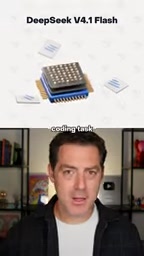
The DeepSeekAd family has a new member. According to an overview on YouTube, the new model — called DeepSeek 4.1 Flash — can understand images, process text, and handle a wide range of coding tasks. The name breaks down into three layers of meaning: DeepSeek is the model family, 4.1 is the version number, and Flash emphasizes its speed advantage — positioning it as a fast, lightweight inference experience.
For users looking to bring an AI assistant into their daily workflow, the appeal of this kind of model lies in its versatility. Whether you hand it an image to interpret, a buggy piece of code to fix, or a repetitive task you want to automate, it's designed to handle all of the above.
Efficiency Gains from a New Architecture
DeepSeek states that 4.1 Flash uses a new architectural design that makes inference faster and more efficient — which is exactly where the Flash suffix comes from. In today's competitive large model landscape, inference efficiency directly affects both cost and user experience. A model that can maintain capability while reducing inference overhead has a natural advantage when it comes to real-world deployment.

It's worth noting that the original source material doesn't go deep on architectural specifics — the coverage is more of a high-level, experience-focused overview. Hard metrics like parameter count and benchmark scores are still pending official disclosure.
How to Try Open-Source Models Quickly: From Model Catalogs to Serverless Inference
Getting started with new models like this is more accessible than many people assume. The video mentions that DigitalOcean's model catalog allows users to compare multiple open-source models side by side, without having to commit to any single one.

Beyond the DeepSeek series, the catalog also includes models like Qwen and GLM, among other mainstream open-source options. For developers, this means that when a model doesn't fit a particular workload, you can quickly switch to an alternative for direct comparison — without having to rebuild your environment from scratch.
Serverless Inference: No GPU Purchasing or Maintenance Required
What really lowers the barrier is serverless inference. Traditionally, running your own large model inference service requires purchasing and maintaining expensive GPU hardware — a significant burden for small teams and individual developers. The serverless model lets users call inference capabilities on demand, eliminating the need to buy or manage any hardware.

This approach aligns closely with the direction the open-source model ecosystem is heading: models themselves are open and free, while compute is provided as a service and consumed on demand — making it easier and cheaper for more people to try and compare different models.
Serverless inference is essentially an extension of the "function-as-a-service" model: the cloud platform dynamically allocates GPU resources in the background, users send requests via API, and the platform returns results after inference — all without the user ever touching the underlying hardware. Billing is typically based on token count or number of requests, with no charges during idle time. This contrasts with the traditional "monthly GPU instance rental" model, where you pay continuously regardless of traffic. For projects with unpredictable call volumes or those in the prototyping stage, serverless inference can reduce early-stage experimentation costs by one to two orders of magnitude. Major cloud providers — including AWS Bedrock, Azure AI, and DigitalOcean GenAI — have all launched similar services, making this one of the key commercialization paths for open-source models over the past two years.
Qwen is Alibaba Cloud's open-source large language model series, spanning multiple scales from small to very large, with support for both Chinese and English as well as code generation. GLM (General Language Model) originates from Tsinghua University and Zhipu AI, known for its bidirectional attention mechanism and autoregressive blank-filling training — with the ChatGLM series being its dialogue-focused deployment. Both series, alongside DeepSeek, represent open-source models led by Chinese research teams, each with distinct strengths in areas like Chinese language understanding and instruction following. Displaying them side by side in a model catalog makes it easy for developers to run head-to-head evaluations on the same business scenario — avoiding the common pitfall of mistaking the limitations of a single model for the ceiling of an entire technical approach.
Takeaway: The Practical Value of Multimodal Open-Source Models
DeepSeek 4.1 Flash continues the family's active presence in the open-source space. The combination of image understanding, text processing, and coding capability gives it strong general-purpose utility across real-world use cases. And with platform tools like model catalogs and serverless inference, everyday users and developers can more easily plug these capabilities into their own workflows.
That said, given the limited information available, specific performance benchmarks, and quantitative comparisons with previous versions or competing models still require the official detailed release. For readers keeping an eye on the open-source AI ecosystem, this model is worth adding to your list of things to try.
Related articles

Felix Rieseberg Personal Homepage
Felix Rieseberg's personal homepage sparks attention on Hacker News. This article covers the Slack engineer's technical background, the rise and fall of nativefier, and the value of a developer homepage as a tech calling card.

@ai-sdk/vue 3.0.306 Patch Release Syncs with [email protected] Update
@ai-sdk/vue 3.0.306 released, synced with [email protected]. A routine patch release for the Vercel AI SDK ecosystem with no public API changes; the Vue adapter layer stays version-aligned with the core package.

Gemini 4 Argon API Launches: The Era of Million-Token Output Begins
Google launches Gemini 4 Argon with sparse MoE architecture, up to 1M output tokens, and a 68.90% Vals Index score, available across API, AI Studio, and the Gemini app.