DeepSeek 4.1 Flash's New Architecture: The Secret Behind 437x KV Cache Compression

DeepSeek 4.1 Flash compresses KV cache 437x via shared memory architecture, matching top models at a fraction of the cost.
DeepSeek 4.1 Flash's core breakthrough is architectural: using a technology called CSA2, different neural network layers share a single KV cache instead of maintaining independent ones, paired with an encoder-decoder structure where the encoder manages a unified global memory. This compresses the KV cache 437x compared to V1 and 4x compared to 4.0 Flash, cutting hardware deployment costs to roughly a quarter of 4.0 Pro while matching top models like Claude Opus 5 on some benchmarks. Key caveats remain: the 500B+ parameter count rules out local deployment, and heavy token usage in reasoning mode partially offsets the KV cache savings. Combined with its open-model and open-paper release strategy, each DeepSeek iteration continues to push industry-wide inference costs lower.
DeepSeek has released its brand-new 4.1 Flash model, and the most striking thing isn't just its speed — it's the revolutionary architectural design underneath. The model compresses KV cache to an extreme degree, dramatically cutting the cost of large model inference. This article is based on Dr. Károly Zsolnai-Fehér's breakdown on the Two Minute Papers channel, unpacking what the model actually got right — and the details that clickbait headlines tend to gloss over.
Speed and Performance: Big Results on a Small Budget
The first impression DeepSeekAd 4.1 Flash gives is pure speed — and not just a little fast. According to the hands-on demo, response times are jaw-dropping, and in some benchmarks it can even outperform top-tier models like Claude Opus 5 and Kimi K3 — some benchmarks, to be clear, not across the board.
More importantly, consider the cost comparison. It consistently outperforms the previous-generation DeepSeek 4.0 Pro, which can cost up to $300,000 to deploy locally — 4.1 Flash needs roughly a quarter of that. It's still a significant investment, but the trajectory is unmistakable: at this rate of progress, similar capabilities might fit in our pockets within a year.
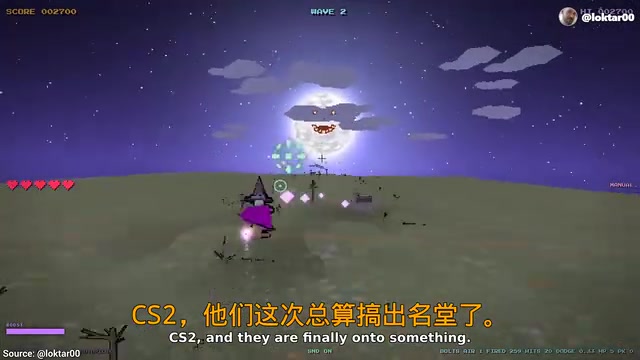
Additionally, 4.1 Flash features native visual understanding. You can hand it a screenshot of a classic game menu and ask it to recreate a playable game interface. That kind of native multimodal support opens up the model's use cases considerably.
437x KV Cache Compression: Breaking Down CSA2
The most astonishing aspect of this model is its paradoxical "big yet small" nature. The "small" part refers to its KV cache — the component responsible for storing contextual information, which is central to determining VRAM usage and inference cost.
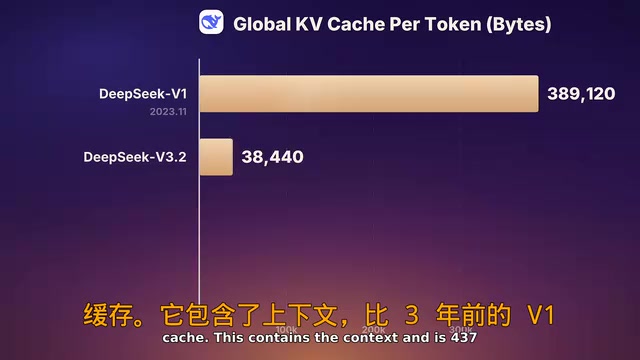
According to the channel's analysis, 4.1 Flash's KV cache is 437 times smaller than the V1 from three years ago, and even 4 times smaller than the 4.0 Flash released just a few months ago. Compressing by 4x in just a few months is a remarkable rate of progress.
The technology behind this is called CSA2. To understand it, you first need to understand how traditional neural networks operate: a network consists of many layers of neurons, and as information passes between layers, each layer maintains its own independent KV memory. This leads to massive redundant storage.
DeepSeek 4.1 Flash's breakthrough lies in having different layers share memory — rather than every layer remembering everything independently, they share a common pool. This is extremely difficult to engineer, because different layers need different "perspectives" on the same historical information. Forcing them to share can easily cause performance to collapse — and DeepSeek found a way to make it work stably.
The Return of the Encoder-Decoder Architecture
Dig deeper into the architecture and you'll find an interesting design choice: the encoder-decoder structure. The encoder creates a shared global memory, while the decoder reads from it as needed. This division of labor is precisely what allows the KV cache to shrink so dramatically.
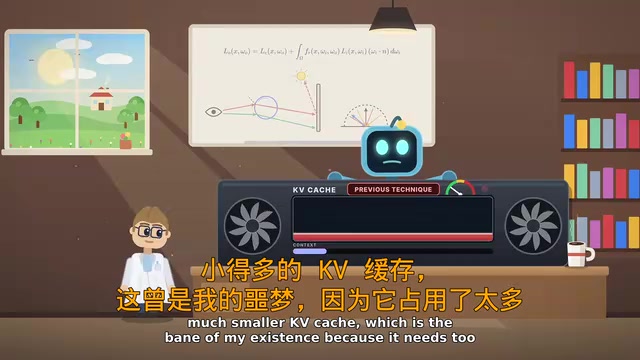
The value of this approach is that it consolidates "memory" from scattered, per-layer storage into a single, centrally managed global resource. For the VRAM bottleneck that has long plagued large model deployment, this is a genuinely significant leap. And since DeepSeek is an open model with a freely available research paper, anyone can study the specific implementation.
The KV cache (Key-Value Cache) is a core component of the Transformer architecture. During autoregressive generation, every time the model generates a new token, it needs to "look back" at the attention information for all previous tokens. To avoid redundant computation, the model caches the Key and Value matrices from each layer — that's the KV cache. Its size scales directly with the number of model layers, the number of attention heads, the sequence length, and the dimension of each head. More layers and longer contexts mean more VRAM usage. For large models with tens or hundreds of billions of parameters, the KV cache is often the dominant source of VRAM consumption during inference, directly determining how long a context a single GPU can handle and how many concurrent requests it can serve. This is why KV cache compression is considered one of the key paths to reducing large model inference costs.
The encoder-decoder structure was first introduced in the original 2017 Transformer paper Attention Is All You Need, originally designed for machine translation. The encoder maps an input sequence into a set of continuous hidden-state representations, and the decoder generates the output sequence step by step, querying the encoder's output at any time via a "cross-attention" mechanism. However, the GPT series pushed the "decoder-only" architecture into the mainstream — simpler, more scalable, and the dominant paradigm for large language models over the past few years. DeepSeek 4.1 Flash reintroduces the encoder, but with a different motivation from the original design: here, the encoder's core job isn't to process "another language" — it's to consolidate the historical KV information scattered across layers into a single shared global memory for all decoder layers to read from uniformly. This breaks the traditional pattern of each layer maintaining its own independent KV cache. It's a creative repurposing of a classic architecture for a new context.
The Hidden Catches: Massive Parameter Count and Token Consumption
Focusing only on the compression ratio can easily give the impression that this is a small model you can casually run at home — but that's not the case. Its parameter count exceeds 500 billion, putting it completely out of reach for consumer hardware. The presenter openly admits they can't run it locally either, relying on APIs or cloud platforms like Lambda instead.
Another catch worth noting: 4.1 Flash loves to think, and burns through a lot of tokens. The per-token price isn't steep, but the volume adds up. So the cost advantage from the smaller KV cache is partly offset by the higher token consumption.
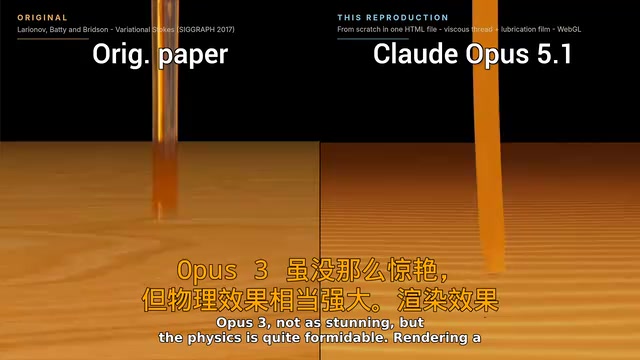
On real-world capability tests, the presenter also stays objective. In an experiment reproducing a physics-related paper, GPT-6 Astra performed best, Opus 5.4 came in slightly behind, and the current generation of DeepSeek still has room to improve on specific sub-tasks like rendering. In other words, it doesn't lead across the board — its standout contribution is in the dimension of cost efficiency.
A model that "loves to think" refers to its reasoning mode: before producing a final answer, the model generates a lengthy internal reasoning chain (Chain-of-Thought), breaking down the problem step by step and verifying intermediate steps. This approach significantly improves accuracy on complex tasks, but at the cost of consuming large numbers of output tokens. Since APIs typically charge separately for input and output tokens, the longer the reasoning chain, the higher the cost per request. For simple Q&A or short text generation tasks, this mode leads to obvious cost waste; for tasks requiring multi-step reasoning — math derivations, code debugging, scientific analysis — the extra token consumption is often well worth it. In practice, whether to enable "thinking mode" should be weighed against the complexity of the task, rather than left on by default.
The Value of Open Science
Every time DeepSeek publishes a new paper, the cost of AI usage across the entire industry tends to drop — that's its greatest contribution to the community. This practice of making cutting-edge technology publicly available for everyone's benefit is helping more doctors, scientists, and practitioners apply AI to real-world work.
For ordinary developers and researchers, even if running a model this large locally isn't feasible, they can use cloud GPU platforms to reproduce papers, fine-tune models, or run inference. Open models paired with open papers make it possible to "verify the truth" rather than blindly trust headlines.
Taken together, DeepSeek 4.1 Flash doesn't represent a victory on any single benchmark — it represents a pragmatic architectural innovation: using shared memory and an encoder-decoder structure to drive inference costs down. It has clear weaknesses and a clear sense of direction, and the story of AI becoming cheaper and more accessible is itself worth documenting.
Related articles

Chain of Thought Isn't Just for AI: How Humans Can Use CoT to Improve Thinking Quality
Chain of Thought isn't just a prompt trick for large models. Starting from a Hacker News discussion, this article analyzes why CoT works for human thinking too, breaks down actionable ways to transfer it, and highlights the key differences between human CoT and machine CoT.
Cloudflare Teams Up with OpenAI: Closi…
Cloudflare Teams Up with OpenAI: Closing the Loop from Vulnerability Discovery to Defense with AI
Cloudflare uses OpenAI Daybreak to investigate security vulnerabilities and generate reviewable remediation plans, while developers use Codex to boost coding efficiency and quality.

Orca Multi-Agent Orchestration in Practice: A Guide to Parallel Collaboration with Claude and Codex
Orca is Stable AI's free open-source agent workbench supporting 34 agents like Claude Code and Codex in parallel. Learn its Git worktree isolation, multi-model orchestration, and mobile management.