DeepSeek API Pricing Adjustments Explained: A New Option for Developer Cost Optimization

DeepSeek's API pricing update intensifies the LLM price war, offering developers new cost optimization options.
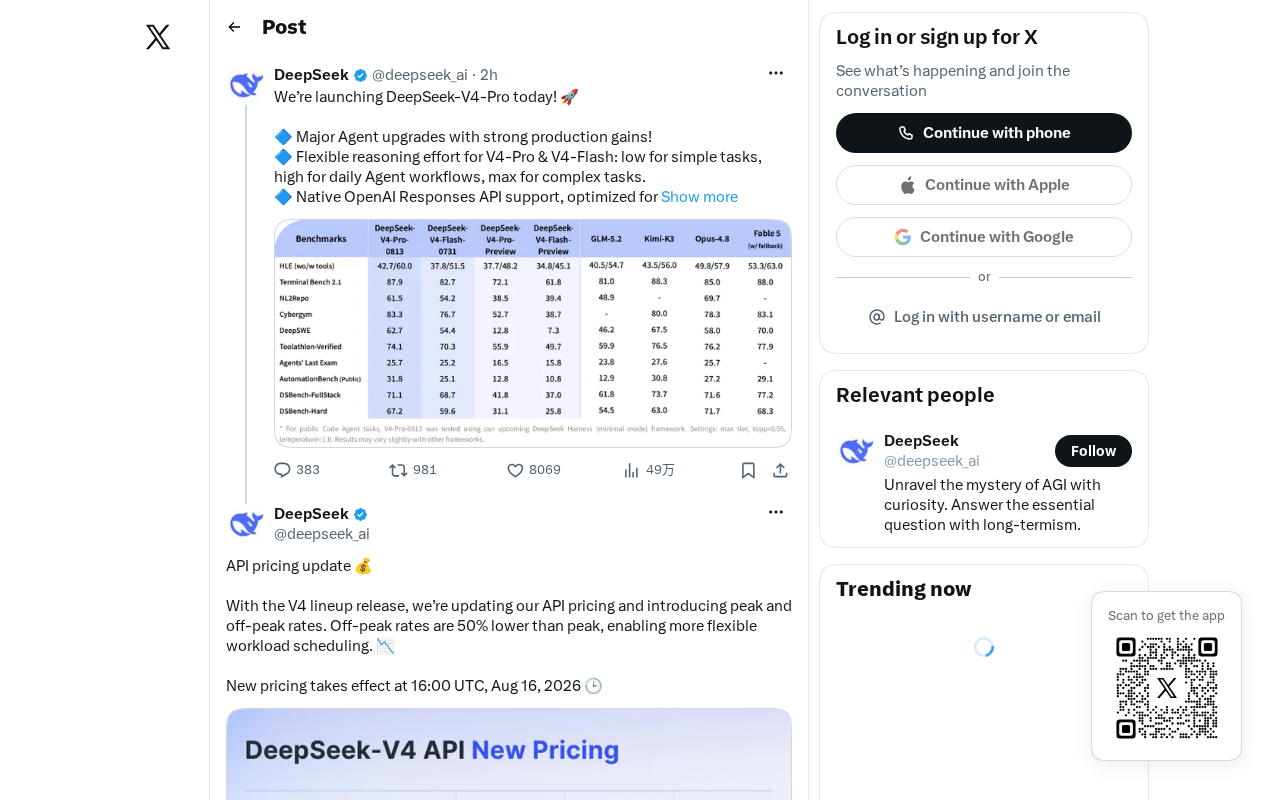
DeepSeek has updated its API pricing strategy, continuing its high cost-performance approach with innovations like disk-based context caching that significantly reduces costs for multi-turn conversations and batch tasks. Leveraging MoE architecture to cut inference costs, DeepSeek is reshaping the LLM API market and pressuring competitors like OpenAI and Anthropic. Developers should weigh pricing against performance, SLA guarantees, and long-term sustainability when making tech stack decisions.
DeepSeek Adjusts API Pricing Again
DeepSeekAd recently updated its API pricing strategy, sparking widespread discussion in the developer community on Hacker News. As a Chinese AI company rapidly rising in the open-source large language model space, every pricing adjustment from DeepSeek captures the attention of developers worldwide. This latest update continues DeepSeek's signature high cost-performance approach and once again pushes the API pricing competition into the spotlight.
For developers and enterprises building applications on top of LLM APIs, the cost of API calls is often a decisive factor in project viability. LLM APIs universally use tokens as their billing unit — tokens are the smallest semantic units produced when text is split by a model's tokenizer. An English word typically corresponds to 1–2 tokens, while a Chinese character usually maps to 1–2 tokens as well. API pricing is denominated in "per million tokens" and distinguishes between input tokens and output tokens, with the latter typically priced higher due to the greater computational resources required for generation. Against the backdrop of persistently high prices for GPT-4, Claude, and other mainstream model APIs, DeepSeek's significant price advantage offers a practical alternative for a wide range of cost-sensitive use cases.
Why API Pricing Matters So Much to Developers
Cost Is the Core Barrier to Scaling
No matter how powerful a large model is, if the cost of calling it is too high, it becomes difficult to deploy at scale in real-world business scenarios. For use cases that need to handle massive request volumes — such as intelligent customer service systems, content generation platforms, code assistance tools, and automated data analysis — even small price differences per thousand tokens get dramatically amplified at scale. For an application making millions of calls per day, the API bill could differ by several times or even an order of magnitude depending on the pricing structure.
Therefore, model providers like DeepSeek that are known for low pricing are effectively redefining the entry threshold for LLM commercialization. They give more small teams and independent developers the opportunity to embed AI capabilities into their products without being priced out by exorbitant API fees.
Context Caching Mechanisms Reduce Real-World Usage Costs
Notably, DeepSeek has introduced a Context Caching mechanism (disk-based), offering substantial discounts on input tokens that hit the cache. The technical principle behind this lies in persistent storage of the KV Cache: in the Transformer architecture, when a model processes input text, it computes Key and Value vectors for each token at every layer. These KV pairs form the foundation for generating subsequent tokens. In the traditional approach, every new request requires recomputing the full KV Cache for the entire prompt. The disk caching mechanism persists the computed KV Cache to storage media, so when subsequent requests share a prefix that matches the cache, the existing computation results can be directly reused, skipping redundant forward passes. This not only reduces costs for users but also alleviates GPU compute load.
This mechanism is particularly advantageous for the following scenarios:
- Multi-turn conversations: Repeated system prompts and historical messages in continuous dialogues can hit the cache
- Long document processing: When asking multiple questions about the same document, the document content only needs to be billed once
- Batch tasks: Requests with similar structures can share context cache
This kind of pricing innovation often demonstrates a deeper understanding of real developer usage patterns than simple price cuts alone.
Analysis of the LLM API Price War Landscape
From Performance Competition to Cost-Performance Competition
Over the past two years, the competitive focus in the LLM industry has undergone a notable evolution. In the early days, vendors primarily competed on absolute model capability — parameter count, benchmark scores, and reasoning quality. As model capabilities have gradually converged and open-source models continue to close the gap with top-tier proprietary ones, the competitive balance has shifted toward cost-performance.
DeepSeek is a prime example of this trend. It achieves dramatic inference cost reduction through MoE (Mixture of Experts) architecture. Unlike traditional dense models that activate all parameters during every inference pass, MoE models use a Router network to dynamically assign inputs to only a few of multiple "expert" sub-networks for processing. For example, DeepSeek-V2 has 236B total parameters but only activates approximately 21B parameters per inference. This means the model maintains the knowledge capacity afforded by a large parameter count while dramatically reducing actual inference computation, thereby significantly lowering per-inference GPU compute consumption and latency. DeepSeek reduces its own operational costs through these technical optimizations on one hand, and directly reflects the cost advantage in pricing on the other, creating strong market appeal. This has also pressured OpenAI, Anthropic, and other providers to cut their API prices multiple times.
Balancing Open Source and Commercialization
A distinctive feature of DeepSeek is its open-source strategy. It publishes model weights openly, allowing developers to self-deploy, while simultaneously offering managed API services. This dual-track model gives developers flexible choices:
- Self-deployment: Full control, suitable for scenarios with extremely high data privacy requirements
- Managed API: Eliminates operational overhead, suitable for rapid validation and small-to-medium scale applications
The cost structure of self-deploying open-source LLMs spans multiple dimensions: GPU hardware costs (e.g., NVIDIA A100/H100 cards, with individual cards costing tens of thousands of dollars), power and cooling costs for inference servers, personnel costs for deploying and tuning model serving frameworks (such as vLLM, TGI), and ongoing operations monitoring overhead. Taking DeepSeek-V2 as an example, a full deployment requires multiple high-end GPUs, with average monthly comprehensive costs potentially reaching tens of thousands of dollars. When API call volume hasn't reached a certain scale, the pay-per-use model of managed APIs may actually be more economical.
The reasonableness of API pricing directly influences developers' trade-off decisions between "self-hosting" and "managed services." When API prices are low enough, the hardware and personnel costs of self-hosting may actually become disadvantageous — this is the core economic logic by which pricing strategy can change developer behavior.
Practical Implications and Recommendations for Developers
Re-evaluate Your Tech Stack
Every major model pricing adjustment is worth a fresh look at your technology stack. If DeepSeek's new pricing offers clear advantages in specific scenarios, projects currently using other models should conduct cost comparison tests.
However, price is only one decision factor. The following dimensions also need to be considered holistically:
- Actual model performance on target tasks
- Response latency and throughput
- Service stability and SLA guarantees — SLA (Service Level Agreement) is a formal commitment from the service provider on key metrics such as availability and response time. This typically covers service uptime percentage (e.g., 99.9% means no more than approximately 43 minutes of downtime per month), percentile guarantees on API response latency, and compensation mechanisms for SLA violations. For enterprises building production-grade applications, SLA guarantees directly affect business continuity
- Data compliance and privacy policies
- API compatibility and migration costs
Consider the Sustainability Behind Low Pricing
While low prices are enticing, developers should maintain a rational perspective. Whether extremely low API prices are sustainable and whether they might be significantly increased in the future are risk factors that need to be considered. Some providers may adopt a "low price to acquire customers, raise prices later" strategy, or use subsidies to capture market share in the short term. When building mission-critical applications, it's advisable to maintain a degree of model portability and avoid over-dependency on a single vendor, in order to handle potential changes in pricing policies. In practice, developers can achieve multi-model switching capability through a unified API gateway layer or interface wrappers compatible with the OpenAI format.
Conclusion
DeepSeek's API pricing update is yet another microcosm of the intense competition in the LLM industry. In an era of converging capabilities, price and cost-performance are becoming the key variables determining market dynamics. For developers, this means lower usage costs and more options, while also reminding us to maintain careful judgment about technical choices and long-term sustainability even as we enjoy the pricing dividends. As more providers join this cost-performance competition, the ultimate beneficiary will be the entire AI application ecosystem.
Related articles

Deep Learning's Three Architectures and the Universal Approximation Theorem: A Complete Guide to MLPs, CNNs, and Transformers
Explaining the inductive bias differences among MLP, CNN, and Transformer, the existence meaning of the Universal Approximation Theorem (UAT), and the role of Taylor expansion in approximation analysis, while clearing up common misconceptions.

GitLab Emergency Patch Release: Analysis of Critical Security Fixes
GitLab releases critical patch 19.5.1, sparking 355 points of discussion on Hacker News. This article analyzes the background, upgrade steps for self-hosted instances, and verification points to help DevOps teams respond quickly to security updates.

Switch 2 Jailbreak: Hackers' Challenges and Security Considerations
Explore the possibility and technical difficulties of Switch 2 jailbreaking, analyzing hacker community dynamics, Nintendo's security measures, and legal and ethical controversies.