DeepSeek Cuts Prices on Two Fronts: Search API as Low as $0.75

DeepSeek cuts prices on models and search API, outpacing market reaction.
DeepSeek released V4.1 Flash 1017 and a Search & Fetch API in the same week. Model cost per task is about $0.20 versus $3.20 for GPT-5.6 Sol; search is $0.75 per 1K requests, over 6.7× cheaper than Perplexity. A hands-on test spent $4.20 on 619M tokens across seven dev tasks. The article attributes the low prices to KV cache compression and sparse attention architecture, not just subsidy, and notes Polymarket has barely priced in the shock.
DeepSeek Cuts Prices on Two Fronts: Search API as Low as $0.75
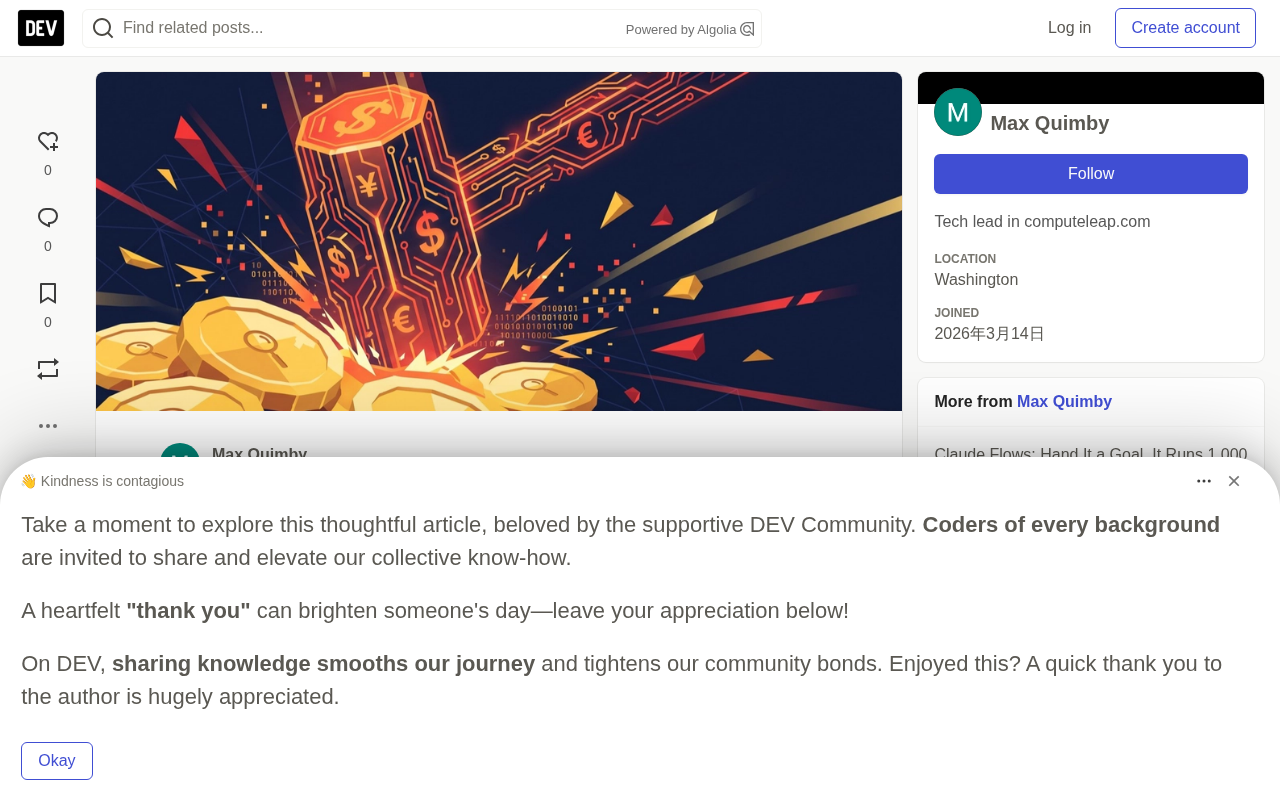
DeepSeekAd released two updates this week, each newsworthy on its own. Taken together, they reveal a pricing strategy the industry hasn't fully digested: a price war on both model inference and web search.
According to the original analysis by ComputeLeap, this combination means DeepSeek is undercutting prices on two fronts at once—and prediction markets have barely reacted.
V4.1 Flash 1017: A "Minor Update" in Name Only
DeepSeek's model card calls V4.1 Flash 1017 a minor version update, but the benchmarks disagree.
According to Bijan Bowen's breakdown, Terminal-Bench 4.0 jumped from 31.2% to 42.3%—a 35% relative improvement in five weeks. That's a generational leap on a single benchmark, and it appears to come from sustained post-training optimization rather than a new base model.
More attention has gone to DeepSWE v1.1 hitting 77%, putting V4.1 Flash in the same range as GPT-5.6 Sol. But the more compelling figure is cost per task: about $0.20, versus roughly $3.20 for Sol. You can run 16 DeepSeek tasks for the price of one Sol task, and the quality gap on software engineering benchmarks falls within the noise.
WorldofAI ran a full test of the 1017 version and reached the same conclusion: the model improved across the board, not just on benchmarks that flatter it. Multiple independent YouTube creators covered the update separately within 24 hours, providing cross-corroboration.
Real Costs: 619 Million Tokens for $4.20
Benchmarks are one thing; the bill is another.
According to AI Chaoyuanyu's hands-on test, running seven complete development tasks on V4.1 Flash 1017 via DeepSeek Harness—including animations, 3D scenes, a tank game, a native iOS app, and more—consumed a total of 619 million tokens at a cost of about $4.20. Not every task was perfect: naval combat controls glitched, some 3D scenes were clipped, and a tablet navigation flow failed. But the failure mode was "good-enough agentic coding at near-zero marginal cost."
Do the math: at $0.14 per million input tokens and $0.28 per million output tokens (off-peak), an agentic coding loop consuming 50 million tokens costs about $14; the same loop on GPT-5.6 Sol costs about $225, and on Claude Opus 5 about $375. The capability gap is converging faster than the price gap.
KV Cache (Key-Value Cache) is a core mechanism in autoregressive LLM inference: when generating each new token, the model needs to reuse the attention key-value vectors of all previous tokens to avoid redundant computation. Cache size grows linearly with context length and is the main source of VRAM usage in long-context inference. Compressing the per-token KV cache to 890 bytes means the same VRAM can support longer contexts or higher concurrency, directly lowering the serving cost per request. This echoes the "memory wall" judgment mentioned later in the article—when the inference bottleneck shifts from compute to memory bandwidth, compressing the KV cache yields more significant gains than simply stacking more GPUs.
Search API: $0.75 Rewrites the Economics
In the same week, DeepSeek launched its Search & Fetch API at $0.75 per 1,000 successful requests, with search and fetch priced the same. The news hit 439 points on Hacker News in under 12 hours.
| Provider | Search cost (per 1K requests) | Notes |
|---|---|---|
| DeepSeek Search | $0.75 | Flat pricing, up to 50 results per query |
| Perplexity Sonar | $5–12 | Varies with search depth |
| Perplexity Sonar Pro | $6–14 | Plus $3/$15 per million tokens |
| Google Custom Search | $5 | 100 free per day; web mode ends January 2027 |
DeepSeek is 6.7× cheaper than Perplexity's lowest tier and 10.7× cheaper than the medium-depth search tier most developers use. A top-voted Hacker News comment nailed it: "These services exist only because Google refuses to offer a paid search API."
What You Actually Get
The Search API (POST /v1/tools/search) returns structured web results: title, URL, snippet, a longer model-oriented summary, site authority tier, relevance score, and publication date. It supports query operators such as site filtering, date ranges, exact phrases, and language targeting, with a rate limit of 5 requests per second. The Fetch API (POST /v1/tools/fetch) takes a URL and returns page content in Markdown format, at the same price and rate limit.
Both bill only for successful requests; failed calls, empty results, and timeouts are free. More importantly: calls made through DeepSeek Harness, Claude Code, or Codex are free until November 1.
For developers building RAG or search-augmented agents, the cost equation has changed. DeepSeek Search ($0.75/1K) plus V4.1 Flash generation ($0.14/$0.28 per million tokens) brings the total cost of a grounded answer to about $0.001. The equivalent query on Perplexity Sonar runs between $0.005 and $0.012.
RAG (Retrieval-Augmented Generation) refers to a pipeline that first retrieves relevant snippets from external knowledge sources, then feeds those snippets as context to an LLM to generate an answer. It decouples "source of facts" from "language generation," so the model doesn't need to parameterize all knowledge, and updates and provenance become easier. RAG cost consists of two parts: retrieval call fees and generation token fees, so the search API unit price and the model unit price multiply directly to determine the cost per Q&A. This also explains why the article emphasizes "search plus generation" full-stack pricing: for most agent builders, retrieval results are just raw material fed into their own pipelines, and answer-quality engineering is not required.
The Lag in Prediction Markets
Polymarket's "Best Chinese AI Company by End of October" market currently reads: Xiaomi 60%, Alibaba 16%, Moonshot 14%. DeepSeek—which just flooded AI YouTube and landed its search API on Hacker News' front page—doesn't appear in this market's pricing. Another market, "Best AI Model by End of October," shows Google 74%, Anthropic 24%, OpenAI 1%, with money flowing toward Gemini's coding demos rather than DeepSeek's cost shock.
This divergence is itself a signal. Two explanations: first, the market is lagging—Polymarket's Chinese AI market lacks the liquidity or attention to reprice on model update cycles; second, the market is right and YouTube is wrong—it's pricing things beyond benchmark performance, such as deployment scale, ecosystem, and consumer reach, where Xiaomi genuinely leads.
The original author's judgment: mostly the first, with some of the second. DeepSeek's strength is APIs and the developer ecosystem, not consumer products. But prediction markets are supposed to price all public information, and this one has clearly fallen behind.
Prediction Market is a market mechanism that reflects the crowd's probability expectations for events through the prices of traded contracts; prices can be seen as real-time pricing of public information. Its effectiveness depends on sufficient liquidity, participant attention, and arbitrage incentives. The divergence observed in the article is essentially a case of "information already public but not fully traded": when a market's trading volume and market-making depth are limited, price adjustment to new information lags significantly, sometimes settling long-term at a narrative-driven equilibrium. So when prediction market prices disagree with creator consensus, it could be mispricing—or the market could be trading another set of variables (such as deployment scale, ecosystem, and consumer reach).
The Bear Case
The case against DeepSeek's pricing: it's subsidy-driven loss-leader customer acquisition, built on favorable economics that may not last. DeepSeek's cost structure differs from US labs: compute costs are influenced by Chinese industrial policy, there's no pressure to show unit profitability, and there's a strategic incentive to lock in developers before integrating the search stack.
Perplexity's premium buys what DeepSeek's bare search API lacks: answer-quality engineering, including citation verification, hallucination reduction, source ranking, and a Pro Search reasoning layer that decomposes complex queries. You're paying 7× more not for the same ten links, but for the RAG pipeline layered on top of retrieval. Google Custom Search shutting down in January 2027 may actually push developers toward integrated search-plus-reasoning APIs, where Perplexity's first-mover advantage matters more than DeepSeek's price advantage.
The counter-counter: most developers building agents don't need Perplexity's answer-quality layer. They need search results to feed into their own RAG pipelines, and they need them cheap. In that use case, DeepSeek's API is 7–16× cheaper and returns structured data that's easy to integrate. The quality premium only matters when you present search results directly to users—and most agent builders don't.
Signals at the Architecture Level
The technical community is digging into how DeepSeek achieves these costs. According to an analysis by Jia-Bin Huang on X, three techniques stand out: a causal encoder-decoder architecture, compressed sparse attention, and KV cache reduced to 890 bytes per token, with persistent cache shrunk 8×, translating directly into lower inference serving costs.
This means the efficiency floor is far lower than what US labs currently ship—cheap inference obtained not through brute-force optimization but by design. If that judgment holds, DeepSeek's pricing is a preview of where industry costs are heading, not loss-leading customer acquisition.
IBM's recent explainer on the "AI memory wall" provides a theoretical frame: LLM inference is increasingly constrained by memory bandwidth rather than compute, and the next wave of efficiency gains will come from memory architecture rather than more FLOPs. DeepSeek's KV cache innovation targets exactly this.
Compressed Sparse Attention refers to keeping or aggregating only part of the key-value pairs in attention computation, rather than performing dense attention over the full sequence. Typical approaches include low-rank compression of KV, block-wise sparsification, or hybrid structures combining sliding windows with global tokens. The cost is potential loss of long-range dependency accuracy, so it needs to be paired with architecture design during training. The article notes that DeepSeek also employs a causal encoder-decoder architecture, which can reuse encoder-side cache during inference and reduce redundant computation on the decoder side. Together with sparse attention, this forms the technical basis for a "lower efficiency floor," rather than post-hoc quantization pruning.
What It Means for Different Roles
Those building search-augmented agents: Test DeepSeek Search for free before November 1. Its structured output is richer than Google Custom Search, and the flat $0.75/1K pricing is predictable. If search quality holds up, search costs drop by 85%.
Those choosing coding models for agent loops: V4.1 Flash 1017's $0.20 per task is the new floor for "good-enough" agentic coding. It won't beat Claude Opus 5 or GPT-5.6 Sol on the hardest tasks, but for the 80% of agent loops that don't need frontier reasoning, the cost difference is 8–16×.
Those evaluating AI API stacks: The dual-front pricing of model plus search creates a full-stack option that didn't exist a week ago. Whether to trust it long-term depends on your judgment of subsidy-pricing sustainability, but the free window before November 1 means zero cost to experiment.
The model race isn't over, but the pricing race just got a new front-runner—and it's moving faster than the market can react.
One-line Summary
DeepSeek cuts prices on both models and search API, with a cost shock that far outpaces market reaction.
Paragraph Summary
DeepSeek released its V4.1 Flash 1017 model update and Search & Fetch API in the same week, with model cost per task around $0.20 and search at $0.75 per thousand requests—a fraction of GPT-5.6 Sol and Perplexity Sonar respectively. A hands-on test ran seven development tasks on 619 million tokens for just $4.20, with the failure mode summarized as "good-enough agentic coding at near-zero marginal cost." The article argues the low prices are backed by architectural innovations like KV cache compression and sparse attention rather than pure subsidy. Meanwhile, Polymarket's pricing of Chinese AI companies and best models barely reflects this shock; the author judges this is mostly market lag, with some component of the market trading variables beyond benchmark performance.
Related articles

Chain of Thought Isn't Just for AI: How Humans Can Use CoT to Improve Thinking Quality
Chain of Thought isn't just a prompt trick for large models. Starting from a Hacker News discussion, this article analyzes why CoT works for human thinking too, breaks down actionable ways to transfer it, and highlights the key differences between human CoT and machine CoT.
Cloudflare Teams Up with OpenAI: Closi…
Cloudflare Teams Up with OpenAI: Closing the Loop from Vulnerability Discovery to Defense with AI
Cloudflare uses OpenAI Daybreak to investigate security vulnerabilities and generate reviewable remediation plans, while developers use Codex to boost coding efficiency and quality.

Orca Multi-Agent Orchestration in Practice: A Guide to Parallel Collaboration with Claude and Codex
Orca is Stable AI's free open-source agent workbench supporting 34 agents like Claude Code and Codex in parallel. Learn its Git worktree isolation, multi-model orchestration, and mobile management.