DeepSeek Harness: A Clear Explanation of the Engineering Beyond the Model

DeepSeek releases an open-source Harness developer preview, making engineering beyond the model explicit.
DeepSeek released the Harness developer preview on August 13, opening testing to developers worldwide and open-sourcing the code. Harness means horse tack and, in AI, refers to the engineering layer outside the model: prompts, tool calls, sandboxing, memory, context management, hooks, middleware, and orchestration. Its core idea is "everything is a plugin," enabling decoupling and flexible customization. The article argues this explicit naming and open-sourcing turns engineering discipline into reusable public components.
Title
DeepSeek Harness: A Clear Explanation of the Engineering Beyond the Model
Meta Description
What is the DeepSeekAd Harness developer preview? Starting from the original meaning of "harness," this article explains that Harness is the engineering layer beyond the model, covering system prompts, tool calls, sandboxes, memory, and orchestration logic, and interprets the open-source design where everything is a plugin.
Article Content
No matter how powerful a large model is, it is like an untamed horse. What actually gets it running—and running steadily—is the engineering system outside the model. DeepSeek named this system Harness and released a developer preview.
According to a related video on Bilibili, DeepSeek Harness released a usable version on the evening of August 13, opened testing to Harness developers worldwide, and simultaneously open-sourced the code. This timing and naming are worth unpacking from the perspective of technical evolution.
What Exactly Does Harness Mean? Starting from "Horse Tack"
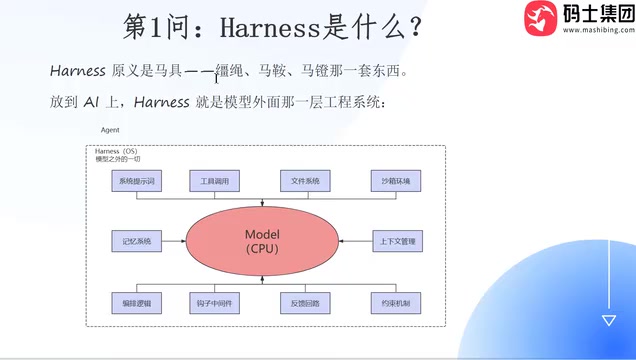
The original meaning of Harness is horse tack—the whole set of reins, saddle, and horse lantern. Technicians use it as an analogy for AI large models: the model itself is highly capable, but in use it is like a wild horse; only by putting on reins and a saddle can it be effectively controlled.
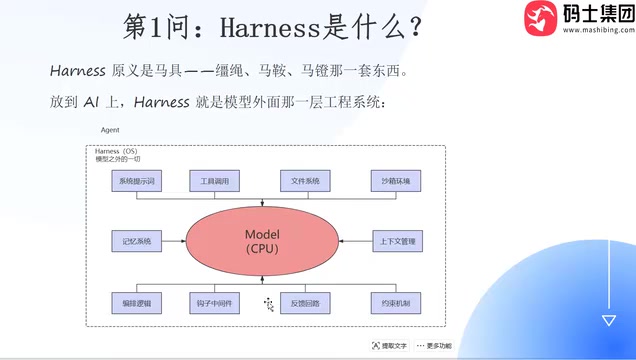
In the AI context, Harness refers to the engineering system outside the model. It incorporates system prompts, tool calls, the file system, sandbox environments, memory systems, context management, constraint mechanisms, feedback loops, hooks, middleware, orchestration logic, and more. In one sentence: the model handles judgment, and Harness handles everything else.
This definition is well suited to interview scenarios. If asked "What is Harness," answering "everything outside the model" captures the key point—it is not a specific component, but the overall abstraction of the engineering discipline.
Understanding Harness's positioning requires distinguishing it from an "Agent Framework." Agent frameworks (such as LangChain and AutoGen) usually provide a set of preset abstractions and workflows, and developers write business logic on top of them; the framework itself is binding. Harness leans more toward the "runtime layer": it does not force you to use a particular orchestration paradigm, but provides infrastructure such as system prompt injection, tool-call protocols, sandbox execution, context compression, failure retry, and permission constraints, so that any model and any tool can be uniformly scheduled on top of it. In other words, a framework cares about "how to write an agent," while Harness cares about "how the external environment is managed when the agent runs." This also explains why DeepSeek named it separately—it describes the layer that is most easily overlooked during productization but has the greatest impact on stability.
Everything Is a Plugin: The Core Design of the Developer Preview
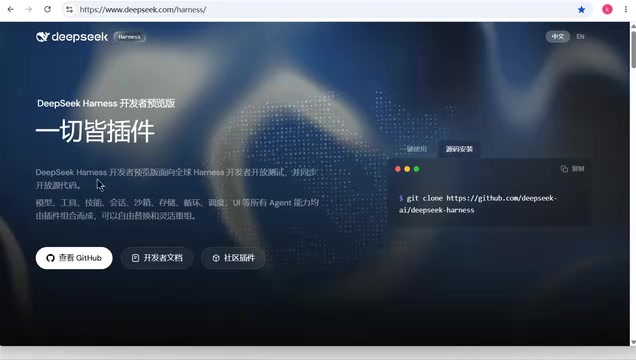
DeepSeek Harness is positioned as a developer preview, and its most distinctive design philosophy is "everything is a plugin." Models, tools, skills, and agent capabilities such as drawing, sandboxing, storage, loops, and UI are all composed of plugins that can be freely replaced and flexibly combined.
The value of this architecture lies in decoupling: the model can be changed, tools can be changed, the UI can be changed, while the orchestration logic remains consistent. For developers, this means they can assemble their own agent capability stack as needed without being bound to a fixed interface from a particular model provider.
Usage is also relatively lightweight: one command installs it with a single click; if you want to study the source code, you can clone the project directly from Git. The publisher also open-sourced the code, which is a friendly signal for developers who want to deeply understand Harness's internal mechanisms.
In engineering terms, "everything is a plugin" corresponds to dependency injection and interface abstraction. Each plugin follows a unified lifecycle and capability declaration, and the host depends only on abstract interfaces rather than concrete implementations, so when replacing a model provider, switching a sandbox backend, or replacing the UI, the orchestration logic does not need to change. This design also brings testability advantages: a single plugin can be replaced with a mock independently of the whole to verify behavior. The cost is that interface design must be sufficiently stable; otherwise, the plugin ecosystem will fragment due to frequent breaking changes—this is also an area to watch closely during the developer preview stage.
Why Harness Deserves to Be Discussed Separately
In the past, discussions about large models often focused on parameters, training, and inference capability. But as model capabilities gradually converge, what truly creates product differentiation is the engineering system outside the model—how context is managed, how tools are invoked, how memory is stored, how failures are rolled back, and how multi-step tasks are orchestrated.
By explicitly naming this layer Harness and open-sourcing it, DeepSeek turns "engineering discipline" from implicit experience into reusable, discussable public components. For agent developers, this is a conceptual alignment: when discussing agent architecture in the future, it will be possible to clearly distinguish "model capability" from "Harness capability."
It should be noted that the current version is still a developer preview, aimed at developer testing, and its capabilities and stability are still evolving. The content described in this article is mainly based on release information and demonstrations; actual usage experience will change with version iterations, so the official repository and documentation should be taken as authoritative.
FAQ
What is the relationship between Harness and the model? The model handles judgment and generation, while Harness handles all engineering support outside the model; the two are in a layered, collaborative relationship.
What does "everything is a plugin" mean? It means that the model's tools, skills, sandbox, storage, UI, and other capabilities can all be replaced and combined as plugins, making the architecture more flexible and easier to customize.
Do ordinary users need to care about Harness? If you only use it for daily conversation, the impact is not very noticeable; but if you are building agent applications, doing tool calls, or orchestrating multi-step tasks, the Harness layer directly determines the final results and maintainability.
One-line Summary
DeepSeek releases an open-source Harness developer preview, making the engineering discipline beyond the model explicit.
Paragraph Summary
On the evening of August 13, DeepSeek released the Harness developer preview, opened testing to developers worldwide, and simultaneously open-sourced the code. Harness originally means horse tack; in the AI context, it refers to a whole engineering layer outside the model, covering system prompts, tool calls, the file system, sandboxing, memory, context management, constraint mechanisms, feedback loops, hooks, middleware, and orchestration logic. Its core philosophy is "the model handles judgment, and Harness handles everything else." Its most distinctive design is "everything is a plugin": models, tools, skills, sandboxes, storage, and UI can all be replaced and combined, enabling decoupling and flexible customization. The article argues that, against the backdrop of converging model capabilities, the explicit naming and open-sourcing of this layer helps turn engineering discipline from implicit experience into reusable, discussable public components, and also makes it easier to distinguish between discussing "model capability" and "Harness capability." The current version is still in preview, and its capabilities and stability are evolving.
Related articles
 Tech Frontiers
Coldframe: A Honeypot Disguised as a Supermarket Freezer Controller
Coldframe is a honeypot disguised as Danfoss AK-SM 800A and Dixell XWEB freezer controllers, built as a single Python file that detects CVE-2025-41450 attempts and is identified as real devices on Shodan.
 Tech Frontiers
GRFNet: A Lightweight PyTorch Model Designed for Multichannel Time-Series Classification
GRFNet is a lightweight PyTorch model for multichannel time-series classification, originating from EEG decoding research. With only 3,847 parameters, it is based on the ROCKET architecture, combining random convolution kernels with learnable spatial filters, supports arbitrary input lengths, and will soon be evaluated on the PhysioNet dataset.
 Tech Frontiers
CUDA-Accelerated Rocket League Simulator: A Player-Made Hardcore Experiment
A Reddit post shows a "100% Accurate" Rocket League simulator accelerated with CUDA. We analyze its technical context, CUDA's value in game physics simulation, and the significance and limitations of such community projects.