DeepSeek Harness Deep Dive: The 'Everything Is a Plugin' Paradigm for AI Programming

DeepSeek Harness redefines AI programming with its radical 'everything is a plugin' architecture.
DeepSeek's open-source Harness framework, built on Cordis Kernel, has exploded to 150K GitHub stars by treating everything—models, tools, agents—as swappable plugins. With built-in traceability logging, multi-model support (including Claude and OpenAI), and a Creator Mode that lets users add features via natural language prompts, it represents a new paradigm in customizable AI programming tools.
Overnight to 150K Stars: DeepSeek's Latest Open-Source Strike
DeepSeekAd has once again become the focal point of the tech world. According to an analysis by Warren, a content creator on the BetterStack channel, DeepSeek recently released its self-developed programming "Harness" (an agent runtime framework), which skyrocketed to 150K stars on GitHub within just a few days, becoming a phenomenal open-source project. It's fully open-sourced under the MIT license, meaning anyone can freely fork, modify, and redistribute it.
The MIT license is one of the most permissive open-source licenses available. It allows anyone to use, copy, modify, merge, publish, distribute, sublicense, and/or sell copies of the software with virtually no restrictions. Compared to copyleft licenses like GPL that require derivative works to also be open-sourced, the MIT license is entirely business-friendly—meaning companies can build closed-source commercial products on top of DeepSeek Harness without revealing their source code. This choice is clearly aimed at maximizing community participation and ecosystem growth—as proven by successful projects like React and Vue.js, permissive licenses significantly lower adoption barriers and accelerate the flywheel effect of community contributions.
This release isn't an isolated event. Just shortly before, DeepSeek launched its V4 Pro model, breaking into the top tier at extremely low cost. According to comparison data in the video, V4 Pro matches GLM 5.2 in intelligence level at a slightly lower price; compared to Anthropic's Opus, considering the enormous price gap between the two, the performance difference isn't that large either. DeepSeek is clearly playing the "high cost-performance" card to continuously disrupt the entire AI programming ecosystem.
Underlying Architecture: Standing on the Shoulders of Cordis Kernel
DeepSeek Harness wasn't built from scratch—it's built on top of a framework called Cordis Kernel. This is a plugin framework that has existed on GitHub since 2022, with its GitHub page describing itself as "a meta framework of spatio-temporal compatibility"—while this phrasing reads somewhat awkwardly, the design philosophy behind it is quite clear.
A Meta Framework is a framework for building frameworks. It provides a set of universal abstraction layers and lifecycle management mechanisms that allow developers to build domain-specific application frameworks on top of it. The "spatio-temporal compatibility" concept mentioned by Cordis Kernel essentially refers to the coordination capability between plugins across the temporal dimension (lifecycle management, hot-swapping) and the spatial dimension (dependency relationships, scope isolation). This design pattern has a long history in software engineering—from Eclipse's OSGI to Webpack's Tapable—the core idea is decomposing applications into loosely coupled modules that collaborate through a unified event bus or dependency injection mechanism. DeepSeek's choice to build on such a mature framework rather than creating its own reflects the engineering philosophy of "composition over inheritance."
DeepSeek's approach: take a mature plugin framework and wrap a complete programming Harness on top of it. The direct benefit is standing on the shoulders of an existing ecosystem while avoiding reinventing the wheel.
Core Philosophy: Everything Is a Plugin
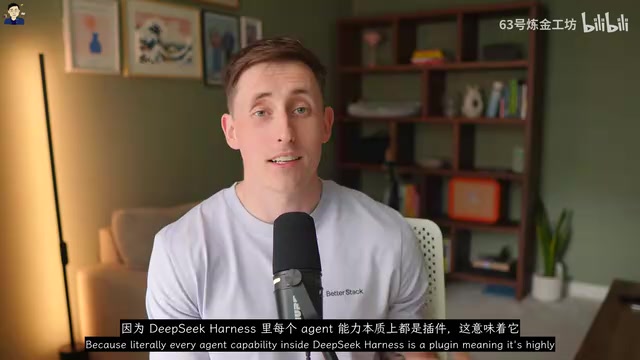
The most disruptive design aspect of DeepSeek Harness is that virtually all capabilities are delivered as plugins. From models, tools, and skills to session management, API gateways, and the agent itself—everything is implemented through Cordis's plugin mechanism.
Plugin Architecture is a software design pattern that splits application functionality into independently loadable modules. Each plugin interacts with the host system through predefined interfaces and can be dynamically loaded, unloaded, or replaced at runtime. Classic examples include VS Code's extension system, WordPress's plugin ecosystem, and Chrome's extension mechanism. The core advantages are: first, it reduces the complexity of the core system since each plugin only needs to focus on its own logic; second, it allows third-party developers to extend functionality without modifying core code; third, it supports on-demand loading to reduce resource consumption. DeepSeek Harness pushes this philosophy to the extreme—even the model itself is a plugin—meaning every dimension of the system can be redefined by the community.
This translates into two key capabilities:
- Ultimate customizability: You can disable any core feature, even "lobotomize" the application down to an empty shell.
- Model freedom: Since the model itself is just a plugin, you're not locked into DeepSeek's own models. The official documentation walks you through connecting Anthropic, OpenAI, Bedrock, or any OpenAI-compatible endpoint. Interestingly, the official configuration examples even include a Claude Sonnet 4.5 entry.
Developers can select, replace, or extend any capability in the configuration without modifying DeepSeek Harness's source code. This "configuration as customization" philosophy dramatically lowers the barrier to secondary development.
Built-in Traceability: Making Every Step Transparent
One feature Warren particularly praised in the video is built-in traceability. This is an append-only logging system that records everything the model sees—including system prompts, reasoning processes, and tool calls.
Append-Only logging is a core design pattern in distributed systems, originating from the WAL (Write-Ahead Log) concept in databases. Its characteristic is that once data is written, it cannot be modified or deleted—new records can only be appended at the end. This design guarantees data integrity and auditability—you never lose historical information, and existing records cannot be tampered with. In the AI agent space, observability is becoming essential: when a model makes incorrect decisions during multi-step reasoning, developers need to precisely trace back to which step went wrong, what context the model saw at that point, and how many computational resources were consumed. Tools like LangSmith and Weights & Biases address similar problems, but DeepSeek Harness builds this in as a first-class citizen feature, reducing the cost of additional integration.
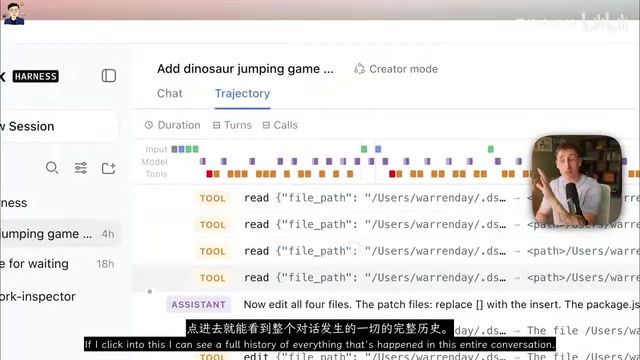
In the desktop application, there are two entry points at the top: Chat and Trajectory. Opening Trajectory reveals the complete history of all events that occurred during the entire conversation, with the ability to highlight specific areas and search for any keyword that appeared. The logs cover the entire conversation, tool calls, and thinking steps.
For example, one operation consumed 187 tokens, with reasoning accounting for 94 tokens. Clicking in reveals the model's complete chain of thought. Tokens are the basic units that large language models use to process text, roughly equivalent to 3/4 of a word in English or 1-2 characters in Chinese. Each model call generates consumption of input tokens (content sent to the model) and output tokens (content generated by the model), while reasoning tokens specifically refer to computational resources consumed during the model's "thinking" process—a new concept introduced by reasoning models like OpenAI o1 and DeepSeek R1. Being able to view token consumption at the individual operation level is crucial for cost control and performance optimization, especially in scenarios where agents loop through dozens of tool calls, where cumulative costs can far exceed expectations. This fine-grained transparency is extremely valuable for debugging agent behavior and understanding model decisions.
Adding Features with a Single Sentence: Creator Mode Explained
If traceability solves the "seeing clearly" problem, then Creator Mode solves the "making changes easily" problem.
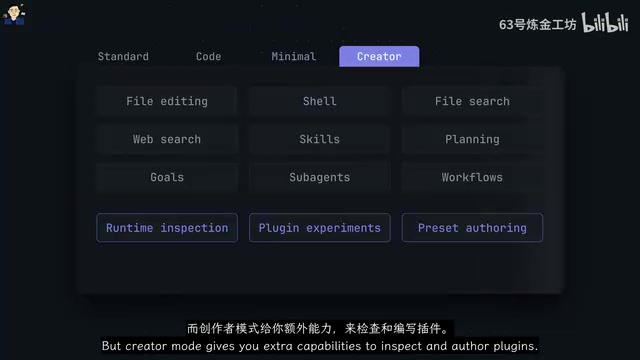
DeepSeek Harness offers multiple operating modes:
Standard Mode
Includes the full toolset, suitable for everyday engineering tasks—this is your primary mode for writing code and calling tools.
Creator Mode
Provides additional capabilities to inspect and write plugins. In other words, you don't need to leave Harness to customize itself.
Creator Mode is essentially a form of metaprogramming—a program that can operate on and modify itself as data. This isn't new in programming languages (Lisp's macro system, Ruby's method_missing), but in the AI agent space it represents an important trend: agents can not only manipulate external code but also modify their own capability boundaries. This bootstrapping characteristic means Harness's feature set can expand infinitely with user needs without waiting for official updates. From a security perspective, this also introduces potential risks—if an agent can modify its own plugins, malicious prompt injection could lead to persistent behavioral changes, which is a security concern that needs attention going forward.
Warren demonstrated this live: sending a message in the chat box requesting "add a dinosaur jumping mini-game in the bottom-right corner of the app." Since it was in Creator Mode, Harness had all the necessary tool permissions, and it actually generated a clickable dinosaur game in the bottom-right corner.
In other words, any feature you want to add to the application can be accomplished with a single prompt—DeepSeek can add plugins to its own Harness. The official marketing page shows more examples, like adding a floating whale or a Snake game. Warren states bluntly that this is one of the coolest features he's seen in any Harness.
He also objectively notes that competitors like OpenCode similarly support customization through prompts, but DeepSeek Harness is much smoother in user experience and the depth of customization enabled by its "everything is a plugin" approach.
Community Ecosystem Explosion: The Compound Interest Effect of Open Source
The power of open source is fully demonstrated in this project.
According to Warren, within just days of the repository going live, the community spontaneously produced a series of derivative projects:
- A desktop application (the version used in the video demo), which alone has already earned 11K stars;
- A Claude Code-style TUI (Terminal User Interface);
- A complete set of Web UI skins;
- And an awesome list resource collection.
TUI (Terminal User Interface) refers to graphical interfaces drawn with characters in command-line terminals, sitting between pure command-line and graphical interfaces. Claude Code is a representative product that runs in TUI form, allowing developers to interact with AI without leaving the terminal. The community building a TUI version for DeepSeek Harness demonstrates developers' strong preference for terminal workflows—many senior engineers complete their daily work entirely in the terminal (vim/neovim + tmux), and GUI is actually a hindrance to efficiency. The rapid emergence of a multi-platform ecosystem (desktop app, TUI, Web UI) proves the portability of the plugin architecture: core logic is completely decoupled from the interface layer, and the frontend can take any form.
A noteworthy detail: none of these were built by DeepSeek officially—they were all spontaneously created by the community within days. This is precisely the compound interest effect enabled by the MIT license + highly extensible architecture—once an ecosystem is ignited, growth often exceeds expectations.
In the settings panel, you can see a dense list of plugins: LLM, sessions, API gateway, the agent itself—all presented as plugins, allowing users to transform the application in any conceivable way. Beyond that, it also has all the standard capabilities you'd expect from a Harness—sending chat messages, calling tools, interacting with local code. Essentially, anything you can do in Claude Code, you can do in DeepSeek Harness.
Summary: Beta Stage, but Stunning Potential
Warren acknowledges that DeepSeek Harness is still in Beta, with some issues present—but this is normal for early-stage projects. He predicts that within the next 12 months, this tool will likely grow into "something special."
Overall, DeepSeek's playbook remains as precise as ever: using ultimate openness and extensibility, combined with the community's organic momentum, to rapidly build an ecosystem moat. When models, tools, and interfaces all become swappable plugins, the customization freedom of AI programming has been pushed to new heights. For developers, this may signal the arrival of an era of "assembling your own programming agent on demand."
Related articles

Chain of Thought Isn't Just for AI: How Humans Can Use CoT to Improve Thinking Quality
Chain of Thought isn't just a prompt trick for large models. Starting from a Hacker News discussion, this article analyzes why CoT works for human thinking too, breaks down actionable ways to transfer it, and highlights the key differences between human CoT and machine CoT.
Cloudflare Teams Up with OpenAI: Closi…
Cloudflare Teams Up with OpenAI: Closing the Loop from Vulnerability Discovery to Defense with AI
Cloudflare uses OpenAI Daybreak to investigate security vulnerabilities and generate reviewable remediation plans, while developers use Codex to boost coding efficiency and quality.

Orca Multi-Agent Orchestration in Practice: A Guide to Parallel Collaboration with Claude and Codex
Orca is Stable AI's free open-source agent workbench supporting 34 agents like Claude Code and Codex in parallel. Learn its Git worktree isolation, multi-model orchestration, and mobile management.