DeepSeek Harness In-Depth Analysis: 10 Questions + 7 Source Code Sessions + 20-Tool Comparison
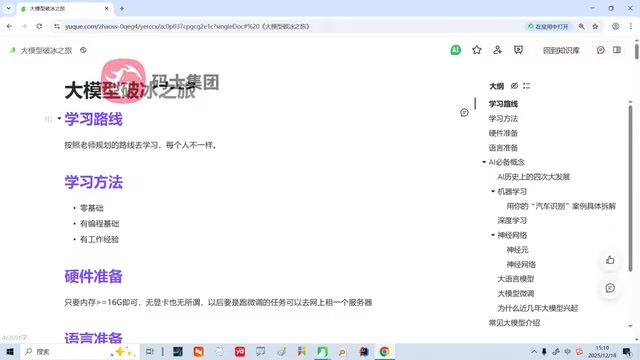
DeepSeek Harness learning path: zero foundation is fine, 16G memory is enough, fine-tuning relies on cloud servers.
The article centers on DeepSeek Harness, an engineering framework and toolset built around the DeepSeek large model. The course covers preliminary concepts, 7 source code analysis sessions, and a 20-tool comparison, forming a closed loop from cognition to hands-on practice to selection. The learning path includes one-on-one planning: zero-foundation learners follow the path strictly; those with programming backgrounds focus on frameworks and tools; those with work experience engage in incremental learning centered on projects. Hardware requires only 16G+ memory, with fine-tuning on rented cloud servers. Python is primary, and a main language such as Java or C++ is recommended for business integration.
What Is DeepSeek Harness?
DeepSeekAd Harness is an engineering framework and toolset built around the DeepSeek large model, designed to lower the barrier to large-model application development so developers can more efficiently complete the entire workflow from prototype to deployment. According to the Bilibili course content, this Harness system covers preliminary concept groundwork, source code analysis, and horizontal tool evaluation across multiple dimensions, providing learners with a path from zero foundation to hands-on practice.
For students with no background or no understanding of AI large models, the course designs an "ice-breaking journey"—first getting familiar with preliminary concepts, then moving into syntax and hands-on practice. This step-by-step approach avoids the confusion that comes from diving straight into code.
Large model application development frameworks generally refer to a software layer built on top of foundation models (such as DeepSeek, Llama, etc.) that encapsulates model invocation, context management, tool integration, workflow orchestration, and other capabilities. Developers no longer need to handle tedious details like API authentication, streaming response parsing, and conversation history concatenation from scratch; instead, they can build chatbots, retrieval-augmented generation (RAG) pipelines, or Agent workflows through declarative configuration or a small amount of code. Common forms include open-source libraries like LangChain and LlamaIndex, as well as SDKs and scaffolding provided by various vendors. The word "Harness" itself means "a harness, a device for controlling," and in software contexts it often refers to an engineering shell that "captures" underlying capabilities and directs them toward practical use. Therefore, DeepSeek Harness can be understood as a set of control and orchestration tools built specifically around the DeepSeek model.
Source code analysis means directly reading the framework's internal implementation code to understand its module division, call chains, and design trade-offs. Compared with only reading documentation and tutorials, reading source code helps developers locate performance bottlenecks, troubleshoot abnormal behavior, and perform secondary development or replace components when the framework's capabilities are insufficient. The "7 source code sessions" arrangement in the course is precisely intended to elevate users from "knowing how to call" to "understanding the principles."
Learning Path and Personalized Guidance
When each student enrolls, the teacher communicates by phone to create a personalized learning path based on their individual foundation, skill points, and subsequent goals, and sets up a small group for Q&A. The core logic of this one-on-one planning is that students with different backgrounds need different entry points and paces.
For those with absolutely zero foundation, it is recommended to follow the planned path steadily—"being obedient" is the most important principle. Follow the path, and ultimately finding a job or achieving your initial expectations is completely achievable.
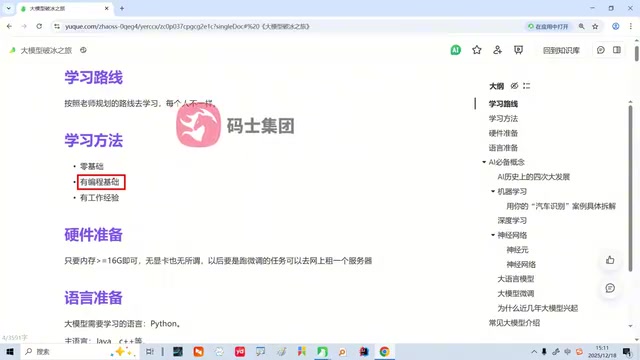
Strategies for Those with Programming Backgrounds
If you have some prior knowledge of Java or Python, you can quickly go through the early syntax sections and focus your time on the later framework learning and tool usage—that is the most important part.
Incremental Learning for Those with Work Experience
For students already working in Java, Python, or data analysis and familiar with company business, learning large models is essentially incremental learning. You can listen carefully and quickly to the teacher's content to see whether it stimulates deeper understanding, while also filling in gaps. The most important endpoint is to complete the later projects to gain practical experience.
Hardware Preparation: Memory Above 16G Is Sufficient
Many students worry about whether their computers can handle large model development and support fine-tuning. The course clearly states: as long as your computer's memory is above 16G, it is actually sufficient, and whether you have a graphics card does not matter. If you later want to run fine-tuning tasks, you can rent a server online for a few yuan per hour, which is completely sufficient. Operating the server remotely through programs is the same as local development.
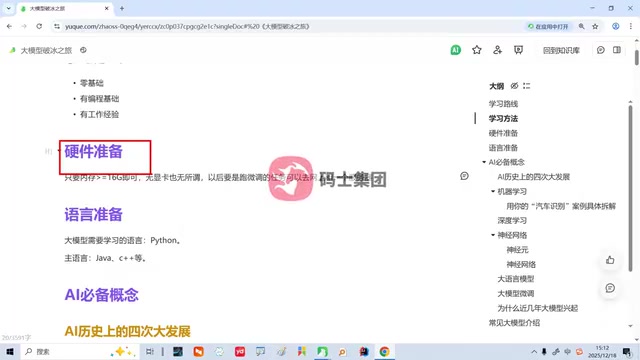
You do not need to buy an extremely powerful graphics card just for learning. Using cloud services for learning is the best practice for learning large models. Whether you are a student, doing your own research, or starting a business, obtaining more computing power through cloud services is a good approach.
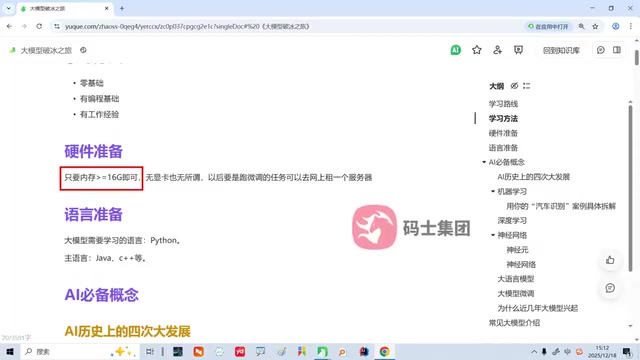
Fine-tuning refers to continuing to train some parameters on the basis of an already-trained large model using data from a specific domain or task, so that the model's output better fits business scenarios. Compared with pre-training from scratch, fine-tuning requires much less data and computing power, but it is still significantly higher than everyday inference calls: full-parameter fine-tuning often requires tens of GB of VRAM, and even parameter-efficient methods such as LoRA usually require a mid-to-high-end graphics card. This is precisely why the article suggests "renting a cloud server when running fine-tuning tasks."
Cloud server rental is currently the mainstream approach for learning and experimenting with large models. GPU instances billed by the hour (such as those equipped with RTX 3090/4090 or A10 models) typically cost from a few yuan to a dozen or so yuan per hour, and are released when no longer needed, avoiding the sunk cost of one-time hardware purchase. After connecting to the instance via SSH or remote development tools, the code editing, debugging, and local development experience are basically the same; you only need to pay attention to data upload/download and the storage retention policy after the instance is shut down.
Language Preparation: Python First, Main Language as a Supplement
If you are only learning large models, the language you need to prepare in the early stage is Python; just follow the learning path. However, large models usually need to be combined with business, and the business may be implemented in languages such as Java or C++. Therefore, it is recommended: if you are not purely in the large model direction and hope to combine it with actual business, it is best to also know a main language, which will broaden your employment path.
Python has become the de facto first choice in the large model field, mainly because mainstream training and inference frameworks (PyTorch, Transformers, vLLM, etc.) and the official SDKs of various models all prioritize Python interfaces, and community examples and tutorials are also the most abundant. Mastering Python's basic syntax, virtual environment management, and commonly used libraries (such as requests and numpy) is enough to get started.
The combination of the main language and business is reflected at another level: existing enterprise systems are mostly built with Java, C++, Go, etc., and large model capabilities ultimately often need to be embedded into these systems in the form of interfaces or services. At this point, if developers understand both the engineering standards of business systems and the model's invocation methods and limitations, they can play the role of a "bridge" and turn model capabilities into maintainable production features. This is also the practical basis for the article's emphasis that, beyond the pure large model direction, it is best to master a main language.
What Do 10 Questions, 7 Source Code Sessions, and 20-Tool Comparison Mean?
From the course structure, the "10 questions" correspond to common confusions and preliminary concepts in large model learning, the "7 source code sessions" go deep into the framework's internal implementation, and the "20-tool comparison" is a horizontal comparative evaluation of ecosystem tools. Together, the three form a complete closed loop from cognition to hands-on practice to selection. For developers, this structure helps build a global judgment about the toolchain while understanding the principles.
Frequently Asked Questions (FAQ)
Q: Can I learn large models without a graphics card? A: Yes. Memory above 16G is enough to start, and fine-tuning tasks can be completed by renting a cloud server.
Q: How should I learn if I have zero foundation? A: Follow the path planned by the teacher, first laying the groundwork with preliminary concepts, then moving into syntax and hands-on practice.
Q: Is Python all I need to learn large models? A: For the pure large model direction, Python is enough; if you want to combine it with business, it is recommended to also master a main language such as Java or C++.
Q: What are the advantages of learning large models after having work experience? A: It is incremental learning, understanding is faster, and the focus should be on project practice to gain experience.
Q: Is the cost of learning with cloud services high? A: Renting a server costs a few yuan per hour, which is completely sufficient and is the best practice for learning large models.
One-line Summary
DeepSeek Harness learning path: zero foundation is fine, 16G memory is enough, and fine-tuning relies on cloud servers.
Paragraph Summary
The article centers on DeepSeek Harness, introducing it as an engineering framework and toolset built around the DeepSeek large model. The course covers preliminary concepts, 7 source code analysis sessions, and a 20-tool comparison, forming a closed loop from cognition to hands-on practice to selection. On the learning path, the teacher creates a one-on-one plan for each student and sets up a group for Q&A: zero-foundation learners should strictly follow the path; those with programming backgrounds can quickly go through syntax and focus on frameworks and tools; those with work experience engage in incremental learning and should focus on project practice. On hardware, memory above 16G is enough, no discrete graphics card is needed, and fine-tuning can use rented cloud servers for a few yuan per hour. On language, Python is primary, and if combining with business, it is recommended to also master a main language such as Java or C++. The FAQ and key points at the end reiterate these conclusions.
Related articles
AI Code Generation Is Getting Cheaper—Validation Is the Real Challenge
Code generation is getting cheaper, and the bottleneck is shifting to validation. Drawing on Satya Nadella's interview, this piece analyzes coding agents' specifications, multi-model review, separation of permissions, organizational changes, and how engineers can turn a single fix into reusable team capability.

Saparo: The Shopping AI Agent That Stacks Discounts Automatically, Topping Product Hunt
Saparo is an AI shopping agent that automatically stacks discounts, topping Product Hunt. It finds the same item, matches sizes, combines promo codes and cashback, ranks by total cost including shipping and taxes, and leaves final payment to the user.

Tripmojo: The AI Travel Agent That Checks You In
Tripmojo is the #2 AI travel agent on Product Hunt: it syncs booking emails into a shared itinerary and lets Mojo attempt check-in, save boarding passes, and flag delays.