DeepSeek Harness in Practice: A Beginner's Guide to Engineering AI Agents
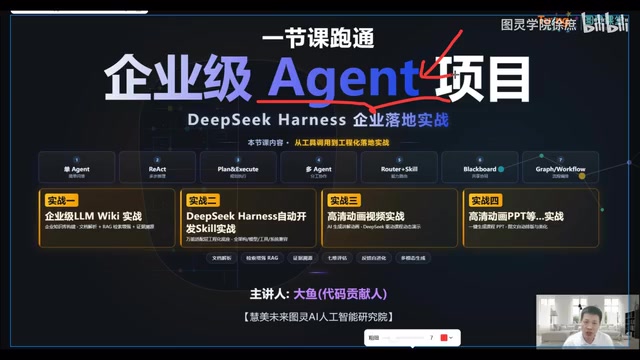
A guide to the engineering path and practical scenarios for deploying AI Agents with DeepSeek Harness.
Based on Teacher Dayu's beginner tutorial on Bilibili, this article maps out the engineering path for AI Agents. It clarifies that native large models are not Agents, citing four shortcomings (no memory, knowledge cutoff, no internet, no local tools), and outlines four core roles: Translator, Tool Master, Memory Butler, and Task Butler. It then covers DeepSeek Harness in practice—automating LMVK and knowledge bases, generating Skills and UI projects, and building enterprise customer service and e-commerce Agents—and discusses the three-stage evolution from tool invocation to engineering foundation, with learning advice for beginners.
AI Agent is one of the hottest technical concepts right now, but many developers are still stuck at the stage of simply chatting with AI. In a beginner-friendly tutorial, Bilibili creator Teacher Dayu systematically explained how to bring AI Agents into enterprise-level projects through DeepSeek Harness, covering the entire journey from understanding core concepts to hands-on practice across multiple scenarios. This article is based on that tutorial, cross-verified with multiple sources, and distills the key path toward engineering AI Agents.
1. What Exactly Is an AI Agent?
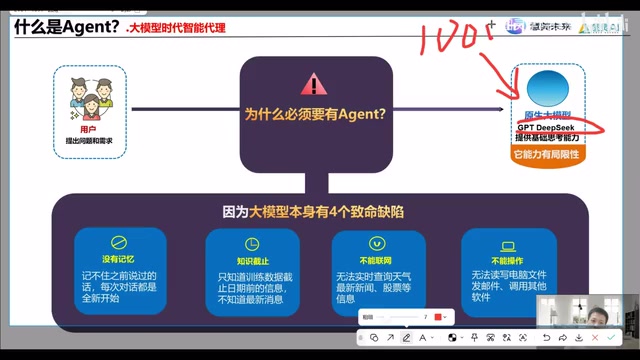
The Four Major Shortcomings of Native Large Models
In the livestream, Teacher Dayu first cleared up a common misconception: a native large model is not the same thing as an Agent. He listed four core flaws of native large models:
- No memory: Every conversation starts from scratch; the model cannot remember context or user preferences.
- Knowledge cutoff: The model's knowledge stops at its training data cutoff date, so it cannot answer time-sensitive questions.
- No internet access: It cannot retrieve real-time weather, stock prices, or other dynamic information.
- No access to local tools: It cannot directly operate files or software on your computer.
These shortcomings mean that simply calling a native large model cannot meet the demands of complex tasks. According to analyses by Bilibili creator Teacher Dayu and several tech bloggers on YouTube, Agents emerged precisely to bridge this gap.
The Four Core Roles of an Agent
Teacher Dayu summarized an Agent's capabilities into four "butler" roles—a framework echoed in multiple independent tutorials, suggesting it has become an industry consensus:
- Translator: Converts the user's natural-language request into instructions the large model can understand, then converts the output back into something usable for the user.
- Tool Master: Calls external tools via APIs, giving the large model the ability to access the internet, look up data, and operate software.
- Memory Butler: Maintains context and user preferences across multiple turns of conversation, ensuring continuity.
- Task Butler: Breaks complex problems into subtasks, plans the execution flow, and proactively adjusts the approach when problems arise.
He further pointed out that everyday tools like Doubao and DeepSeekAd are essentially Agents—when a user asks a question, it first goes to the Agent layer, which then calls the large model and processes the result. Similarly, AI coding tools like Cursor and Claude Code can remember project structure and debug code precisely because they rely on an Agent's "Tool Master" and "Memory Butler" capabilities.
System Prompt is one of the key vehicles through which an Agent realizes these four roles. It is instructional text injected into the large model before a conversation begins, used to set the model's identity, behavioral boundaries, output format, and tool-usage rules. In an Agent architecture, the system prompt typically also includes metadata such as the list of available tools, task-decomposition strategy, and memory-access methods—essentially the "butler's" operating manual. The accompanying image relates to system prompts; understanding their design helps grasp how an Agent constrains a native large model into a controllable task executor.
2. Practical Scenarios for DeepSeek Harness
The tutorial showcased several hands-on projects built on DeepSeek Harness, progressing from simple to enterprise-grade. Below we analyze a few representative scenarios.
Automated Development of LMVK and Knowledge Bases
The first hands-on project demonstrated how to use DeepSeek Harness to automate the development of LMVK, and compared it with traditional RAG solutions. The project involved a workbench, an enterprise management knowledge base, an image knowledge graph, and various evaluation modules. According to Teacher Dayu, Harness handles task orchestration and tool invocation in such tasks, automating the RAG pipeline that previously had to be wired together manually.
RAG (Retrieval-Augmented Generation) is a technical paradigm that combines external knowledge retrieval with large-model generation: the system first retrieves relevant document fragments from a knowledge base based on the user's question, then injects these fragments as context into the prompt, and the large model generates an answer based on the retrieved results. Compared with relying solely on a model's parametric knowledge, RAG can mitigate knowledge-cutoff and hallucination issues and supports private data integration. A traditional RAG pipeline usually requires manually chaining multiple steps—document parsing, vectorization, index construction, retrieval re-ranking, and generation—whereas an Agent can automatically orchestrate these steps and make dynamic decisions, such as choosing different retrieval strategies based on question type or triggering multi-round retrieval.
LMVK in the context of this tutorial refers to a class of projects/components requiring automated development and integration; the specific tech stack was not elaborated in the original text. Given the context, it involves a workbench, an enterprise management knowledge base, an image knowledge graph, and evaluation modules—a typical multi-module, knowledge-intensive system. Harness therefore primarily handles cross-module task orchestration and tool invocation here.
Automated Generation of Skills and UI Projects
Given the current demand among many developers to write Skills, the tutorial showed how to use DeepSeek Harness to automate Skill development, significantly improving efficiency. He also demonstrated using natural-language conversation combined with external custom Skills and plugins to automatically generate UI projects that traditionally required tools like Cybernetics and ConvUI—users simply chat with DeepSeek and get a complete project as output.

Skill in the Agent context typically refers to a reusable capability unit that encapsulates domain-specific knowledge, operational procedures, or tool-invocation logic, which an Agent can load and combine on demand. Unlike low-level API tools, a Skill is more like a "skill pack for completing a certain type of task"—for example, generating documents in a specific format or performing a certain kind of code review. Automating Skill generation means using Harness to let an Agent produce standardized Skill definitions and implementations from natural-language descriptions, thereby reducing manual authoring costs.
Cybernetics and ConvUI are UI-development-related tools mentioned in the original text (their specific functions were not detailed); traditionally, developers had to use these tools manually to build interfaces. The approach demonstrated in the tutorial is natural-language conversation combined with external custom Skills and plugins, with the Agent automatically generating a complete UI project—reflecting the Agent's evolution from "assisted coding" to "end-to-end output."
Enterprise-Grade Intelligent Customer Service and E-Commerce Agents
The latter part of the tutorial covered enterprise-level projects reflecting real-world logic at major companies, including an intelligent customer service system (integrating multimodal RAG retrieval and high-concurrency optimization) and an e-commerce Agent (involving multimodality, model fine-tuning, and more). These projects illustrate the evolution of Agent engineering from single-point tool invocation to complex system integration. Teacher Dayu emphasized that such projects place the highest demands on "Task Butler" capabilities, requiring Agents to be robust in problem decomposition, process planning, and fault tolerance.
3. The Three Stages of Agent Technology Evolution
At the end of the course, Teacher Dayu mentioned that Agents have undergone three technological leaps: from tool invocation, to programming orchestration, to an engineering foundation. This division aligns with the industry's general understanding of Agent maturity—early Agents could only call a single API, then evolved into orchestrating multi-step workflows, and ultimately formed engineering platforms with memory, planning, and a tool ecosystem. DeepSeek Harness is in the practice of this third stage.
It should be noted that different sources currently describe the specific timing and definitions of the "three leaps" differently. Some developer communities believe that programming orchestration and the engineering foundation overlap and are not strictly linear. This divergence reflects that the Agent field is still evolving rapidly.
4. Learning Path and Industry Observations
Drawing on nearly 40 years of professional experience (including 8 years as a project manager at a listed company in Beijing), Teacher Dayu pointed out that the current large-model application track is "competitive on technology and projects" rather than "competitive on academic credentials," and that traditional enterprises are actively using large models for upgrades and transformation. He recommends that beginners focus on understanding the logic and mindset behind Agents, then adapt them to their own scenarios using project source code.
From multiple sources, this judgment appears to be widely shared: data from several tech communities and recruitment platforms shows that demand for AI Agent-related roles is growing rapidly, with greater emphasis on engineering implementation ability than on academic background. However, some viewpoints caution that enterprise-grade Agent projects demand strong system design and optimization skills, and beginners should avoid stopping at the tool-invocation level.
Overall, DeepSeek Harness represents a viable path toward engineering AI Agents—by encapsulating tool invocation, memory management, and task orchestration, it lowers the barrier for developers building complex Agent applications. For developers hoping to move from "chat-style AI" to "task-oriented AI," hands-on tutorials like this provide an actionable starting point.
Related articles
 Tech Frontiers
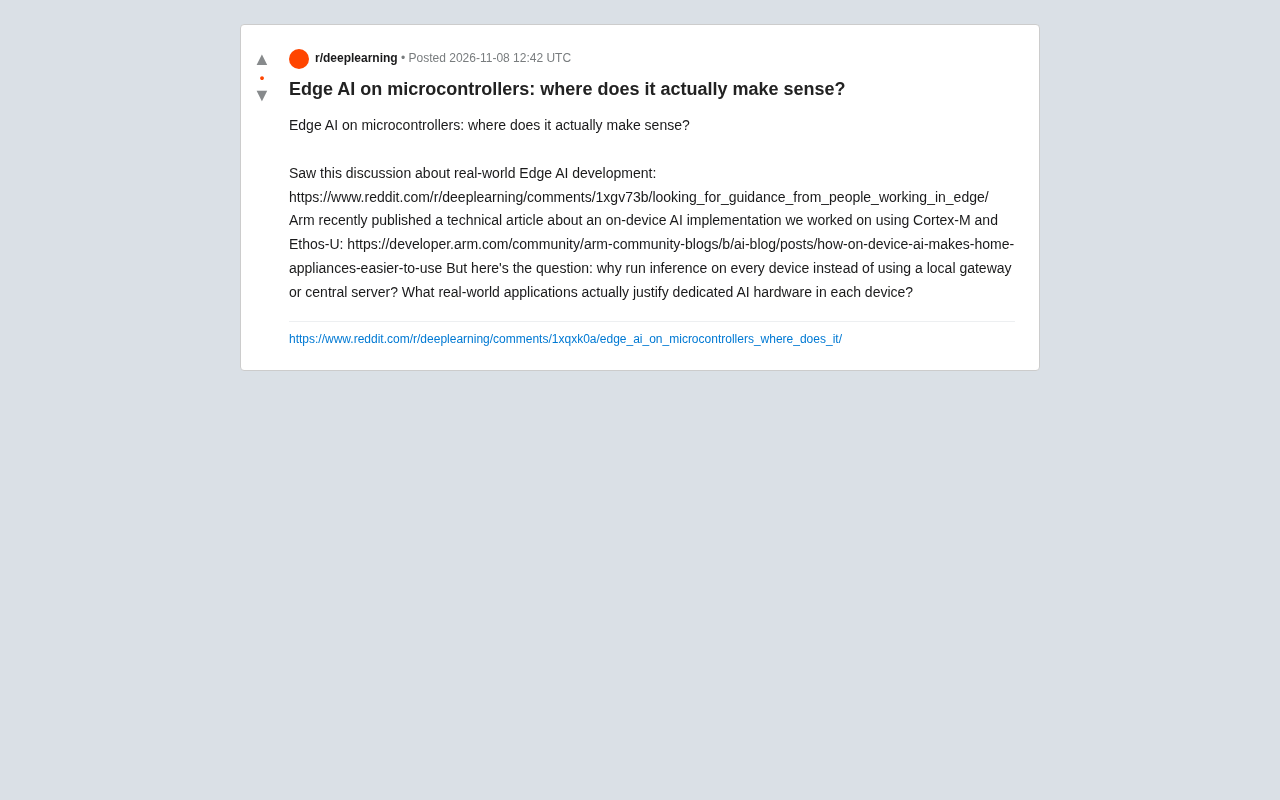
Edge AI on Microcontrollers: When Is It Actually Worth Deploying?
Drawing on Reddit discussions and Arm case studies, this article analyzes the real-world use cases for edge AI on microcontrollers: when each device needs independent inference, when a gateway or cloud is more reasonable, and the costs and boundaries of specialized hardware.
 Tech Frontiers
Pushing the Limits of Extreme Sudoku on a 16GB GPU: Insights from Depth and Flow Matching
A researcher trained a 16.54M-parameter model on a 16GB GPU to solve extreme Sudoku, finding effective depth breaks the 60% plateau and flow matching with improved sampling pushes accuracy past 99% with ~50× lower layer-evaluation budget.
 Tech Frontiers
AI Agent Approval Workflows: Why Human Confirmations Always Get Mindlessly Clicked
Why do AI agent approval workflows always get mindlessly clicked? A Reddit discussion shows that separating rules from keys, low-frequency high-risk approvals, and GitHub Environments-style gates are the keys to effective approvals.