DeepSeek Harness in Practice: From Tool Calling to Production-Ready Agent Engineering

A practical breakdown of Agent concepts and DeepSeek Harness engineering from a beginner-focused livestream.
This article distills key technical insights from a beginner-oriented DeepSeek Harness livestream, cutting through the marketing noise. It covers the four core Agent roles (Translator, Tool Expert, Memory Manager, Task Manager), the three technological leaps from tool calling to engineering foundations, and the RAG and Function Calling mechanisms that underpin it all. The article concludes with a grounded take: this kind of content is useful for building a mental model, but real engineering capability requires hands-on practice — "job-ready after one course" claims should be viewed with skepticism.
Starting with a Livestream: Why Agent Has Become the Core of LLM Deployment
This article is based on a Bilibili livestream aimed at beginners covering DeepSeekAd Harness in practice. While the session was heavily oriented toward recruitment and lead generation, stripping away the marketing rhetoric reveals a genuinely clear introductory framework for understanding Agent (intelligent agent) concepts and production engineering approaches. This article objectively summarizes the key technical points while adding necessary context to help readers assess the real value of this type of tutorial.
The presenter described a background transition from traditional Java, Android, and PHP development, with years of experience as a project manager and hands-on developer, currently working on multimodal RAG and Agent projects in e-commerce scenarios. He repeatedly emphasized a key observation: the current LLM application space is in a phase of "more jobs than talent" — similar to the Java and Android booms a decade or so ago — an era where competing on technical skills and project experience matters more than credentials. This view has some basis in reality — engineers who can productionize LLM systems are genuinely scarce — but the claim that "you can freelance and get hired after finishing this course" deserves skepticism. A 90-minute livestream builds a mental model; it's a long way from actually delivering enterprise-grade projects.
What Is an Agent: The "Proxy" of the LLM Era
Before understanding Agents, it helps to look at the limitations of raw LLMs. Whether it's GPT or DeepSeek, ordinary users have essentially two ways to interact with these models: write code, or call the API. But even after successfully connecting, the native models themselves have several critical shortcomings.
The presenter laid these out plainly: first, no memory — every conversation starts from scratch, the model can't remember context; second, knowledge has a cutoff date — for anything outside its training data, the model will "confidently make things up"; third, no internet access — ask it tomorrow's weather or real-time stock prices, and it can't answer; fourth, no access to local tools — it can't read files on your computer or call external programs.

An Agent is the middleware layer built to solve exactly these problems. The presenter used a vivid analogy: an Agent is like a translator helping a Chinese speaker communicate with an American — standing between the user and the LLM, acting as a bridge. When a user asks a question, the Agent interprets the need, calls various tools, aggregates the results, and returns them to the user. In other words, an Agent is the proxy layer of the LLM era.
The Four Core Problems Agents Solve
The presenter distilled the value of Agents into four roles — a framework that's genuinely helpful for beginners trying to understand Agent architecture:
The Translator
The Agent translates a user's natural language request into instructions the LLM can understand, then converts the model's output back into a usable form. This is the most fundamental interaction-layer capability.
The Tool Expert
The Agent enables the LLM to call various tools and APIs — giving it the ability to browse the web, query databases, and more. The core value here is transforming the LLM from something that "can talk" into something that "can act." This is the most closely watched capability in current Agent technology, and it's the essence of Function Calling and tool invocation.
Background — Function Calling: Function Calling is the underlying mechanism behind the "Tool Expert" capability. Developers pre-define a set of callable tool functions (e.g., check weather, query a database, execute code) and pass descriptions of these functions to the LLM. During inference, the model determines when and which tool to call, generates a structured call request, and the Agent layer executes it, returning the result to the model to synthesize a complete answer. This mechanism was formally introduced by OpenAI with GPT-3.5/4 and is now supported by mainstream models including DeepSeek and Claude. Function Calling marks the shift of LLMs from "language generators" to "executable reasoning engines" — and is the engineering foundation for Agents to have real operational capabilities.
The Memory Manager
The Agent is responsible for retaining context, user preferences, and conversation history, allowing the model to maintain coherence across multi-turn conversations without "forgetting." This directly addresses the native model's lack of memory.
The Task Manager
Faced with complex problems, the Agent can break them down into sub-steps, plan an execution workflow, and proactively try multiple approaches when something goes wrong. This corresponds to the Agent's task planning and autonomous decision-making capabilities.

The presenter pointed out that popular products people use every day — like Doubao and the DeepSeek chat interface — are fundamentally Agents. A user's question doesn't go directly to the underlying LLM; it first passes through the product's Agent layer, which calls the model, iteratively processes the results, and returns the most accurate answer. Coding tools like Cursor and various coding assistants work the same way — their ability to remember project structure, devise solutions, and iterate through debugging depends precisely on the "Tool Expert" and "Task Manager" capabilities.
Background — Task Planning (Planning): At the technical level, task planning is typically implemented through paradigms like ReAct (Reasoning + Acting) or Plan-and-Execute. In ReAct, for example, the model alternates between outputting "Thought → Action → Observation" cycles, progressively completing complex tasks through iterative reasoning rather than generating a complete answer in one shot. This mechanism gives Agents the ability to self-correct and dynamically adjust — if a tool call fails or the result doesn't meet expectations, the Agent can revise its strategy in the next reasoning step. Multi-agent collaboration frameworks (such as AutoGen and CrewAI) go further by assigning planning responsibilities to a dedicated "Planner" Agent that coordinates multiple execution agents to handle sub-tasks in parallel — a leading architecture direction for enterprise-scale deployments today.
The Three Technological Leaps in Agent Development
The session outlined a notable trajectory: Agent technology has gone through three leaps — from tool calling, to orchestration, to the engineering foundation. This broadly aligns with mainstream industry understanding of Agent development stages:
- Tool Calling Stage: Teaching models to call APIs and external tools — the earliest breakthrough;
- Orchestration Stage: When individual tools aren't enough, multiple steps and tools need to be choreographed into workflows;
- Engineering Foundation Stage: What's referred to as Harness (the engineering framework) — transforming Agents from toys into stable, maintainable, and extensible enterprise-grade systems.
The core value of DeepSeek Harness lies in this third stage — it's concerned not with single calls, but with how to bring Agent capabilities into production.

Background — RAG: RAG (Retrieval-Augmented Generation) is the mainstream solution for addressing the model's "knowledge cutoff" problem and an important component in Agent engineering practice. The core idea: rather than cramming all knowledge into model weights, when a user asks a question, relevant document fragments are first retrieved from an external vector database, then appended as context in the prompt, allowing the model to generate answers based on freshly retrieved content. Enterprise knowledge bases and intelligent customer service systems nearly all rely on RAG to ensure answer timeliness and accuracy. Harness frameworks standardize and encapsulate the RAG pipeline, making it a standard module in the Agent engineering foundation — developers can reuse retrieval pipelines without building them from scratch.
The Eight Hands-On Projects in the Livestream Series
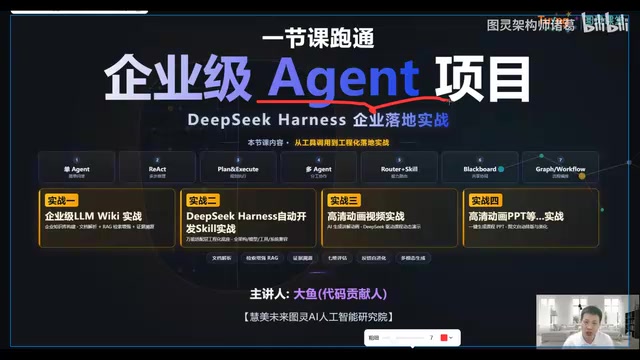
The presenter previewed eight projects ranging from simple to enterprise-grade, covering a broad range — useful as a learning path reference:
- Automated development of document-based applications using DeepSeek Harness, comparing them with traditional RAG approaches — covering project workspaces, enterprise knowledge bases, knowledge graphs, and evaluation;
- Automated Skill development with Harness to boost development efficiency;
- Integrating LLMs with UI animation tools (e.g., ComfyUI) to generate content through conversation and plugins;
- Using Harness to automate PPT creation and project workflows;
- Enterprise-grade intelligent customer service, covering multimodal inputs, RAG retrieval, high-concurrency optimization, and more;
- E-commerce Agents built with big-tech engineering principles, involving multimodal capabilities and model fine-tuning.
These project descriptions are wide-ranging, but a word of caution: a 90-minute livestream can't cover any single enterprise-grade project in depth. For beginners, the more valuable takeaway is the "thinking and logic" — not the expectation of independently delivering projects after watching. Reaching the level of freelancing or landing a job still requires systematic engineering practice and learning through real-world mistakes.
A Grounded Assessment of This Type of Tutorial
To give a fair evaluation: this session does a solid job at conceptual introduction — the four Agent roles and the three-leap framework provide genuine value for beginners building a mental model. However, the content is heavily diluted by marketing tactics — repeated "comment 1 or 6," "stick around to the end for freebies," "more jobs than talent," and "land a job after finishing" — which take up considerable time and reduce the actual density of technical content.
For readers looking to get started with Agent development, treat this type of content as a "cognitive map," not an "implementation manual." Once you've grasped the essence of Agents — the proxy layer, tool calling, memory management, task planning — a more effective path forward is reading official documentation, building a minimal runnable Agent project hands-on, and iterating in real scenarios. Engineering capability has never been something you can shortcut with a single course; it's built up through repeated debugging and production experience.
Related articles

JobRunner MCP Server: AI Agents Can Now Fix Failed Java Jobs
JobRunner launches an open-source MCP server enabling AI agents to view cluster status, diagnose failures, and recover Java jobs—incident response from any cloud coding environment or existing agent.

MLAI Digital Launches 9 Security Agents: MCP Server Safeguards the Full Lifecycle of Agentic AI
MLAI Digital launches Security MCP Server with nine built-in specialized security agents covering vulnerability discovery, attack simulation, prompt injection detection, API and infrastructure assessment, and accelerated remediation—embedding security validation across the full Agentic AI lifecycle from development to production.

Running Isaac Lab on H100 GPUs: Exploring Better Approaches
Exploring optimization methods for running Isaac Lab on NVIDIA H100 GPUs, including MIG configuration, mixed precision, TensorRT acceleration, and community experience to improve robotics simulation and reinforcement learning efficiency.