DeepSeek Harness Open Source: A Practical Intro to the "Everything is a Plugin" Agent Framework

DeepSeek launches DSH, a plugin-based open-source Agent framework you can start with a single command.
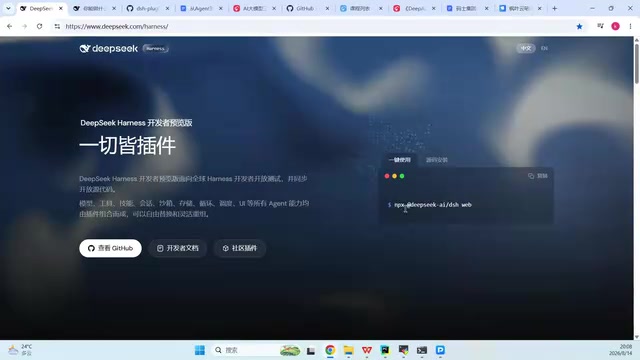
DeepSeek Harness (DSH) is an open-source Agent framework built around the philosophy that "everything is a plugin" — decoupling LLM calls, tool integrations, and Skill orchestration into freely composable modules. With Node.js installed, a single npx command launches the web interface, and the source code is available on GitHub for deeper exploration. The plugin architecture delivers composability, extensibility, and maintainability, solving the tight-coupling problems common in traditional Agent development. Currently in beta, DSH is best suited for early adopters and contributors rather than production use.
What is DeepSeek Harness
DeepSeekAd Harness (DSH for short) is an open-source Agent framework released by the DeepSeek team. Its core design philosophy can be summed up in a single phrase: "everything is a plugin." It abstracts LLM calls, tool integrations, and Skill orchestration into interchangeable, pluggable modules. Developers don't need to build complex scheduling logic from scratch — they simply combine plugins as needed to rapidly build their own AI Agent applications.
According to hands-on demos by content creators on Bilibili, the framework is currently in a beta release stage and still iterating quickly, but it's already usable. For developers who want to study the underlying implementation of Agents or quickly build DeepAgent-style applications, it offers a compelling open-source starting point worth following.
An Agent Framework is the engineering infrastructure specifically designed for building "intelligent agent" applications. An intelligent agent is an AI system capable of perceiving its environment, autonomously planning, and executing multi-step tasks — it doesn't just answer a single question, but can call external tools like search, code execution, or file operations to independently accomplish a complete goal. The market already has several Agent frameworks including LangChain, AutoGen, and CrewAI, each with different emphases on tool-calling, multi-agent collaboration, and memory management. DSH differentiates itself through its native plugin-based design and deep integration with DeepSeek models, making the migration and onboarding cost relatively low for developers already using the DeepSeek API.
Installation: Get Started with a Single Command
The barrier to installing DSH is extremely low — the only prerequisite is having Node.js installed locally. Installation requires just a single npx command:
npx @deepseek-ai/dsh web
This command launches DSH's web interface, letting you experience the framework's capabilities directly in your browser without manually configuring a bunch of dependencies. This "out-of-the-box" design is clearly intended to lower the barrier for newcomers.
For developers who want to dive into the source code and understand the framework's internal mechanics, there's another path: clone the repository directly from GitHub.
git clone <DeepSeek-Harness repository URL>
By reading the source code, you can get a much clearer picture of how "plugin-based architecture" is actually implemented at the engineering level, and it makes it easier to build on top of the framework for customized development.

npx is a package execution tool bundled with Node.js (installed alongside npm 5.2+). Its key feature is that you don't need to globally install a package beforehand — it temporarily fetches the latest version at runtime and executes it. This is extremely convenient for trying out and distributing frameworks. Users don't need to manually manage versions; every time you run npx @deepseek-ai/dsh web, you get the latest published release. This is especially practical during rapid iteration phases. If your Node.js version is older (below v16), it's recommended to first upgrade to an LTS version via nvm (Node Version Manager) to avoid potential compatibility issues.
Why "Everything is a Plugin" Matters
"Everything is a plugin" isn't a marketing slogan — it's an architectural stance. Traditional Agent development often tightly couples model calls, tool wrappers, and task orchestration together, meaning that swapping out one component can trigger a cascade of changes. The plugin-based approach decouples each capability unit, allowing them to operate independently and be assembled on demand.
The direct benefits include:
- Composability: Different plugins snap together like building blocks, enabling rapid construction of customized Agents.
- Extensibility: Adding a new tool or skill only requires writing a new plugin, with no impact on existing logic.
- Maintainability: Clear module boundaries reduce the cost of debugging and iteration.
Keywords like DeepAgent and Skill also suggest that DSH aims to unify both "agents" and "skills" under the same plugin specification, forming a continuously extensible ecosystem.

Plugin-based architecture has a long history in software engineering — VS Code's extension mechanism and Webpack's loader/plugin system are classic examples. In the AI Agent space, this approach is especially important: a mature Agent application often needs to simultaneously manage LLM calls, RAG retrieval, code interpreters, and external APIs. If these capabilities are hard-coded together, swapping a model or adding a new tool can trigger a chain of changes. Plugin-based design solves this by defining a unified interface contract — each capability module only needs to conform to an "input/output protocol" to be integrated, while the framework handles scheduling and lifecycle management. This thinking aligns with the "Single Responsibility Principle" in microservices architecture. The core benefit is a clean separation between "business logic" and "capability implementation," keeping the system manageable even as complexity grows.
Currently in Beta: Opportunities and Considerations
The framework is explicitly described as "beta-released," with many features still being refined. This means two things:
On one hand, this is a relatively early-stage project. APIs and design decisions may change with version updates, so using it in production environments requires careful evaluation of stability. On the other hand, the early stage is precisely the best window for participating in an open-source project and influencing its direction. For developers, getting started now means getting ahead of the learning curve while also having the opportunity to contribute feedback and code to help shape the ecosystem.

Five Key Takeaways
Drawing from the available content, here's a quick summary of the core points about DeepSeek Harness:
- Purpose: An open-source Agent framework from DeepSeek, built around a plugin-based architecture.
- Philosophy: Everything is a plugin — models, tools, and skills can all be freely assembled.
- Installation: Requires Node.js; launch the web interface with a single
npx @deepseek-ai/dsh webcommand. - Source Code: Can be cloned directly from GitHub for study and customized development.
- Stage: Currently in beta; features are continuously evolving — ideal for early adopters and contributors.
Final Thoughts
DeepSeek Harness breaks down complex Agent development into a set of pluggable modules, letting developers experience the full workflow with minimal setup friction. While it's still in beta, its clear architectural philosophy and open-source nature make it a solid entry point for anyone looking to get into Agent development or explore how DeepAgent works under the hood. If you're curious, there's no better way to start than running a single command and then diving into the source to explore the plugin mechanics yourself.
Related articles

Chain of Thought Isn't Just for AI: How Humans Can Use CoT to Improve Thinking Quality
Chain of Thought isn't just a prompt trick for large models. Starting from a Hacker News discussion, this article analyzes why CoT works for human thinking too, breaks down actionable ways to transfer it, and highlights the key differences between human CoT and machine CoT.
Cloudflare Teams Up with OpenAI: Closi…
Cloudflare Teams Up with OpenAI: Closing the Loop from Vulnerability Discovery to Defense with AI
Cloudflare uses OpenAI Daybreak to investigate security vulnerabilities and generate reviewable remediation plans, while developers use Codex to boost coding efficiency and quality.

Orca Multi-Agent Orchestration in Practice: A Guide to Parallel Collaboration with Claude and Codex
Orca is Stable AI's free open-source agent workbench supporting 34 agents like Claude Code and Codex in parallel. Learn its Git worktree isolation, multi-model orchestration, and mobile management.