DeepSeek Harness Open-Source Agent Framework: Breaking Down the 90K-Star Viral Sensation in 48 Hours

DeepSeek Harness explodes to 95K GitHub stars in 48 hours with its open-source, plugin-based AI Agent framework.
DeepSeek Harness, an open-source AI Agent framework, became the fastest-growing project in GitHub history with 95K stars in 48 hours. Its MIT license, LEGO-like plugin architecture, and one-command setup drove explosive adoption. With 700+ community plugins emerging instantly, it represents a paradigm clash with commercial products like Claude Code—positioning open-source ecosystems as the gateway to the Agent era.
The Fastest-Growing Open-Source Project in GitHub History: 95K Stars in 48 Hours
48 hours. 95,000 stars. This may well be the fastest-growing open-source project in GitHub history, bar none. And behind it stands the Chinese AI company DeepSeekAd.
This open-source Agent framework called DeepSeek Harness ignited the entire AI developer community virtually overnight. To understand why it went so viral, you first need to grasp the core formula DeepSeek put forward:
Model + Harness = Agent
In plain English: the model is the brain, and the Harness is the hands and feet. Previously, DeepSeek could only offer suggestions, like a consultant. Now with Harness, it can write code, call tools, run tests, and keep going until the job is done before handing it back to you.
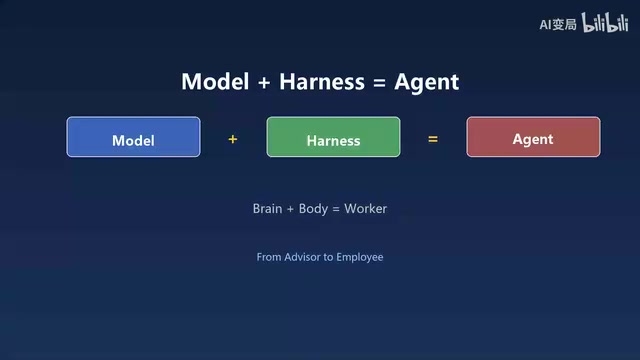
This is a role upgrade from "consultant" to "employee" — you state the goal, and it figures out how to get it done. This is also the critical watershed moment where AI transitions from "chatting" to "doing work."
From a technical evolution perspective, AI's journey from 'chatting' to 'doing work' has gone through several key stages: The first stage was pure text dialogue (ChatGPT in 2022), where models could only generate text responses. The second stage was Function Calling (2023), where models could make structured requests for external tools to perform specific operations. The third stage involved multi-step reasoning and execution (such as the ReAct paradigm), where models could autonomously complete multi-step tasks in a 'think-act-observe' loop. The fourth stage is the current complete Agent system, equipped with persistent memory, autonomous planning, error recovery, and multi-tool coordination capabilities. DeepSeek Harness represents exactly the infrastructure for this fourth stage — it doesn't just enable models to call tools, but provides a complete execution environment, state management, and human-machine interaction interface.
Three Core Reasons Behind DeepSeek Harness's Explosive Popularity
MIT License, Fully Open Source, Zero Cost
DeepSeek Harness uses the MIT license with fully open source code and completely free access. This stands in stark contrast to the commercial subscription model of Claude Code and similar products. For developers, the allure of zero cost and zero licensing barriers is enormous.
The MIT License (Massachusetts Institute of Technology License) is one of the most permissive open-source licenses currently available. It allows anyone to freely use, copy, modify, merge, publish, distribute, sublicense, and sell copies of the software — the only requirement being that the original copyright notice and license notice are included in all copies. By comparison, the GPL license requires derivative works to also be open-sourced, while the Apache license includes additional patent grant clauses. The minimalist nature of the MIT license allows commercial companies to integrate it into their proprietary products without hesitation, which is why widely-used projects like React, jQuery, and Node.js all chose the MIT license. For DeepSeek Harness, choosing MIT means any company — whether a startup or a tech giant — can build commercial products on top of it without paying any fees or open-sourcing their own code.
Everything-as-a-Plugin LEGO-Style Architecture
In Harness's design, models, tools, sessions, sandboxes, and interfaces are all replaceable — making it the "LEGO of AI." This plugin-based architecture means developers can freely combine and customize Agent capabilities without being locked into any single fixed solution.
From a technical architecture perspective, an AI Agent framework is the middleware layer connecting large language models to the external world. In Agent architecture, core components typically include: a planning module (breaking complex tasks into sub-steps), a memory module (short-term working memory and long-term knowledge storage), a tool-calling module (API calls, code execution, file operations, etc.), and a feedback loop (self-correction based on execution results). Previously mainstream Agent frameworks included LangChain, AutoGPT, CrewAI, etc., but they commonly suffered from complex configuration, poor extensibility, or being too tightly coupled to specific models. DeepSeek Harness's 'everything-as-a-plugin' design philosophy essentially abstracts each of these components into hot-swappable interfaces, allowing developers to freely replace the underlying model, sandbox execution environment, or even the frontend interface. This decoupled design is known in software engineering as 'Separation of Concerns.'
One-Command Setup, Ready Out of the Box
As long as you have Node.js installed, a single command gets it running in your browser. Compared to other Agent frameworks that often require complex configuration, this out-of-the-box experience dramatically lowers the barrier to trying it out.
Hands-On Experience: Can DeepSeek Harness Actually Get Work Done?
After installation, Harness was tested with several tasks. For example, asking it to refactor a webpage — it wrote code, made modifications, and previewed the results, all without any manual keyboard input.
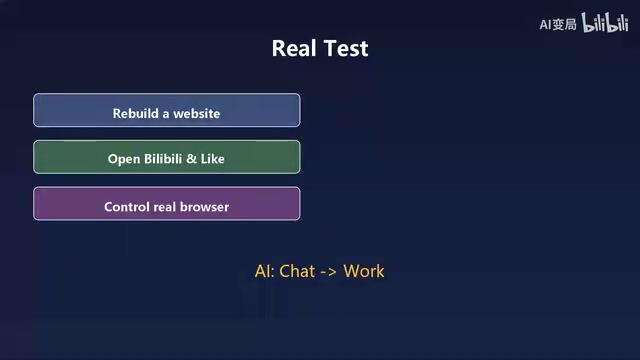
In a more extreme case, someone installed a browser plugin and had it automatically open Bilibili (China's YouTube equivalent), like videos, and send virtual coins — completing the entire web operation workflow autonomously. These demonstrations vividly show that the boundaries of Agent capabilities are being rapidly expanded — AI is no longer just answering questions but truly "operating on your behalf."
Of course, this kind of automation also raises concerns worth noting: when an Agent can autonomously control a browser to perform arbitrary operations, permission management and security boundaries become unavoidable topics.
An Explosion of Creativity from the Chinese Developer Community
Surprisingly, just two days after Harness went open source, the first and third spots on GitHub's plugin leaderboard were both created by Bilibili content creators.
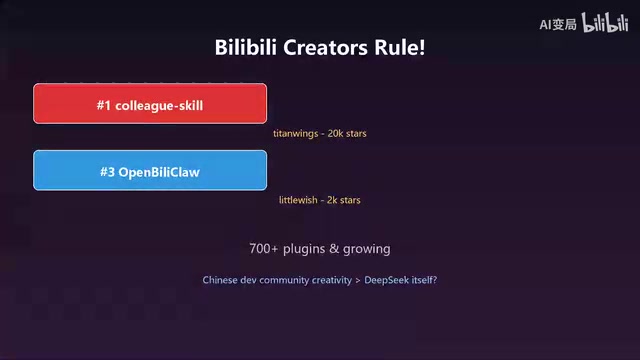
- First place: TitanWings' Kalix Skill, which distills colleagues' knowledge into AI skills, already earning 20,000 stars
- Third place: LittleWish's OpenBillyClub, a cross-platform AI content discovery Agent
Over 700 plugin repositories have already emerged. People have used it to create digital pets, 18 mini-games, and even replicated retro ad interfaces in 2005 style. This reveals a fascinating phenomenon: The creative power of the Chinese developer community might be even more formidable than DeepSeek itself. Once good infrastructure is opened up, it can spark ecosystem vitality far beyond expectations.
The strategic value of a plugin ecosystem can be found in historical parallels. When Apple's App Store launched in 2008, it initially had only 500 apps, but the open developer ecosystem spawned over 300,000 apps within two years. These apps in turn became the iPhone's core competitive advantage — users weren't buying hardware, they were buying into an ecosystem. Similarly, WordPress's plugin marketplace has over 60,000 plugins, helping it capture 43% of the global website market share. In the AI Agent era, the network effects of a plugin ecosystem are equally critical: more plugins attract more users, and more users incentivize developers to create more plugins. The emergence of over 700 plugin repositories within 48 hours for DeepSeek is an early signal of this flywheel effect.
Open-Source Ecosystem vs. Commercial Products: A Clash of Two Paradigms
Many people compare DeepSeek Harness with Claude Code. The differences between them represent two fundamentally different AI Agent approaches:
| Dimension | DeepSeek Harness | Claude Code |
|---|---|---|
| License | MIT open source, free | Commercial product, paid |
| Architecture | Everything as a plugin | Relatively closed |
| Monetization | Ecosystem-driven | $2.5B annualized revenue |
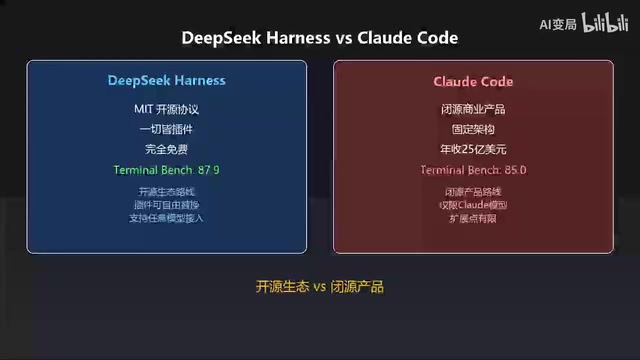
In terms of capability, according to cited data, on Terminal Bench benchmarks, DeepSeek V4 Pro scored 87.9 points while Claude Opus 4.8 scored 85 points. This means that on Agent tasks, Chinese-made models are no longer falling behind in real-world performance.
Terminal Bench is a benchmark specifically designed to evaluate AI Agents' execution capabilities in real terminal environments. Unlike traditional language model evaluations (such as MMLU for general knowledge or HumanEval for code generation), it examines whether a model can complete complex end-to-end tasks through a series of terminal commands, file operations, debugging, and fixes after being given an objective. This type of evaluation is closer to real work scenarios — the model must not only write correct code but also understand project structure, handle errors, and coordinate multiple tools. While the gap of 87.9 vs. 85 isn't numerically large, considering that Chinese-made models typically lagged behind Anthropic and OpenAI's top models in such hands-on evaluations, this result carries milestone significance.
It's important to emphasize that this isn't simply a matter of "who replaces whom," but rather a clash between two paradigms: open-source ecosystem on one side, and commercial closed-source products on the other. The disruptive potential of DeepSeek's open-source approach may be even greater than the model itself.
From "Selling Models" to "Selling Results": A Turning Point for the AI Industry
The significance of this release goes far beyond a single product. It signals that the AI industry is shifting from "selling models" to "selling results" — what users truly care about isn't how powerful a model is, but whether it can actually get the job done.
The strategic core of "open source + plugin architecture = capturing the ecosystem" is this: Whoever captures the plugin ecosystem captures the gateway to the Agent era. In the mobile internet era, app stores were the gateway; in the Agent era, plugin ecosystems will likely play the same role.
From this perspective, Chinese AI is no longer just "benchmarking" and following — it now has the potential to lead on the Agent infrastructure track. How much this "dark horse" can actually accomplish is worth continued attention.
Note: The data and perspectives in this article are primarily sourced from a Bilibili creator's first-look analysis of DeepSeek Harness. Some benchmark scores and revenue figures are cited from the video and provided for reference.
Related articles

DeepCell: One-Click AI Generation of Documents, Spreadsheets, and Slides
DeepCell tops Product Hunt with one-click generation of documents, spreadsheets, and slides, using the .deepcell format for linked updates, designed for System 2 tasks like modeling and sales reviews.

Doneas: 15-Minute Daily Accountability Calls That Keep Indie Developers From Procrastinating
Doneas is a daily accountability tool for indie developers: plan tasks on Monday, join a 15-minute call with five builders each day, and log deliveries on a public progress page. This article analyzes its core mechanics, effectiveness, and potential issues around retention and matching.

Fastlane 2.0: Fully Automated AI Ad Campaigns, From Creative to Optimization
Fastlane 2.0 is an AI ad automation tool: enter your website and it learns your brand, generates video and image ads, and runs and optimizes them on Meta, TikTok, Instagram, and YouTube.