DeepSeek Harness Open-Sourced: A Deep Dive into the "Everything is a Plugin" Agent Framework
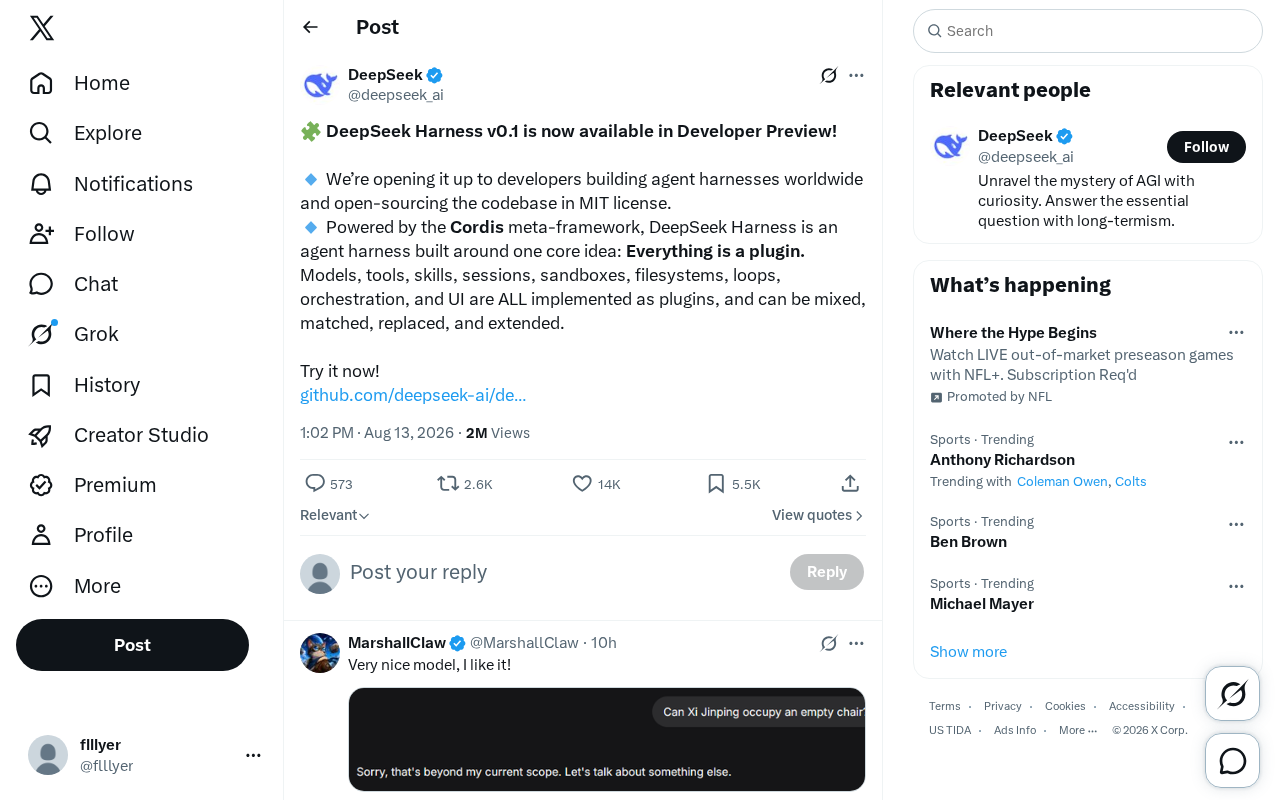
DeepSeek open-sources Harness v0.1 under MIT, a fully plugin-based Agent framework built on the Cordis meta-framework.
DeepSeek has released Harness v0.1 Developer Preview under the MIT license. Built on the Cordis meta-framework, it follows an "Everything is a Plugin" design philosophy — models, tools, sandboxes, sessions, and orchestration are all plugins that can be freely mixed, replaced, and extended. The MIT license enables unrestricted commercial use and modification, fostering a plugin ecosystem. Currently in early preview, it's best suited for experimentation rather than production deployment, marking AI vendors' competitive focus shifting toward Agent engineering infrastructure.
DeepSeek Harness v0.1 Developer Preview Released
DeepSeek has announced the launch of DeepSeek Harness v0.1 Developer Preview, releasing the entire codebase under the MIT license. This release targets developers worldwide who are building Agent Harnesses, and signals DeepSeek's move beyond model capabilities into the Agent infrastructure layer.
For developers who have long followed the AI Agent ecosystem, this is a noteworthy signal. Competition among large language models has gradually shifted from pure model performance to the engineering challenge of "how to make models efficiently call tools, collaborate on tasks, and execute complex workflows." DeepSeek Harness is aimed squarely at this problem.
Core Philosophy: Everything is a Plugin
DeepSeek Harness is built on the Cordis meta-framework, and its design revolves around one central idea — Everything is a Plugin.
According to the official documentation, the following components are all implemented as plugins within this framework:
- Models: The underlying large language models
- Tools: External capabilities the Agent can invoke
- Skills: Encapsulated high-level capability units
- Sessions: Conversation and state management
- Sandboxes: Secure code execution environments
- Filesystems: Data read/write and persistence
- Loops: The Agent's reasoning and execution loops
- Orchestration: Multi-task and multi-Agent coordination
- UI: User interaction interfaces
All of these plugins can be freely mixed, matched, replaced, and extended. This thoroughly plugin-based architecture means developers are no longer locked into a fixed tech stack — instead, they can assemble customized Agent systems like building blocks, according to their own requirements.
The Core Value of a Plugin Architecture
Abstracting all components into a unified plugin interface delivers an immediate benefit: decoupling and flexibility. Traditional Agent frameworks often tightly couple model calls, tool execution, and state management. When a developer needs to swap out one part of the system, they may face large-scale refactoring.
Under the "Everything is a Plugin" design, replacing the underlying model, swapping the sandbox environment, or integrating a new tool theoretically requires only replacing the corresponding plugin — without touching the overall architecture. For teams that need to iterate quickly and experiment with different technology combinations, this can significantly reduce engineering overhead.
Cordis Meta-Framework: A Framework for Building Frameworks
DeepSeek Harness relies on the Cordis meta-framework at its core. A "meta-framework" can be understood as a framework for building frameworks — it provides foundational mechanisms such as a plugin system, dependency injection, and lifecycle management, allowing the upper-layer Agent Harness to be organized flexibly in a plugin-based manner.
This layered design is not uncommon in software engineering, but applying it to the construction of Agent systems reflects DeepSeek's thinking about standardizing Agent infrastructure. Through a unified plugin contract, components from different sources and with different functions can work together within the same framework.
Cordis is a JavaScript/TypeScript meta-framework that originated from the open-source chatbot project Koishi. Its design goal is to provide a unified underlying skeleton for complex plugin-based applications. Its core mechanisms include: Dependency Injection — plugins can declare which services they depend on, and the framework automatically resolves and injects them at runtime; Lifecycle Management — the loading, activation, suspension, and unloading of plugins are all uniformly scheduled by the framework, preventing resource leaks and state inconsistencies; and the Service Locator pattern — plugins discover and call each other through unified service names, without directly depending on concrete implementation classes. This design has precedents in IDE plugin systems (such as VS Code's Extension Host) and game engine component systems. DeepSeek's choice of Cordis as the foundation means Harness inherits a plugin governance mechanism validated by real-world projects, rather than designing a new component protocol from scratch.
MIT Open-Source License and Developer Ecosystem Building
It's worth emphasizing that DeepSeek Harness is open-sourced under the permissive MIT license. This means developers are free to use, modify, and commercialize the codebase with virtually no additional licensing burden.
For teams building their own Agent Harnesses, a well-designed, thoroughly plugin-based open-source framework can save a significant amount of foundational work. Open-sourcing also encourages the community to contribute plugins around this framework — whether new tools, model adapters, or orchestration logic for specific scenarios — all of which can accumulate as plugins and form an ecosystem.
Current Stage: Developer Preview Caveats
It's important to note that what's been released is a v0.1 Developer Preview. This means the framework is still in an early stage, and its APIs, stability, and documentation may undergo significant changes in future versions. For developers who want to try it out, it's recommended to treat it as a tool for experimentation and exploration rather than deploying it directly in production.
The MIT license is one of the least restrictive types of open-source software licenses, with significant differences compared to licenses like Apache 2.0 or GPL. GPL requires derivative works to also be released as open source (the so-called "copyleft" effect), while MIT only requires retaining the original copyright notice — it permits closed-source commercial use, free modification, and redistribution, with almost no legal risk for businesses. This means enterprises can integrate DeepSeek Harness into internal products or commercial SaaS without worrying about open-source obligations. In contrast, some competing frameworks (such as early derivatives of certain LangChain projects) chose stricter licenses, creating additional barriers on the path to commercialization. The choice of MIT signals DeepSeek's strategic intent to maximize developer adoption and prioritize growing the ecosystem.
Conclusion: A New Starting Point in the Agent Infrastructure Race
The release of DeepSeek Harness is yet another example of AI vendors extending their reach beyond the model layer into Agent engineering infrastructure. The "Everything is a Plugin" philosophy may not be architecturally novel in concept, but systematically applying it to every component of an Agent Harness still carries considerable engineering value.
For Agent developers worldwide, having one more highly modular, MIT-licensed open-source option is a net positive. Whether this framework can deliver on its flexibility promises in real-world use, and whether it can attract enough community contribution to build out a plugin ecosystem, will be the key factors in its future development. Developers who are interested are encouraged to get hands-on during this developer preview phase.
Related articles

Invalid Source Material Notice
The source material provided lacks substantive information and is unrelated to AI/tech topics, making it impossible to produce a complete professional article.

Invalid Source Material: Unable to Generate a Valid AI/Tech Article
This Twitter source material is an irrelevant marketing tweet with no AI or tech content, making it impossible to generate a valid professional article.
Insufficient Source Material: Unable to Generate a Valid Article
The source material was limited to a single broken tweet with no usable content, making it impossible to produce a complete, high-quality article.