DeepSeek Hits 1.54M DAU, Open-Source Agent to Build Its Own Plugin Marketplace

DeepSeek discloses 1.54M DAU as open-source models and tooling shift toward automation.
The article rounds up recent AI and tech developments. The headline: DeepSeek disclosed agent operating data for the first time — 1.54M DAU, over 1M monthly growth, 35,000 third-party plugins, and plans for its own plugin marketplace, as the open-source project voluntarily faces retention scrutiny. On domestic models, Alibaba teases a next-gen Qwen, while Tencent's Hunyuan claims first among open weights with a 77.6% APEX Agents pass rate. Overseas tools converge on one direction: Inkling 2 uses MoE to limit activated parameters, Meta Muse adds themed "Spaces," Cursor adds a voice agent, Open Router rebuilds auto-routing, and AWS turns coding agents into a cloud service. On the product side, Doubao removes the 5-hour quota, ByteDance's coding tool merges accounts into Doubao Feishu, Mistral's speech model detects sentence completion, and OpenAI releases BioBasics Bench. The overall thread: tools automating manual configuration.
An open-source agent discloses its user numbers for the first time
DeepSeekAd has published operating data for its agent product: 1.54 million daily active users, up more than 1 million in a single month. This figure deserves separate mention because it puts the question of "how many users can an open-source agent retain" on the table for the first time.
Two details accompanied the data release: there are already 35,000 third-party plugins, and the company has confirmed plans to build its own plugin marketplace. The product was open-sourced only in August, and the repository has already reached 275,000 stars. In form, it looks more like an agent workbench that can install plugins than a simple chat box — the plugin ecosystem and the self-built marketplace clearly point toward a platform play.
When an open-source project discloses DAU, it is voluntarily submitting to scrutiny over retention. 1.54 million DAU paired with 275,000 stars is a substantial scale, but whether the plugin marketplace can actually keep developers around is the more critical variable.
MoE (Mixture of Experts) architecture: The phrase "594 billion parameters, only 17 billion activated each time" refers to a classic MoE design. A traditional dense model activates all parameters on every inference, whereas MoE splits the feed-forward layers into multiple "experts" and uses a router to dynamically select a small subset of experts based on the input. This allows total parameter count to grow large for capacity while keeping the compute cost per inference tied only to activated parameters. The trade-off is that VRAM usage is still calculated by total parameters, and uneven routing can waste capacity, so "fewer activated parameters" does not directly equal "cheaper" — the article's emphasis on per-task cost rising to 6x shows that token consumption and routing overhead beyond activated parameters matter just as much.
Domestic models: Alibaba drops a hint, Tencent lets the leaderboard do the talking
Alibaba's official account posted just one line: "Everything is about to begin," accompanied by an image of a flock of birds and the text "In the Northern Sea there is a fish, its name is—" with the rest left blank. The community immediately picked up on it — some said a Qwen fourth-generation post had leaked and was then deleted, others reported benchmark results for the 27B version, and multiple videos on the same topic with over 10,000 views have already appeared on the platform. But the company has yet to announce a model name or a timeline.
Tencent took a different path. Hunyuan scored a 77.6% pass rate on APEX Agents, which the company claims is first among open-weight models and third overall; on the same day it also mentioned scoring just 0.1 points behind GPT6.1 on another design benchmark, at 40% of the cost. Both figures were posted by the company itself. Hunyuan had previously been discussed a lot, but this time it is letting the leaderboard do the talking — the "open-source first" position had long been held by others.
The two companies' rhythms form a contrast: one keeps the community in suspense, the other drops the hammer with benchmark numbers. For developers watching open-source models, the reproducibility of leaderboard results is more worth tracking than topic hype.
Overseas tooling: routing, voice, spaces, and the cloud
Mira Murati's company released the second generation of its model Inkling, with 594 billion total parameters and only 17 billion activated per inference, an intelligence index score of 31 — 18 points higher than the previous generation. That score is roughly on par with Google 3.8 Flash, at the cost of higher token consumption — per-task cost is 6x that of the previous generation. The website lists it as open weights, and it can be fed into Tinker for training.
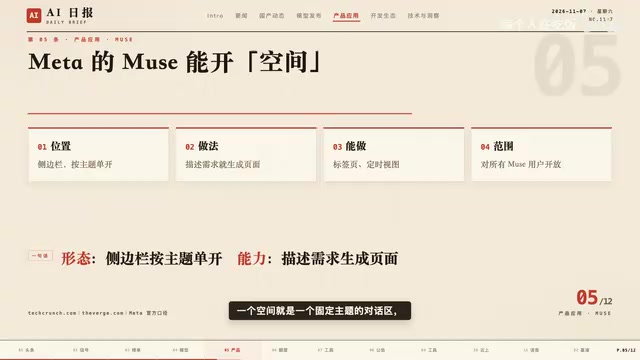
Meta added something called "Spaces" to Muse, located in the sidebar. A space is a conversation area dedicated to a fixed theme — say, a trip. You describe what you want, and it generates a clickable page with tabs and scheduled views you can interact with. The company calls it a "custom experience"; the media put it more bluntly: a dedicated sub-room around a theme. Meta says all Muse users can use it, and you can open one each for shopping, class schedules, and listening history.
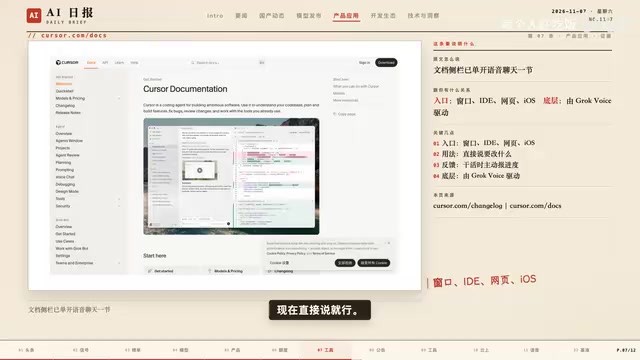
Cursor's update added a voice call agent: when idle, tap the waveform button to speak, and you can directly say what to change or ask what it is currently doing. It proactively speaks up to report progress while working, but only in short bursts. Entry points include the agent window, the editor, the web version, and iOS; on iOS it can also be invoked via Siri, with voice powered by Grog Voice. Previously you had to type descriptions; now you can just say it.
Open Router reworked its auto-routing and added Auto Code specifically for coding. Each request weighs 11 factors — real-time pricing, health, leaderboard scores, and cache status among them — then picks one model from your allowed pool, and even decides reasoning intensity along with it. The old version went by overall marketplace preference; the new version calculates based on the current moment. For small teams, this means not having to maintain a price table themselves.
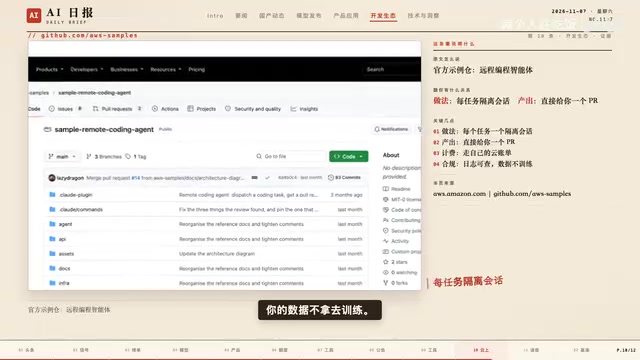
AWS published an official blog post on how to run Cloud Code in the cloud: drop tasks into a runtime on Bedrock, each task runs in an isolated environment and gives you a PR when done. The benefits are no per-seat licensing, usage billed through your own cloud bill, logs going to Cloud Trail, and data not used for training. It amounts to buying a coding agent as a cloud service, and the sample code lays out the whole workflow.
These directions are actually consistent: models start picking models themselves, assistants start opening their own spaces, and coding tools start running tasks in the cloud on their own.
LLM routing (Router): The auto-routing layer sits between user requests and specific models, dispatching requests to the most suitable model based on task type, real-time pricing, latency, availability, and historical benchmark scores. It solves the problem of "too many models, and manual selection is both error-prone and uneconomical." Routing strategies generally fall into two categories: static (by rules or leaderboards) and dynamic (by current instance health and cache hits), with Open Router's new version belonging to the latter. For teams, the value of the routing layer is turning model selection from a one-time architecture decision into a continuously optimized runtime strategy, but it also introduces new burdens of observability and consistency.
Open weights vs. open source: Open weights means the parameters of a finished model can be downloaded and deployed, but the training data, code, and training process are not necessarily public; open source usually requires all of these to be visible. Inkling's second-generation website lists it as open weights, meaning it can be self-hosted and fine-tuned (as with Tinker mentioned in the article), but this does not imply its training method is reproducible. This distinction is especially important when discussing "open-source model rankings": what the leaderboard calls "open-source first" often actually means "open-weight first," and the two differ in how auditable they are.
Product changes and industry infrastructure
Doubao Work Personal Edition changed its rules: starting November 6, the 5-hour short-cycle quota limit is removed, so individual users are no longer constrained by 5-hour windows and can schedule at their own pace, though weekly quotas and other rules still follow the plan. To check remaining quota, go to Subscription & Quota Management in settings.
ByteDance's AI coding tool issued an announcement: starting November 18, accounts will automatically upgrade to Doubao Feishu accounts. The company stressed that data and entitlements remain unchanged and code project history is fully preserved. TRAE is ByteDance's AI-native development environment; it merged two older products into one in October, and this change folds the account system into the Doubao and Feishu setup. The announcement did not mention whether plan pricing will change.
Mistral updated its speech model, highlighting one detail: it can tell whether a sentence is actually finished. Transcription is not hard; what's hard is knowing whether the other person has stopped or is still thinking, so that after detecting a pause the reply doesn't have to wait idly. It also does multilingual transcription, speaker diarization, and context-based error correction. Pricing is public too: small-model transcription at 0.4 per minute.
OpenAI, together with a biotech company, released a new benchmark called BioBasics Bench, which tests whether agents can understand raw data from experiments. It consists of 100 everyday lab tasks — not multiple choice — where the agent must read conclusions out of raw readings. The company says there was previously no unified way to measure this step, and both the leaderboard and documentation are released so anyone can run it. This path used to rely on manually matching readings; now there is a reproducible evaluation standard.
Reproducibility of benchmarks: The value of benchmarks like APEX Agents and BioBasics Bench depends on whether the task set, scoring scripts, and runtime environment are public. When companies self-report scores, a common problem is that prompts, tool permissions, and retry counts are not disclosed, making it hard for third parties to align. BioBasics Bench explicitly releases its leaderboard and documentation and emphasizes drawing conclusions from raw readings rather than multiple choice, precisely to improve reproducibility. For developers, when tracking a benchmark, prioritize whether it provides executable task definitions and scoring code rather than just looking at the pass rate.
A shared shift
Looking across today's items, the main thread is not any single model's score but the word "automatic": the routing layer picks models automatically, assistants switch spaces automatically, coding agents run tasks in the cloud automatically, and speech models judge conversation rhythm automatically. Tools are taking away the steps that used to require manual configuration.
Back to the headline question: now that an open-source agent has put 1.54 million DAU on the table, whether the plugin marketplace can hold on to this user base will be a harder indicator than star count.
Related articles
 Tech Frontiers
MuJoCo: An Analysis of DeepMind's Open-Source General-Purpose Physics Simulator
An in-depth analysis of Google DeepMind's open-source physics simulator MuJoCo: high-performance C++ kernel, MJCF modeling format, contact solving principles, MJX GPU acceleration, and robot reinforcement learning use cases.
 Tech Frontiers
Claude API Quick Start: The Official Quickstarts Project Collection
Anthropic's official claude-quickstarts project collection helps developers quickly build deployable apps with the Claude API. Nearly 20k stars, Python-based, great for beginners and prototyping.
 Tech Frontiers
AI Agents Connecting Directly to APIs: Which Calls Can Be Safely Allowed?
AI agents can call any API, but the real challenge is deciding which calls can be safely allowed. This article analyzes allowance decisions from three dimensions—intent matching, least privilege, and controllable impact—and argues that the control layer should sit outside the agent, combined with audit traceability to build a trustworthy API call governance mechanism.