DeepSeek Importable Conversations, Gemini 4 Hydrogen 2.5x Faster | AI Daily
DeepSeek drawing import, Gemini 4 Hydrogen speed boost, Anthropic IPO and self-hosted Agents among updates
This issue covers multiple AI and tech updates: DeepSeek Harness V0.2.2-2C3 adds an experimental drawing import plugin to bring App or web historical sessions into the workspace and fixes Windows desktop update failures; Google releases Gemini 4 Hydrogen, claimed 2.5x faster than 3.8 Flash with 4 thinking depths, default exceeding Argon, priced at $1.5/$7.5 per million tokens; Anthropic launches its IPO and files with the SEC, plus a Meeting Agent Cloud MeetingsCode and self-hosted Managed Agents; Google Smart Glasses open for pre-order shipping December 10, OpenRouter adds Simplified Chinese among 7 languages, and Tencent open-sources Tube Sandbox V0.8.0 with crash restart. Two unconfirmed NVIDIA rumors are included, to be treated cautiously.
DeepSeek Harness V0.2.2-2C3: Bringing App and Web Conversations into the Workspace
DeepSeekAd Harness has released version V0.2.2-2C3, adding an experimental DeepSeek drawing import plugin. The core value of this plugin lies in bridging the gap between "historical conversations" and the "workspace"—users can import historical drawings from the App or web version into the workspace and continue the conversation. For long-conversation scenarios constrained by context length, this effectively gives old sessions a new lease on life.
The update also fixes the Windows desktop version update failure issue. The word "experimental" in the version number is worth noting: the import feature is still in its early stages, and stability and compatibility may need further iteration. But for users who rely heavily on historical context, the direction itself is more noteworthy than the specific implementation.
Google Releases Gemini 4 Hydrogen: 2.5x Speed Boost and Four Thinking Depths
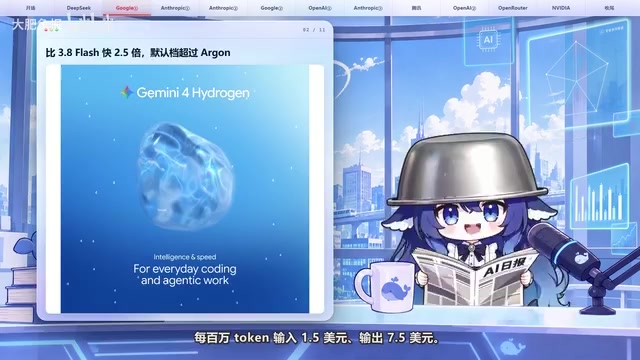
Google has launched Gemini 4 Hydrogen, officially claimed to be 2.5x faster than 3.8 Flash. The model offers 4 thinking depth levels, and the default level already outperforms Argon. Pricing is $1.5 per million input tokens and $7.5 per million output tokens.
"Adjustable thinking depth" is becoming a standard design for the new generation of models—users can trade off between response speed and reasoning quality rather than being forced to accept a single level. The detail that the default level exceeds Argon indicates that Google has chosen a quality-leaning strategy for the default configuration, with the speed advantage coming from the underlying architecture rather than cutting reasoning steps.
Thinking Depth is an adjustable parameter commonly introduced in recent reasoning models. Essentially, it controls how many internal reasoning steps the model performs before generating the final answer (i.e., the "chain of thought" length or reasoning budget). Higher levels mean the model spends more tokens on intermediate derivation, typically yielding higher accuracy on complex reasoning, code, and math problems, but with correspondingly higher latency and cost; lower levels respond faster and cost less, suitable for casual chat and simple retrieval tasks. This design gives users the power to trade off "speed vs. quality" rather than having vendors fix a balance point. The phrase "default level exceeds Argon" means that without manually adjusting the level, the new model's reasoning performance already surpasses the reference model Argon, implying most users can obtain a good quality baseline without tuning parameters.
Anthropic's Triple Announcement: IPO, Meeting Agent, Self-hosted Managed Agents
Anthropic has announced the launch of its initial public offering, having filed a registration statement with the SEC. Underwriters include Goldman Sachs and Morgan Stanley. The company reminds investors to read the prospectus in the registration statement.
On the product side, Anthropic has released Cloud MeetingsCode, which can join team video calls as a participant, generating documents, whiteboards, and other deliverables during discussions. It is currently in beta rollout for Team and Enterprise plans. Another move is the launch of a self-hosted version of Managed Agents: Agent credentials and drawing history are hosted by the customer themselves, and customers can decide which egress their requests use.

The significance of the self-hosted version lies in returning data sovereignty to enterprises. For compliance-sensitive organizations, granular control over "which egress requests use" often determines procurement decisions more than the features themselves.
IPO Registration Statement (S-1) and Prospectus are key steps in the U.S. company listing process: the company submits a registration statement to the SEC (typically Form S-1), which includes a prospectus disclosing the business model, financial data, risk factors, equity structure, and use of proceeds. After submission, the SEC reviews and provides comments, and the company revises accordingly until the registration becomes effective before pricing and issuance. Therefore, "registration statement filed" only indicates the process has started; there are still roadshows, pricing, and underwriting allocations before official listing, and changes in market conditions may cause delays or withdrawals. For investors, the prospectus is the only legally binding source of information, which is precisely why the company reminds readers to read the registration statement.
Self-hosted and Data Sovereignty refers to deploying an Agent's runtime components, credential management, and session history in the customer's own environment or designated egress, rather than entirely in the vendor's cloud. The core difference lies in the control boundary: which network egress requests are sent from, where sensitive credentials are stored, and whether historical data leaves the enterprise boundary are all decided by the customer. This is particularly critical for compliance-sensitive industries such as finance, healthcare, and government, where data cross-border transfer, audit trails, and access control are often hard procurement thresholds. The trade-off is that customers bear some operational and upgrade responsibilities, and feature iterations may lag behind cloud versions. Therefore, self-hosted versions are typically offered alongside hosted versions for organizations with different compliance levels.
Hardware and Ecosystem: Google Smart Glasses Open for Pre-order, OpenRouter Adds Simplified Chinese
Google Smart Glasses are officially open for pre-order, in partnership with Samsung, Gentle Monster, and Warby Parker. Shipping begins December 10, with in-store trials available starting today. The Warby Parker version is approximately $395.

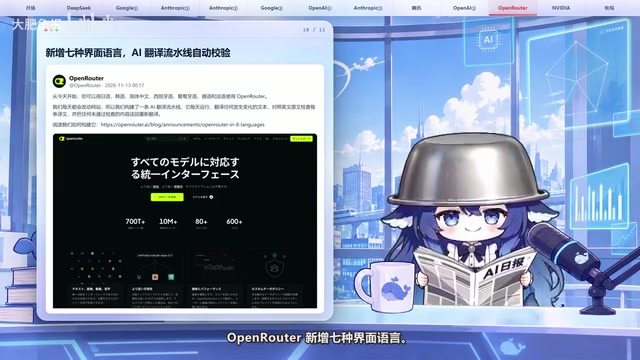
OpenRouter has added 7 interface languages, including Simplified Chinese, Japanese, Korean, and European languages. The website changes daily, and the team uses an AI translation pipeline for automatic validation.
Tencent has open-sourced Tube Sandbox V0.8.0, adding crash restart capability. Failed sandboxes can recover on the same node, supporting Juicefs Scout and Jing file system snapshot scheduling, with built-in Cell plugin or custom GRPC. The reliability enhancement of this open-source sandbox tool is a tangible infrastructure improvement for teams running long-duration Agent tasks.
Other updates include: XGPT's Dot update is live, with faster replies, fewer terms, and better execution. It supports custom instructions, allowing users to request a draft before sending an email, configurable in Customize on mobile; OpenAI has disclosed cybersecurity tools under development, covering automated patching and automated red teaming. The Cyber model Exploit Gym has a 77% success rate, though this has not been officially confirmed.
OpenRouter is a model aggregation and routing platform where developers call models from multiple vendors through a unified API, with the platform handling billing, rate limiting, and failover. For multi-model applications, it reduces the cost of integrating with each vendor individually and facilitates dynamic selection based on price or capability. Interface multilingualization may seem like mere localization work, but it actually affects developer onboarding barriers and documentation readability; the "AI translation pipeline automatic validation" mentioned in the article typically involves generating a first draft with machine translation, then using another model or rules to check terminology consistency, placeholder integrity, and formatting, reducing manual review workload. Since the website changes daily, this pipeline allows new copy to quickly cover multiple languages without manual retranslation each time.
Two Unconfirmed Rumors
According to Rotas, Jensen Huang has a third office romance, with an intimate relationship with a second employee; another report claims that CFO Colette Cress will serve as interim CEO. Neither NVIDIA nor Jensen Huang has officially confirmed. These two pieces of news should be treated as rumors until official responses are available, and readers should exercise caution.
One-line Summary
DeepSeek drawing import, Gemini 4 Hydrogen speed boost, Anthropic IPO and self-hosted Agents among updates
Paragraph Summary
This issue summarizes multiple AI and tech updates: DeepSeek Harness V0.2.2-2C3 adds an experimental drawing import plugin that can import App or web historical sessions into the workspace to continue conversations, and fixes the Windows desktop update failure issue; Google releases Gemini 4 Hydrogen, claimed to be 2.5x faster than 3.8 Flash, offering 4 thinking depth levels with the default exceeding Argon, priced at $1.5 and $7.5 per million tokens for input and output respectively; Anthropic launches its IPO and files a registration statement with the SEC, while releasing the meeting Agent Cloud MeetingsCode and self-hosted Managed Agents; on hardware and ecosystem, Google Smart Glasses open for pre-order with shipping on December 10, OpenRouter adds 7 interface languages including Simplified Chinese, and Tencent open-sources Tube Sandbox V0.8.0 with enhanced crash restart capability. The article ends with two rumors unconfirmed by NVIDIA officially, to be treated with caution.
Related articles
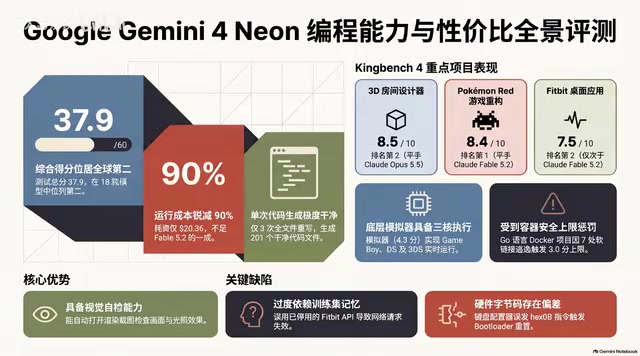
Gemini 4 Neon Hands-On: Value King or Confident Catastrophe?
Gemini 4 Neon review: 1M-token context, four thinking levels, 201 files in one KingBench4 pass at one-tenth Fable 5.2's cost—but it hallucinates fake data, leaves 7 symlink escapes, and bricks keyboards.

Google Gemini 4 Neon Hands-On: 6 3D Works That Impress and Fail
Hands-on with Google Gemini 4 Neon on a 3060 laptop: 6 3D works tested. Sunshower Fishing Harbor and mechanical keyboard impress; soft-body physics and faces fall short.
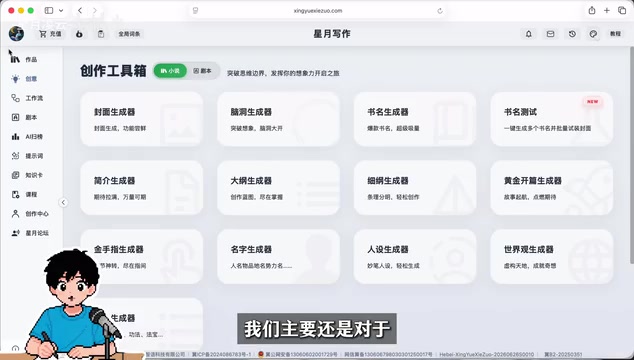
Gemini 4 Neo Web Novel Writing Test: Faint AI Flavor, Textured Dialogue
Bilibili creator's first-look review of Gemini 4 Neo for Chinese web novel writing: testing a Three Kingdoms transmigration opening with faint AI flavor, emotionally textured dialogue, and strong crisis building, plus comparison of 4A/4H/4C models and full workflow demos.