DeepSeek Open-Sources DeepInfer Inference Engine: What It Can Run, What It Lacks

DeepSeek open-sources its production-grade inference engine DeepInfer, but limits it to offline use, a single model, and two chip types.
DeepSeek has open-sourced DeepInfer, the inference engine behind its official API—a further disclosure of its deployment chain after opening model weights. But the engine has three hard constraints: offline-only, V4.1-Flash only, and Blackwell or Ascend only, excluding Hopper, Ampere, and consumer GPU users. The article argues the real beneficiaries are private deployment teams with matching hardware, inference researchers, and Ascend developers, and that this boundary-conscious open-sourcing offers an official tuning baseline rather than a plug-and-play tool.
Title
DeepSeek Open-Sources DeepInfer Inference Engine: What It Can Run, What It Lacks
Meta Description
DeepSeekAd has open-sourced DeepInfer, the inference engine behind its API—but it's offline-only, supports only the V4.1-Flash model, and runs only on Blackwell or Ascend hardware. This article breaks down these three constraints, the profile of teams that genuinely benefit, and the strategic signal this open-sourcing sends.
Article Content
DeepSeek has open-sourced the inference engine behind its own API, called DeepInfer. But don't rush to clone the repo—it's offline-only, supports only the V4.1-Flash model, and recognizes only Blackwell or Ascend chips. These three constraints, taken together, mean it's neither a "plug-and-play" gift for ordinary developers nor a purely symbolic open-sourcing gesture.
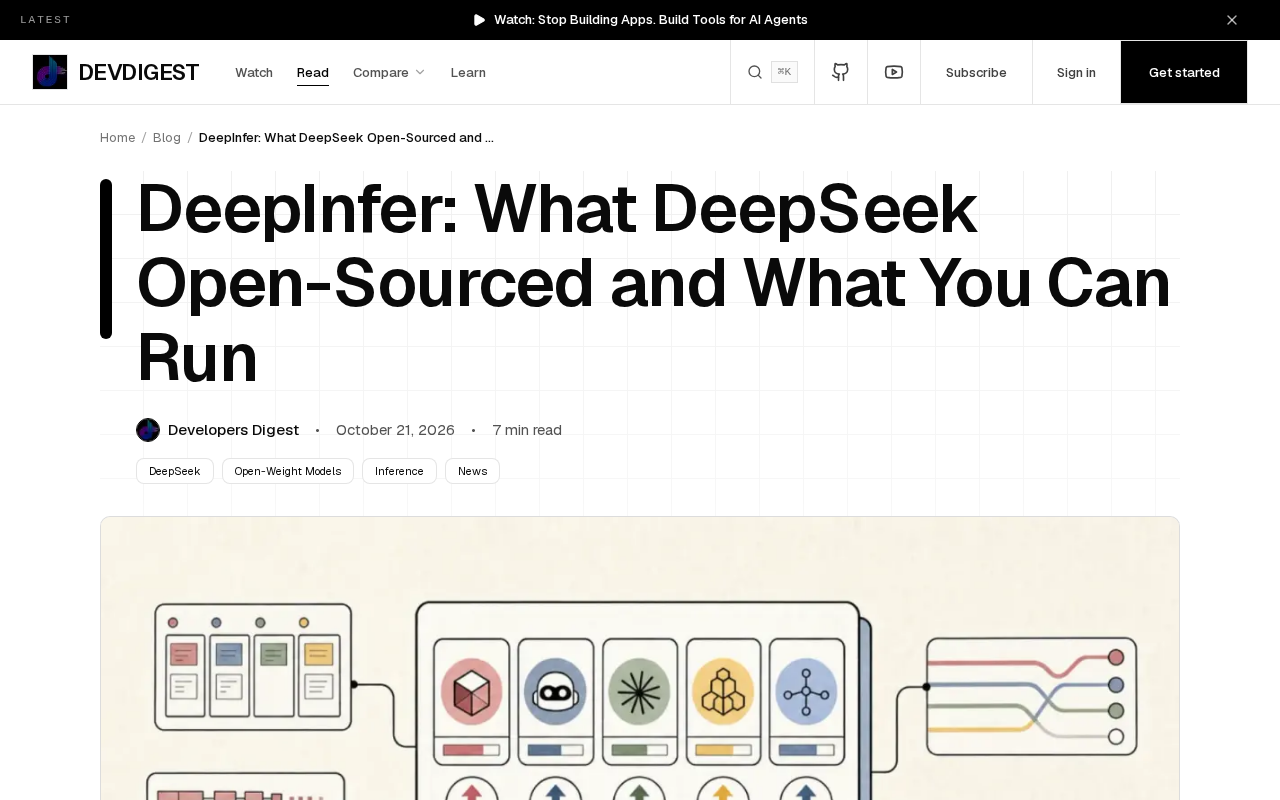
What Exactly Is DeepInfer
DeepInfer is the inference engine that DeepSeek's official API service relies on. Previously, developers could only call DeepSeek models through the API, and how the underlying scheduling worked, how batching was done, and how throughput was squeezed out of specific hardware were all a black box. This open-sourcing exposes the server-side inference layer.
From an engineering perspective, this goes a step further than open-sourcing model weights. Open-sourcing weights addresses "whether the model can be used"; open-sourcing the inference engine addresses "how to run the model efficiently." For a team that has already opened up its model weights, handing over the inference engine means putting the final link of the deployment chain on the table as well.
Inference Engine is a layer of software system between trained model weights and end-user requests, responsible for loading the model's computational graph into GPU memory, managing the KV Cache, scheduling request batching, and selecting and fusing low-level operators, thereby optimizing throughput and latency on given hardware. Common examples include vLLM, TensorRT-LLM, and SGLang. Unlike training frameworks, the core metrics of an inference engine are tokens processed per unit time, first-token latency, and memory usage. Open-sourcing weights only lets the community "get it running," while the engineering quality of the inference engine determines "how fast, how economical, and how stable it runs." Therefore, production-grade engines often contain a large number of non-generic optimizations targeting specific hardware and model structures—which is also the technical root of why DeepInfer supports only a single model and two types of chips.
Three Hard Constraints, Each Blocking a Group of People
According to the original information, DeepInfer has three explicit constraints, and they take effect simultaneously:
Offline-only. The engine is not designed for online service scenarios and has no built-in request queue, multi-tenant isolation, or dynamic autoscaling capabilities. To use it to directly build an external API service, you'd have to add a complete service layer yourself on the outside.
Supports only V4.1-Flash. This is a rather narrow model support scope. DeepInfer is not a general-purpose inference framework but a specialized engine deeply tuned for a specific model. Switching models is basically equivalent to switching engines.
Supports only Blackwell or Ascend. The hardware threshold falls on two lines: NVIDIA Blackwell architecture and Huawei Ascend. Developers with Hopper, Ampere, or consumer-grade GPUs are directly out of the game.
After crossing these three conditions, the scenarios that can actually run are quite limited: teams that have Blackwell or Ascend hardware, need to deploy V4.1-Flash offline, and are willing to fill in the service-layer capabilities themselves.
Blackwell is a GPU architecture released by NVIDIA in 2024 (corresponding to data center products such as B200/B100), succeeding Hopper (H100/H200). Each generation of architecture differs significantly in Tensor Core specifications, memory bandwidth, support for low-precision formats such as FP4/FP8, and NVLink topology, and kernels hand-written for one generation usually cannot run directly on the previous generation. Ascend is Huawei's AI accelerator series (such as Ascend 910B), using its self-developed Da Vinci architecture and CANN software stack, with an instruction set and CUDA ecosystem that are completely isolated. Therefore, "supports only Blackwell or Ascend" means the engine maintains separate operator implementations internally for these two ISAs, which also explains why users of Hopper, Ampere, and consumer-grade GPUs are excluded—the porting cost is not flipping a compilation switch but rewriting the low-level kernels.
Who Really Benefits
The beneficiary profile is narrower than imagined, but also more substantial than imagined.
The first category is enterprise teams doing private deployments. In scenarios where data cannot leave the intranet but DeepSeek model capabilities are needed, previously they could only figure out inference optimization on their own. DeepInfer provides an officially tuned starting point, saving exactly the most labor-intensive part of the work.
The second category is inference performance researchers. An engine deeply customized for a specific model and specific hardware is itself research material—batching strategies, memory management, and operator fusion choices are all hidden in the actual code.
The third category is developers in the Ascend ecosystem. Supporting both Blackwell and Ascend hardware lines simultaneously shows that DeepSeek has invested real engineering resources in adapting to domestic compute power, which has reference value for large-model deployment practices on Ascend.
Private deployment refers to deploying models and inference services within an enterprise's own data center or dedicated cloud, with data not leaving the intranet, usually driven by compliance requirements such as classified protection, finance, or healthcare. Such scenarios naturally fit DeepInfer's "offline-only" positioning: request volume is predictable, multi-tenant isolation is unnecessary, but the throughput cost per unit of hardware is extremely sensitive. Enterprises previously either tuned general frameworks like vLLM themselves or purchased vendor all-in-one machines; DeepInfer provides a configuration baseline validated by DeepSeek under production traffic, which can significantly shorten the tuning cycle from "getting it running" to "running it well." The cost is that enterprises still need to build service-layer components such as gateways, authentication, monitoring, and canary releases themselves—these capabilities are not open-sourced along with the engine.
The Strategic Signal of the Open-Source Move
Open-sourcing the inference engine while simultaneously locking down the model and hardware is a kind of openness with clear boundaries. DeepSeek has handed over the engineering implementation while retaining control over the model iteration pace and hardware partnership direction.
For the community, the value of this kind of open-sourcing is not in using it immediately but in providing an "official answer": what a production-grade inference engine looks like given specific hardware and a specific model. As for how far this answer can be reused, it depends on whether the model support scope is later opened up and whether online service capabilities are added.
In the short term, to judge whether DeepInfer suits you, you only need to answer three questions: Do you have Blackwell or Ascend? Are you running only V4.1-Flash? Is it an offline scenario? If all three are "yes," it's worth a try; if one is "no," it's probably not meant for you.
One-line Summary
DeepSeek open-sources the production-grade inference engine DeepInfer, but limits it to offline, a single model, and two types of chips.
Paragraph Summary
DeepSeek has open-sourced DeepInfer, the inference engine behind its official API—a further disclosure of the deployment chain following the opening of model weights. But the engine is simultaneously subject to three hard constraints: it targets only offline scenarios, supports only the single V4.1-Flash model, and adapts only to NVIDIA Blackwell and Huawei Ascend hardware, with Hopper, Ampere, and consumer-grade GPU users directly excluded. The article argues that the real beneficiaries are private deployment teams with the corresponding hardware, inference performance researchers, and Ascend ecosystem developers; this kind of open-sourcing—"handing over the engineering implementation while retaining control over model and hardware direction"—shows clear boundaries, and its value lies more in providing an officially tuned answer than in being a plug-and-play tool.
Related articles

Chain of Thought Isn't Just for AI: How Humans Can Use CoT to Improve Thinking Quality
Chain of Thought isn't just a prompt trick for large models. Starting from a Hacker News discussion, this article analyzes why CoT works for human thinking too, breaks down actionable ways to transfer it, and highlights the key differences between human CoT and machine CoT.
Cloudflare Teams Up with OpenAI: Closi…
Cloudflare Teams Up with OpenAI: Closing the Loop from Vulnerability Discovery to Defense with AI
Cloudflare uses OpenAI Daybreak to investigate security vulnerabilities and generate reviewable remediation plans, while developers use Codex to boost coding efficiency and quality.

Orca Multi-Agent Orchestration in Practice: A Guide to Parallel Collaboration with Claude and Codex
Orca is Stable AI's free open-source agent workbench supporting 34 agents like Claude Code and Codex in parallel. Learn its Git worktree isolation, multi-model orchestration, and mobile management.