DeepSeek Open-Sources DeepInfer Inference Framework: A Revolution in Local LLM Deployment Efficiency

DeepSeek open-sources DeepInfer inference framework, signaling local AI's shift toward hardware-software co-optimization.
DeepSeek open-sources DeepInfer, shifting local AI focus from whether models can run to how fast and efficiently they run. It integrates speculative decoding, MoE expert morphing with async scheduling, and high-performance operators to cut serial waiting and boost hardware utilization, while optimizing long-context KV Cache overhead. Benchmarks show a 30B-class model hitting 100+ TPS single-stream and DeepSeek V4.1 Flash 1017 at 66 tokens/s locally—though data is single-source and not generalizable.
DeepSeek has open-sourced its internal inference framework DeepInfer, a move that has sparked considerable discussion in the local AI community. In the past, when people assessed the feasibility of local deployment, their attention was almost entirely focused on a few hard metrics: model parameter count, VRAM size, and whether it could run at all. The signal from DeepSeek's open-sourcing this time is clear: whether a model can run is only the starting point—whether it runs fast enough and whether compute is used efficiently enough are equally key variables determining the local AI experience.

What Problem Does DeepInfer Solve
The pain points of local LLM deployment often lie not in "can't install it" but in "can't use it comfortably." The waiting sensation of token-by-token generation, the dual pressure on VRAM and cache in long-context scenarios, and limited compute being wasted by inefficient scheduling—these problems don't disappear automatically just because the model itself gets smaller. As the core inference technology supporting model operation, DeepInfer targets precisely these engineering-level efficiency bottlenecks.
Based on public information, DeepInfer integrates multiple inference optimization techniques: speculative decoding lets a smaller model predict multiple candidate tokens in advance, which are then verified and constrained by the main model, reducing the serial waiting of character-by-character generation; MoE expert morphing and asynchronous scheduling perform load balancing and parallel optimization for mixture-of-experts architectures; and high-performance operators squeeze hardware compute at the lower level. Together, these technologies point toward one goal—enabling the same hardware to complete more effective computation.
Speculative Decoding is a technique that accelerates autoregressive generation without changing the model's output distribution. The basic idea is to use a smaller, faster draft model to first predict multiple candidate tokens consecutively, then have the target large model verify these candidates in parallel in one pass, keeping the accepted portions and discarding and correcting the rejected ones. Since verification can be done in parallel, the generation process that originally required multiple serial forward passes is compressed into a few steps, significantly reducing the waiting sensation of token-by-token generation. The key to this technique is that the draft model's distribution must be sufficiently close to the main model's; otherwise the acceptance rate drops and the speedup is diminished.
MoE (Mixture of Experts) architecture splits the feed-forward network into multiple "expert" sub-networks, activating only a few of them for each token, thereby controlling the cost of a single computation even when the total parameter count is very large. Its engineering challenge lies in load balancing: if requests concentrate on a few popular experts, some devices sit idle while others are overloaded. Therefore, MoE inference typically requires expert parallelism partitioning, dynamic routing scheduling, and asynchronous communication to flatten the load—which is why DeepInfer emphasizes "expert morphing and asynchronous scheduling."
Continuous Optimization of Long Context and Cache Overhead
Long context is an easily underestimated cost item in local deployment. As the context window lengthens, KV Cache usage expands rapidly, and computational overhead rises accordingly. DeepInfer has made continuous optimizations in this area, attempting to reduce the computation and cache burden in long-context scenarios.

For local users, this means that on the same device with the same model, adjusting the inference framework, quantization precision, and runtime parameters offers the chance to trade off different combinations of speed and resource usage. The inference framework is no longer a transparent layer that merely "runs"—it has become a performance lever that can be actively tuned.
KV Cache is the mechanism that caches the Key and Value tensors of historical tokens during autoregressive inference of large models, used to avoid recomputing all historical attention each time a new token is generated. Its VRAM usage is roughly proportional to "number of layers × attention head dimension × sequence length × batch size × precision bytes," so doubling the context window approximately doubles cache usage. This is precisely why long context is especially expensive on local devices.
Around this overhead, common optimization directions in the industry include: quantizing the cache to lower precision (such as FP8, INT8), evicting or sparsely retaining unimportant historical tokens, managing the cache by pages to reduce fragmentation, and reusing caches with the same prefix (prefix caching). These approaches often need to work in conjunction with specific attention implementations and fall under the purview of the inference framework rather than the model itself.
What the Benchmark Data Reveals
According to benchmark information shared by a Bilibili content creator, on a hardware platform with 128G unified memory, 873G bandwidth, and 2070 TOPS of compute, combined with VLM and related solution optimizations, a Qwen 30B-class model (originally stated as "3087B," likely a typo) achieved over 100 TPS single-stream performance on coding tasks. Two compute devices also completed local deployment testing of DeepSeekAd V4.1 Flash 1017, currently reaching a maximum speed of 66 tokens/s.

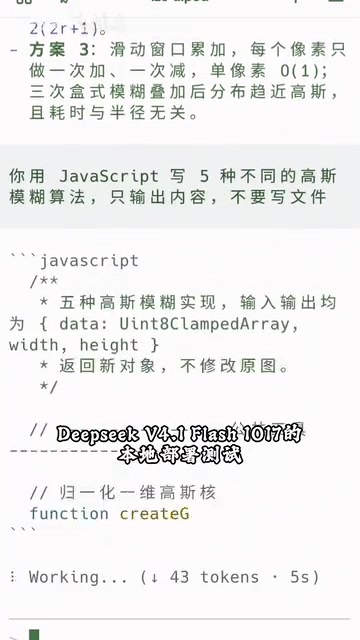
It should be noted that this data comes from a single-source benchmark share, with specific hardware configurations and test conditions, and should not be directly extrapolated to all devices. But it at least demonstrates one point: the optimization space of the inference framework is sufficient to make the same hardware deliver significantly different performance.
TPS (Tokens Per Second) refers to the number of tokens generated per second and is the most intuitive metric for measuring inference speed. It is important to distinguish between "single-stream" and "aggregate" measurements: single-stream refers to the generation rate of a single request itself, directly determining the response speed perceived by the user; aggregate throughput is the total output of a server under multiple concurrent requests, reflecting hardware utilization. The two can trade off against each other—increasing batch processing can boost total throughput but may raise single-request latency.
Furthermore, TPS values are highly dependent on conditions such as context length, output length, quantization precision, and batch size; comparing data across different devices without these premises is of limited significance. When reading benchmark results, it is more prudent to first confirm the test methodology and configuration before judging performance.
Local AI Competition Shifts Toward Hardware-Software Co-Optimization
The open-sourcing of DeepInfer reflects a trend: competition in local AI is shifting from "single-point comparison of model capabilities" to "co-optimization of hardware and inference software." Model capabilities determine the ceiling, while inference efficiency determines practical usability. For developers and power users, paying attention to the evolution of inference frameworks, updates to quantization tools, and changes in scheduling strategies may yield more practical benefits than simply waiting for larger models.
An open question worth noting: in local deployment scenarios, do you value the model's own reasoning capability more, or runtime speed and resource efficiency? This trade-off will directly influence framework selection and the direction of hardware investment.
One-line Summary
DeepSeek open-sources its DeepInfer inference framework, signaling that local AI competition is shifting toward hardware-software co-optimization.
Paragraph Summary
DeepSeek has open-sourced its internal inference framework DeepInfer, shifting local AI's focus from "can the model run" to "how fast does it run and how efficiently does it use compute." DeepInfer integrates speculative decoding, MoE expert morphing and asynchronous scheduling, and high-performance operators to reduce the serial waiting of token-by-token generation and improve hardware utilization, while continuously optimizing KV Cache and computational overhead in long-context scenarios. Benchmark shares show that on a 128G unified memory platform, a 30B-class model can achieve over 100 TPS single-stream on coding tasks, and DeepSeek V4.1 Flash 1017 reaches up to 66 tokens/s in local deployment—but the data comes from a single source with specific conditions and should not be extrapolated. The article argues that local AI competition is shifting from single-point comparison of model capabilities to co-optimization of hardware and inference software.
Related articles

Chain of Thought Isn't Just for AI: How Humans Can Use CoT to Improve Thinking Quality
Chain of Thought isn't just a prompt trick for large models. Starting from a Hacker News discussion, this article analyzes why CoT works for human thinking too, breaks down actionable ways to transfer it, and highlights the key differences between human CoT and machine CoT.
Cloudflare Teams Up with OpenAI: Closi…
Cloudflare Teams Up with OpenAI: Closing the Loop from Vulnerability Discovery to Defense with AI
Cloudflare uses OpenAI Daybreak to investigate security vulnerabilities and generate reviewable remediation plans, while developers use Codex to boost coding efficiency and quality.

Orca Multi-Agent Orchestration in Practice: A Guide to Parallel Collaboration with Claude and Codex
Orca is Stable AI's free open-source agent workbench supporting 34 agents like Claude Code and Codex in parallel. Learn its Git worktree isolation, multi-model orchestration, and mobile management.