DeepSeek Open-Sources DiSpark: Up to 85% Faster AI Inference Without Changing Hardware

DiSpark accelerates LLM inference by up to 85% using speculative decoding — no new GPUs or retraining needed.
DiSpark is an open-source inference optimization framework from DeepSeek and Peking University that achieves 60–85% speedup on large language models without hardware upgrades or model retraining. It combines speculative decoding, semi-autoregressive generation, confidence-based hierarchical verification, and hardware-aware scheduling to maximize GPU utilization and reduce energy consumption while preserving output quality.
Faster AI Inference Without New GPUs or Retraining
Imagine significantly speeding up your large language model (LLM) without swapping out GPUs, retraining from scratch, or sacrificing output quality. That's exactly what DiSpark aims to solve — an open-source framework developed jointly by DeepSeekAd and Peking University.
DiSpark isn't a new model. It focuses on the inference stage — how a model generates responses at runtime. This is what actually determines user experience in production. Users don't care how many matrix multiplications happen under the hood; they care about how fast the model responds. That frustrating lag, as if someone is typing behind the screen, is fundamentally a decoding speed problem.
To understand why decoding speed is so hard to improve, we need to look at a fundamental bottleneck. The Transformer architecture introduced by Google in the 2017 paper Attention Is All You Need enables parallel computation over entire sequences during training via self-attention. But at inference time, autoregressive generation requires producing one token at a time — each new token depends on all previous ones — making parallelization impossible by design.
This serial constraint isn't a design flaw. It's an intrinsic mathematical property of autoregressive language models: the probability factorization P(x₁,x₂,...,xₙ) = ∏P(xₜ|x₁,...,xₜ₋₁) requires every generation step to be conditioned on all prior tokens. Any approach that tries to break this constraint must prove its output distribution is equivalent or approximately equivalent to the original autoregressive distribution.
The deeper bottleneck is memory bandwidth, not raw compute — a phenomenon known as the "Memory Wall." GPU FLOPS have grown roughly 100× over the past decade, while memory bandwidth has only grown ~5×. On an NVIDIA A100, peak compute is 312 TFLOPS, but memory bandwidth is only 2 TB/s. Generating each token requires loading billions of parameters from memory, but actual matrix computation time is minimal — GPU utilization often sits below 10%.
This can be quantified using Arithmetic Intensity (FLOP/Byte). During autoregressive decoding with batch size 1, arithmetic intensity is roughly equal to the hidden dimension size (typically 4,096–16,384), while modern GPUs peak above 200. This means autoregressive decoding is almost always memory-bandwidth-bound, not compute-bound — adding more compute does almost nothing for speed.
KV Cache (caching Key and Value matrices per layer to avoid recomputing past tokens) is standard in all production inference systems. But its memory footprint grows linearly with sequence length and batch size, consuming over 60% of total GPU memory in long-context scenarios. This challenge gave rise to techniques like vLLM's PagedAttention, which manages KV cache in non-contiguous fixed-size pages inspired by OS virtual memory, reducing fragmentation overhead from ~30% to near zero.
Speculative Decoding: The "Write-and-Review" Approach
How Speculative Decoding Works
The underlying idea in DiSpark is speculative decoding. The concept traces back to DeepMind's 2022 Blockwise Parallel Decoding research, but was systematized with formal lossless equivalence guarantees in Google Brain's 2023 paper Speculative Decoding.
The key to maintaining quality while accelerating lies in a mathematically rigorous rejection sampling protocol: when the draft model's token probability q(x) ≥ the target model's p(x), accept unconditionally; when q(x) < p(x), accept with probability p(x)/q(x), otherwise resample from a corrected distribution. This strictly guarantees the final output distribution is identical to pure target-model generation — distinguishing it from lossy methods like quantization or pruning.
The core insight targets the memory wall: by introducing a "draft model" with ~1/10 the parameters of the main model to batch-predict candidate sequences, then having the main model verify them in parallel, multiple tokens can be processed in a single forward pass — dramatically improving GPU utilization.
A useful analogy: imagine writing quickly on paper while a reviewer sits beside you — not waiting until you finish, but watching in real time, ready to say "delete that, rewrite" the moment something looks wrong. This "write-while-reviewing" approach is much faster and more token-efficient than sequential generation.

However, standard speculative decoding has a clear weakness: the longer the sequence, the lower the acceptance rate for later candidate tokens. Pushing for more speed often degrades verification efficiency and can introduce hallucinations. DiSpark targets exactly this pain point.
DiSpark's Three Key Innovations
Semi-Autoregressive Generation: Balancing Speed and Coherence
DiSpark introduces "semi-autoregressive generation" — a middle ground between slow serial generation and fast parallel generation — allowing the model to maintain coherence without sacrificing speed.
This design has solid theoretical grounding: mutual information between tokens in natural language decays exponentially with distance. Early n-gram models already observed this — 3-gram and 4-gram models capture most local dependencies, with diminishing returns at longer distances. Attention weight visualizations in BERT and GPT models confirm adjacent tokens receive significantly higher attention weights than distant ones.
Semi-autoregressive generation engineers this statistical regularity: sequences are split into chunks, with parallel generation within chunks and autoregressive dependencies maintained between chunks. By tuning chunk size, the system preserves sufficient local dependency information while greatly increasing parallelism. To support this, the team uses lightweight Sequential Heads that explicitly model the ordering relationship between tokens within a chunk, compensating for coherence loss from parallelization.
Hierarchical Verification: Confidence-Based Differential Review
Another highlight is confidence-based hierarchical verification. Rather than reviewing all candidate tokens with equal intensity, the system dynamically decides whether to audit large blocks or small chunks based on per-token confidence scores.
Verification itself consumes GPU, CPU, and memory resources. Uniform high-intensity verification is expensive with limited marginal benefit; but loose verification degrades quality. Hierarchical verification finds the optimal balance between speed and reliability.
The confidence proxy is typically the peak value of the draft model's softmax distribution or its entropy. When the distribution is concentrated (low entropy), the draft model is highly certain, and the acceptance probability approaches 1 — safe to use coarse-grained batch verification. When the distribution is flat (high entropy), fine-grained per-token verification is warranted. This concentrates verification resources on genuinely uncertain tokens rather than spreading them uniformly across the sequence.
Hardware-Aware Scheduling: Dynamic Adaptation to Server Load
DiSpark also integrates hardware-aware scheduling. The scheduler monitors real-time server load and execution state: increase verification when the server has spare capacity to fully utilize compute; reduce redundancy under high load to protect the system and control energy consumption.
This is implemented through real-time monitoring of GPU utilization, memory occupancy, PCIe bandwidth, and batch queue depth, with adaptive control algorithms dynamically adjusting the draft sequence length (the K value — number of speculative steps per round). Higher K under light load means more candidate tokens per round; lower K under heavy load reduces wasted computation from frequent verification failures and relieves KV cache memory pressure.

Benchmark Results: 60%–85% Real-World Speedup in Production
In actual deployments of DeepSeek V4 Flash and DeepSeek V4 Pro, DiSpark achieved:
- Flash series: single-user generation speed improvement of 60% to 85%
- Pro series: improvement of 57% to 78%
These figures are measured under equivalent inference quality, not idealized benchmark conditions — they reflect real production environments, real users, and real server load.
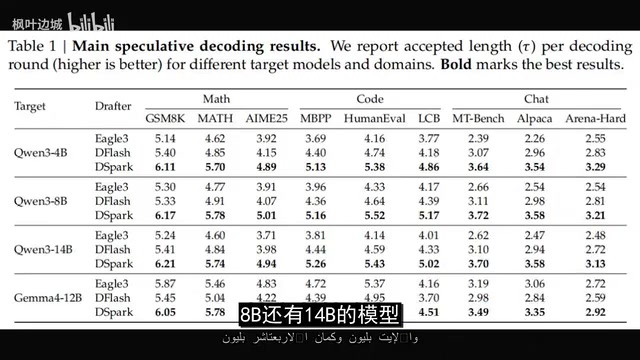
In comparative testing, DiSpark outperforms Eagle 3 and DeepFlash on Mean Accepted Token Length (MATL) — the core metric for speculative decoding efficiency. MATL measures the average number of draft tokens accepted by the main model per draft-verification cycle. MATL=1 means degradation to standard autoregressive decoding; MATL=4 means the main model advances ~4 tokens per forward pass, approaching a 4× theoretical speedup.
MATL improvement difficulty grows exponentially with its value. Going from MATL=1 to MATL=2 is relatively easy; pushing from MATL=3 to MATL=4 requires the draft model to simultaneously excel at distribution alignment, context awareness, and confidence calibration.
MATL is also highly task-dependent. Code generation typically achieves higher MATL than open-domain dialogue — code has stronger local determinism, and syntactic constraints sharply reduce candidate token entropy. Open-domain creative writing sees MATL typically between 2.0–2.5.
DiSpark outperforms Eagle 3 (which uses main model feature layers to improve acceptance rates) and DeepSeek's own DeepFlash on this key metric across 4B, 8B, 14B model scales as well as the Gemma 4 12B series.
Why DiSpark Matters: Open Source, Generality, and Energy Efficiency
No retraining required — plug and play. Apply it to existing models without training anything from scratch, dramatically lowering the adoption barrier.
Truly open source and highly portable. DeepSeek has open-sourced the complete DeepSpark project, including training, evaluation, and experiment code, portable to Qwen, Gemma, and other mainstream models.
Addresses the energy efficiency crisis. AI server energy consumption has become a policy and ESG issue. According to the IEA's 2024 Electricity report, data center electricity consumption reached ~460 TWh in 2023 and is projected to exceed 1,000 TWh by 2026 — roughly equivalent to France's total annual electricity consumption. AI inference is the fastest-growing contributor, since models are trained once but may be called billions of times per day.
Microsoft acknowledged in its 2024 Sustainability Report that carbon emissions increased ~30% compared to its 2020 baseline due to AI compute expansion — directly contrary to its 2030 carbon-negative target. The EU AI Act and various national data center efficiency standards are increasingly incorporating compute efficiency into compliance requirements.
A GPT-4-level inference query consumes roughly 10× the energy of a standard Google search. Improving inference efficiency by 85% theoretically means the same hardware can serve 85% more requests, or the same request volume requires ~46% fewer servers. Software-level inference optimization offers unique advantages over hardware upgrades — no waiting for next-gen chips, no lengthy data center expansion approvals, deployable immediately on existing infrastructure.

Conclusion
DiSpark represents a clear industry direction: rather than endlessly stacking hardware, use software-layer innovations — speculative decoding, semi-autoregressive generation, hierarchical verification, and hardware-aware scheduling — to fully unlock the inference potential of existing models.
The memory wall problem in autoregressive decoding is a structural constraint. The widening gap between GPU FLOPS and memory bandwidth won't disappear anytime soon. DiSpark demonstrates that this constraint can be significantly mitigated through elegant system design, without changing model architecture or sacrificing output quality.
For developers, an open-source, general-purpose, retraining-free LLM inference optimization toolkit like this is an exceptionally compelling practical solution.
Related articles

Felix Rieseberg Personal Homepage
Felix Rieseberg's personal homepage sparks attention on Hacker News. This article covers the Slack engineer's technical background, the rise and fall of nativefier, and the value of a developer homepage as a tech calling card.

@ai-sdk/vue 3.0.306 Patch Release Syncs with [email protected] Update
@ai-sdk/vue 3.0.306 released, synced with [email protected]. A routine patch release for the Vercel AI SDK ecosystem with no public API changes; the Vue adapter layer stays version-aligned with the core package.

Gemini 4 Argon API Launches: The Era of Million-Token Output Begins
Google launches Gemini 4 Argon with sparse MoE architecture, up to 1M output tokens, and a 68.90% Vals Index score, available across API, AI Studio, and the Gemini app.