DeepSeek Open-Sources Harness Framework: AI Competition Shifts from Models to Agents and Infrastructure

AI competition expands from model capabilities to agent frameworks, infrastructure, and ecosystem dominance.
DeepSeek's open-source Harness agent framework gained 50K GitHub stars in 12 hours, Claude achieved a breakthrough on the Riemann Hypothesis zero lower bound (41.6% to 67.2%), and OpenAI's Cerebras wafer-scale chip boosted inference speed 14x to 750 tokens/sec. These developments signal AI competition is shifting from model parameters to agent ecosystems and infrastructure.
The past two weeks in the AI industry have been nothing short of a battle royale—from open-source frameworks to frontier mathematical breakthroughs, to wafer-scale chips delivering massive inference speedups, five major developments dropped in rapid succession. A clear signal is emerging: the main battlefield of AI competition is expanding from individual model capabilities to agent frameworks, underlying infrastructure, and ecosystem dominance. This article breaks down each key development and analyzes the broader industry trends behind them.
DeepSeek Open-Sources Harness: From Model Competition to Agent Framework Competition
On August 13, DeepSeekAd open-sourced its agent framework Harness under the MIT license, while simultaneously launching the official release of its flagship model V4 Pro with fully upgraded Agent capabilities. This marks the extension of open-source competition from the model layer upward into the agent framework layer.
The MIT license is one of the most permissive open-source licenses available, allowing anyone to freely use, modify, and distribute the code—even for commercial projects—with the sole requirement of retaining the copyright notice. Compared to the GPL license (which requires derivative works to also be open-sourced) and Apache 2.0 (which adds patent grant clauses), the MIT license means enterprises can directly integrate the Harness framework into closed-source commercial products without worrying about legal risks. This dramatically lowers the adoption barrier and is one of the key reasons the project gained massive attention in such a short time.
Harness's core design philosophy is "everything is a plugin"—models, tools, caches, sandboxes, UIs, and all other components are fully pluggable and replaceable. This thoroughly decoupled architecture lets developers freely combine various agent modules like building blocks, dramatically lowering the barrier to constructing complex Agent systems.
The impact of this open-source release was immediate. According to statistics, the GitHub repository garnered 50,000 stars within just 12 hours of going public, making it one of the fastest-growing open-source projects in history.

This phenomenon reflects a broader trend: the MIT permissive license combined with highly modular design is becoming the key formula for rapid open-source project adoption. As model capabilities increasingly converge, whoever can provide more comprehensive agent infrastructure will gain the upper hand in the ecosystem battle.
Claude Tackles the Riemann Hypothesis: Substantive AI Breakthroughs in Frontier Mathematics
The second blockbuster development came from Anthropic. Reports indicate that a research version of Claude, working autonomously for approximately a day and a half, improved the lower bound for zeros of the Riemann Zeta function on the critical line from 41.6% to 67.2%, producing formally verifiable results.

To appreciate the significance of this achievement, some background on the Riemann Hypothesis is necessary. The Riemann Hypothesis is one of the most famous unsolved problems in mathematics, proposed by German mathematician Bernhard Riemann in 1859, and listed as one of the seven Millennium Prize Problems by the Clay Mathematics Institute with a million-dollar bounty. The conjecture asserts that all non-trivial zeros of the Riemann Zeta function have a real part equal to 1/2. The zero lower bound problem is an important sub-direction—researchers attempt to prove that at least a certain percentage of zeros lie on the critical line. The previous best result was 41.6%, proven by Conrey in 1989, a record that had stood for decades. Claude's improvement to 67.2% represents an order-of-magnitude advance in our understanding of zero distribution.
The technical details of this work are equally noteworthy: Claude orchestrated approximately 60 sub-agents working collaboratively, consuming a total of about 31 million tokens. This large-scale multi-agent collaboration pattern perfectly validates the value of agent frameworks—complex tasks that a single model cannot accomplish are being progressively conquered through agent orchestration.
The outside world widely regards this as AI's first substantive breakthrough in frontier mathematics. It should be noted that this "breakthrough" does not mean solving the Riemann Hypothesis itself, but rather achieving verifiable progress on related lower bound estimates. Yet even so, the fact that AI can produce formally verifiable results in such a rigorous mathematical proof domain already far transcends the scope of previous computational assistance.
Formal verification refers to using computer proof assistants (such as Lean, Coq, Isabelle, etc.) to convert every step of a mathematical proof into machine-checkable logical deductions. Unlike traditional peer review, formal verification eliminates the possibility of human oversight or logical gaps—once verified, it can be considered absolutely correct. The fact that Claude's results pass formal verification means it produced not an argument that "looks correct," but a complete proof chain that withstands the most rigorous logical scrutiny—this is what truly shook the mathematics community.
OpenAI's Wafer-Scale Chip: Inference Speed Boosted 14x Into a New Tier
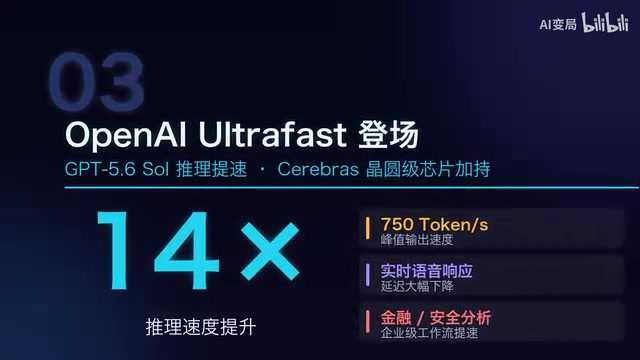
The third focal point centers on the infrastructure layer. OpenAI released an Ultrafast preview mode powered by Cerebras wafer-scale chips, boosting GPT-5.6-level inference speed by 14x to output up to 750 tokens per second.

Cerebras's core innovation lies in using an entire wafer (a silicon disc approximately 300mm in diameter) as a single complete chip, rather than the traditional approach of dicing a wafer into hundreds of individual chips. Its latest-generation WSE-3 (Wafer Scale Engine 3) integrates approximately 4 trillion transistors and 900,000 AI cores, with 44GB of on-chip SRAM and memory bandwidth of 21 PB/s. The greatest advantage of this architecture is eliminating inter-chip communication bottlenecks—in traditional GPU clusters, significant time is consumed transferring data between chips, while wafer-scale chips integrate all compute units on the same silicon die, allowing data to flow at high speed across extremely short physical distances. This enables throughput and latency performance in inference tasks that far exceeds traditional GPU solutions.
What does 750 tokens per second mean in practice? Taking Chinese as an example, one token corresponds to approximately 1-2 Chinese characters, so 750 tokens/s equates to generating roughly 500-700 Chinese characters per second. This speed already far exceeds human reading speed (typically 200-300 Chinese characters per minute), meaning AI's output bottleneck is no longer generation speed but rather human absorption capacity. For machine-to-machine scenarios—such as inter-agent conversations, automated code generation pipelines, and real-time financial decision-making—this speed enables complex multi-turn reasoning to complete in seconds, fundamentally changing expectations for AI system response times.
This speedup brings not just numerical improvements but a qualitative transformation in application scenarios. Real-time voice interaction, financial analysis, security response, and other latency-sensitive scenarios all enter an entirely new speed tier. When inference speed approaches real-time, many application forms previously constrained by latency will be fully unlocked.
You might not have noticed, but OpenAI's choice of the wafer-scale chip route is itself a bet on AI infrastructure competition. As marginal improvements in model capabilities become increasingly difficult, optimizing underlying hardware to unlock performance dividends is becoming a critical means for leading companies to widen their competitive gap.
Industry Briefs: Chain Reactions Across Capital, Organizations, and Ecosystems
Beyond the three core developments, several other industry movements are worth noting:
- Anthropic plans to IPO in October, with a valuation exceeding $2 trillion, potentially making it the largest IPO in history. Anthropic was founded in 2021 by former OpenAI core members Dario and Daniela Amodei, focusing on AI safety research, and has previously received massive investments from tech giants including Amazon (over $8 billion cumulative) and Google. The $2+ trillion valuation would potentially surpass previous IPO records—this figure also reflects the capital market's extreme bullishness on leading companies in the AGI (Artificial General Intelligence) race. For comparison, NVIDIA's market cap is approximately $3 trillion, while Anthropic has yet to achieve large-scale profitability. Capital operations at this scale will further reshape the competitive landscape of the AI industry.
-
Google DeepMind changes leadership, with founder Hassabis stepping down—organizational adjustments often signal shifts in strategic direction.
-
Claude Code auto-mode enabled by default, with its security interception rate far exceeding manual review, reflecting that AI's capabilities in code security auditing have reached practical value.
-
Grok video generation upgraded to version 1.5, with native 1080P support, as multimodal generation capabilities continue to evolve.
The AI Battlefield Shifts: From Model Parameters to Ecosystem Dominance
Looking at the industry developments over these two weeks in aggregate, one core conclusion becomes increasingly clear: beyond models, competition is shifting toward agents and infrastructure.
From DeepSeek's Harness framework, to Anthropic's multi-agent collaborative research, to OpenAI's wafer-scale chip speedup—these three main threads correspond to competition at the agent layer, application layer, and infrastructure layer respectively. When model parameters and benchmark scores alone are no longer the sole moat, the decisive factors become: who can build a complete agent ecosystem, who can establish advantages in underlying compute, and who can attract a larger developer community.
This comprehensive competition spreading from models to agents, infrastructure, and ecosystems has only just begun. Who will emerge as the ultimate winner remains a question only time can answer.
Related articles

DeepCell: One-Click AI Generation of Documents, Spreadsheets, and Slides
DeepCell tops Product Hunt with one-click generation of documents, spreadsheets, and slides, using the .deepcell format for linked updates, designed for System 2 tasks like modeling and sales reviews.

Doneas: 15-Minute Daily Accountability Calls That Keep Indie Developers From Procrastinating
Doneas is a daily accountability tool for indie developers: plan tasks on Monday, join a 15-minute call with five builders each day, and log deliveries on a public progress page. This article analyzes its core mechanics, effectiveness, and potential issues around retention and matching.

Fastlane 2.0: Fully Automated AI Ad Campaigns, From Creative to Optimization
Fastlane 2.0 is an AI ad automation tool: enter your website and it learns your brand, generates video and image ads, and runs and optimizes them on Meta, TikTok, Instagram, and YouTube.