DeepSeek Open-Sources Its Entire App: Frontend Given Away Free, APIs Fully Open, Industry Landscape Shifts

DeepSeek open-sources app to become a platform; chip traceability report and NVIDIA post-leadership earnings expectations take focus
Three main threads intertwine in tech this week: DeepSeek splits search, files, voice, and more into APIs and open-sources a purely static frontend, letting developers replicate the app 1:1 as it shifts from model vendor to platform, though content safety checks and responsibility remain concerns. A chip traceability report judges 6 Chinese frontier models, marking only DeepSeek V4 Flash as "confirmed"; the method is clever but conclusions have clear boundaries. After NVIDIA's leadership change, its stock fell sharply in a day and banks cut targets, with the 17th earnings a key watch point. Domestic compute shipments keep climbing, AI chip design is still early-stage, and robots and flying cars at the Lisbon show signal AI moving from screens into the physical world.
DeepSeek has open-sourced its entire app — the frontend code given away free, the backend APIs fully open, and even voice capabilities exposed externally for the first time. This is not just a feature update, but a role transition: from model vendor to platform. Meanwhile, a report on frontier models and NVIDIA chips, expectations for NVIDIA's first earnings report after its leadership change, and progress in domestic compute together sketch out the most noteworthy threads in tech this week.
DeepSeek Open-Sources the App: Developers Can Replicate It 1:1
According to a roundup by Bilibili's Tech Evening News, DeepSeekAd on the evening of the 13th split its entire multimodal capability set into APIs. In the past, developers could only call the model; search, file reading, and voice all had to be sourced from third parties, and they had to handle call messages and context stitching themselves. Now these are all done server-side, and developers are just one parameter away.
All three breakpoints are supported: chat completion, the responses API, and the Anthropic-format messages API. There is only one model — DeepSeek Flash, the version released on October 17. It supports a 1M context and up to 384,000 resource output.
According to the video author's summary, the core capabilities opened this time include: web search, which in thinking mode directly searches web pages and images, with answers carrying citations, and can search while reasoning; file input, where PDFs, Office documents, and images can all be parsed into text or mixed text-image content; link reading, which automatically grabs addresses in messages and puts them into context; and content safety, which returns a flag when risk is hit. There are also five clickable capabilities: search, scraping, OCR, speech recognition, and speech synthesis. Voice capabilities are being opened for the first time.
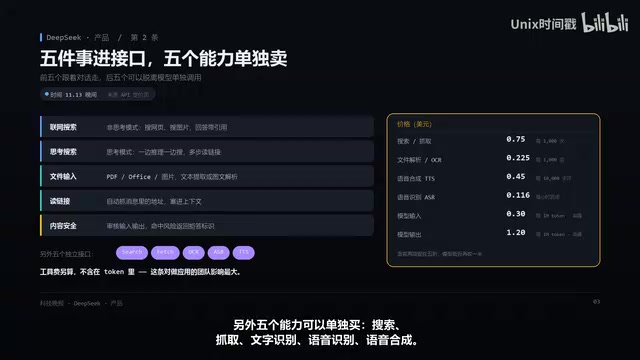
Pricing was also announced: search and scraping cost 0.75 millidollars per 1,000 calls; file parsing and OCR cost 0.225 per 1,000 pages; speech synthesis costs 0.45 per 10,000 characters; recognition costs 0.116 per hour. All are currently 50% off. The model itself has no charge (per the original wording); peak input is 0.3 and output 1.2, halved again off-peak.
More importantly, the company wrote its own frontend and open-sourced it (per the original wording). The repository is purely static with no backend; keys are stored in the browser locally, conversations in IndexedDB, and even chat export archives from DiDi can be imported directly. The domestic media evaluation is apt: developers can replicate a DeepSeek 1:1 — what used to be called a wrapper, now the official team teaches you how to wrap.
The significance lies not in the features but in the position. Previously DeepSeek sold inference; now it puts the application layer on the shelf too: search, files, voice, closure (per the original wording), transforming from model vendor to platform. But three things must be clear: first, enabling safety checks will permanently override your own temperature and top1 settings (per the original wording); second, providing external services requires enabling checks — content selection, alignment, and flagging are your responsibility; third, these capabilities only hang on the flagship prompt (per the original wording) and are not yet fully integrated.
IndexedDB is a low-level NoSQL database built into browsers, allowing web pages to store large amounts of structured data locally (including files, Blobs, etc.), with capacity typically far larger than localStorage. DeepSeek's frontend stores conversation records in IndexedDB, meaning data stays entirely on the user's device and is not uploaded to servers — protecting privacy, reducing backend costs, and enabling offline viewing of history. This is also the key to the "purely static, no backend" architecture: browser-local storage takes on the role of a database in a traditional app, and developers only need to implement sync or backup logic themselves.
Chip Traceability Report: Only One Item Marked "Confirmed"
The hardest story this week is a report published on the 12th by former TopNair researcher Will Depp at a nonprofit, with a long title: "Chinese Frontier Models, Carrying Export-Controlled NVIDIA Blackwell."
According to the Bilibili video summary, the list has 6 entries: DeepSeek's V4 Flash and V4 Pro, Instrument Second Face's K3.1 Pro, MiniMax's M3, and Ant's Lin3.1 Flash. Note the wording — only V4 Flash is described as "confirmed"; the other 5 are "highly likely." As of that afternoon, all 4 companies and NVIDIA had not publicly responded.
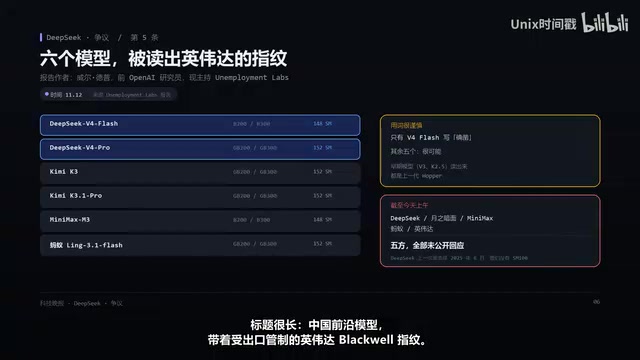
The method itself is elegant, in four steps: before training starts, tune parameters based on C cardinality (per the original wording), and generate layouts using the Philox algorithm; the algorithm allocates based on the number of ICMs on the GPU, and each generation's layout differs — 132 units shipped, with differences among B200 and B300, GB200 and GB3; during training, change parameters it has seen, and for words never appearing in the training set, that row's initial values remain untouched, like fossils; finally, reverse-search by restarting massive seed layouts and validating with rows not participating in the search.
But the report itself draws three lines: weakest 4.9 standard deviations, strongest 138.5, random hit 1.8. The author made a B300 chart and reproduced bit by bit the untouched portion of V4 Flash; swapping to A700, nothing matches. But he also states clearly: it only proves the initialization used which generation of card, not where the cards are or who owns them.
More interesting is the counter-evidence. The same method on D3 reads out as good (per the original wording), and the generation matches; but D4.1 Flash comes out as paper pellets, finding nothing. Domestic media said this "signs that domestic cards are used," but we should pour cold water — models that changed frameworks or ran night races CC also have no fingerprints; not finding them cannot be reversed into "not used," nor can it be asserted that NVIDIA was definitely used. On the capital side, just one note: according to British media claims, in the October funding round one party came in through an entity set up by someone else — single source, no response, and it doesn't explain where the chips went.
Standard deviation (σ) in statistics measures how much data deviates from the mean. In chip traceability "fingerprint matching" analysis, the report uses standard deviations to express the gap between observed layout features and random guessing: 4.9σ means the probability of a random hit is extremely low, 138.5σ is almost impossible to be coincidence, and 1.8σ is generally considered insufficient evidence. The author uses this metric to distinguish "confirmed" from "highly likely," essentially quantifying evidence strength rather than giving a definitive conclusion. Understanding this is necessary to see why the report emphasizes "only proves which generation of card the initialization used, not where the cards are or who owns them."
NVIDIA: After the Leadership Change, Only Three New Numbers to Add
The video author deliberately reminds: NVIDIA said enough yesterday; today we only add three new numbers. First, stock price — intraday on the 12th it fell as much as 14%, closing down 4.34%, losing $182 billion in a day. Second, ratings — multiple investment banks cut target prices, one canceled outright. Third, calendar — earnings after market on the 17th, Kress's first public appearance.
One more detail: an internal employee poll showed 97% hope he stays (per the original wording). That number says more about the company's internal state than the stock price.
Why put these two things together? Because they share a supply chain narrative: one report says Blackwell can be read out, another says the funding list hides people who can get Blackwell. Both are indirect evidence, neither conclusive, but they point to the same question: how did these cards actually get in?
Price target is an investment bank analyst's forecast of a stock's price over the next 12 months, often used for rating adjustments. A cut target implies lower expected returns and may trigger selling; outright "canceling" a target is rarer, usually indicating the analyst sees too much uncertainty for a reliable valuation. After NVIDIA's leadership change, multiple banks cutting targets reflects concerns about strategic continuity under new management and supply chain risk, not merely predictions about earnings numbers.
Other Signals Worth Noting
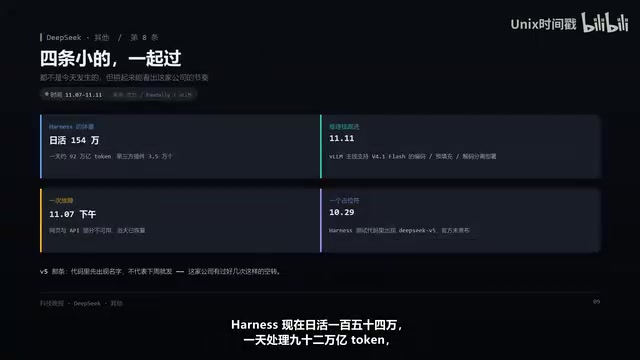
According to the video roundup, a few smaller threads: Harnis is active again, 1.54 million, 92 trillion dimensions processed per cycle, 35,000 third-party plugins; on the 11th the D1LM mainline supported three-tier augmented deployment of D4.1 Flash (per the original wording), one-code pre-charge, reduced code can open expansion; on the afternoon of the 7th the web and API had a partial outage, now recovered; on October 29 a GPC V5 placeholder appeared in special news code, and the author reminds not to treat it as a launch event.
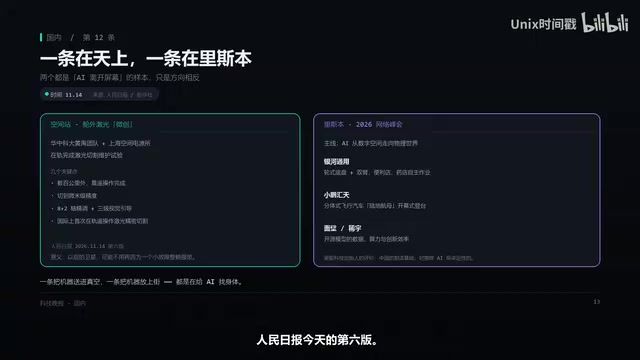
Two more news items with stronger on-site feel: the domestic space station completed a "surgery" — a device by the Huazhong University of Science and Technology team and Shanghai Space Store employees (per the original wording) performed on-orbit extravehicular laser cutting, remotely operated from hundreds of kilometers away, cutting to micron precision, a world first. The other is in Lisbon, at the 2026 Web Summit (per the original wording), where Chinese companies stood in the middle: Galaxy General's wheeled dual-arm robot picked goods by itself in a simulated power store, and XPeng AeroHT's split-type flying car "Land Aircraft Carrier" appeared. The opening discussion's main thread was clear: AI is moving from the screen into the physical world.
Industry quick reads: on domestic compute, Tuiteng has shipped over 15 million units cumulatively, with the second 5 million taking only a year and a half; Sugon 8000 is a 100,000-card machine, revealed in July on the national supercomputing internet. On AI designing chips, K3 used open-source EDA to complete a 4-square-millimeter chip on 45nm, with gate count 3.8 max (per the original wording), running from spec revision through design to physical implementation, but industry evaluation is: still in early stages, some distance from commercialization.
Open-source EDA refers to electronic design automation toolchains with public source code, covering logic synthesis, place-and-route, physical verification, and more. Traditional EDA is monopolized by a few vendors like Synopsys and Cadence, with high licensing fees. K3 using open-source EDA to complete a 4-square-millimeter chip on 45nm is significant in validating the full "spec-to-physical-implementation" flow and lowering the tape-out barrier. But the industry says "some distance from commercialization" because open-source tools still cannot match commercial tools in advanced processes, yield optimization, and signoff accuracy; 45nm is also a mature process, far from mainstream advanced nodes.
Tying It All Together
On product, DeepSeek is the most aggressive, splitting the entire application into APIs. In narrative, it is caught between two questions: where do the chips come from, and who are the shareholders. And NVIDIA's leadership change happens to give both questions an additional strong responder (per the original wording). Next coordinates: NVIDIA earnings on the 17th, Anthropic listing on the 19th.
Related articles

GPT-6.2 Astra and Sol Released: Dual-Model Architecture and Community Buzz
OpenAI releases GPT-6.2 with Astra and Sol models. This article summarizes the official announcement and Hacker News discussion, analyzing the potential impact of the dual-model architecture on developers and offering selection advice.

Gmod TTT Egyptian-Themed Map: Space Capitalism vs. the Pharaoh
Explore the fun of a Gmod TTT Egyptian-themed map: players pick roles like pharaoh, teleport to space via a cube, and engage in a humorous capitalism vs. communism showdown with chaotic prop fighting.

GraphRAG: Beyond Search, Toward Global Knowledge Discovery
GraphRAG is a knowledge-graph-enhanced retrieval technology from Microsoft Research that goes beyond local search in traditional RAG to enable global knowledge discovery. This article introduces its core ideas, generational evolution, and healthcare use cases.