DeepSeek Open-Sources Its First Vision Model, Dramatically Lowering the Bar for Multimodal Agents
DeepSeek open-sources its first vision model, dramatically lowering the multimodal Agent barrier for developers.
DeepSeek open-sources V-Flash-Vision-XP, its first multimodal model approaching Claude Opus 4.8 in Agent benchmarks. Alibaba Tongyi launches multi-agent video creation teams, while the agents.md standards dispute highlights interoperability challenges. OpenCloud 2.0 introduces shared cloud sessions, Hugging Face open-sources a sub-$400 bipedal robot, and ChatGPT's ad platform hits $1B annualized revenue.
DeepSeek Open-Sources Its First Vision Model, with Multimodal Capabilities Approaching Opus 4.8
DeepSeek has officially open-sourced the first multimodal model in its V series — DeepSeek-V-Flash-Vision-XP — on Hugging Face. Released under the MIT license, the model's weights and inference code are fully open, allowing developers to freely pull, deploy, and build upon it.
As a model with native vision input support, its biggest highlight is a "no-compromise" approach: it gains multimodal capabilities while fully preserving V-Flash's original pure-text reasoning performance. This is critical — many previous multimodal models sacrificed text reasoning ability in exchange for visual understanding. Multimodal Models typically need to embed a visual encoder (such as ViT) at the architecture level and map visual features into the language model's representation space through cross-modal alignment training. This process is highly prone to "capability regression," where the original language reasoning accuracy degrades while adapting to the new modality. DeepSeek's claim of fully preserved text capabilities suggests they may have employed strategies like freezing core language layers and incremental visual adaptation to avoid this long-standing issue. In multimodal Agent benchmarks, its capabilities are already approaching Claude Opus 4.8, a top-tier closed-source model.
For developers looking to build local GUI Automation or multimodal Agents, this is arguably the most worthwhile open-source foundation to pull down and try immediately. GUI Automation requires models to understand UI elements like buttons and text fields in screenshots and execute corresponding click and input commands, demanding extremely fine-grained visual understanding. This model has truly brought the barrier of "running multimodal Agents locally" within reach of individual developers.
Alibaba Tongyi Launches Multi-Agent Video Creation Team
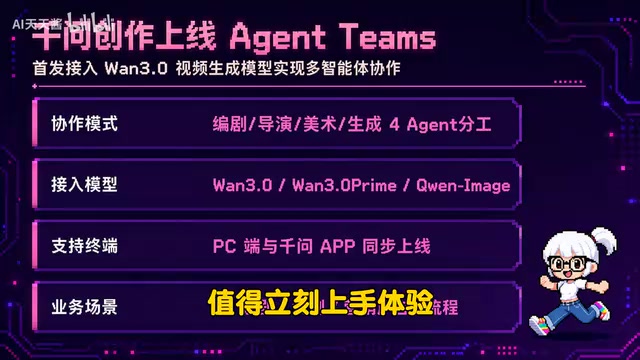
Moving from model foundations to content creation workflows, there's also notable progress. Alibaba's Tongyi Creation has officially launched its Agent Teams multi-agent collaboration feature, simultaneously integrating the full-parameter versions of Wan 2.0 and Wan 2.0 Prime video models.
Multi-Agent collaboration systems represent a major trend in current AI application architecture. The core idea is to decompose complex tasks into subtasks handled by specialized Agents, coordinated through an Orchestration Layer — a design that borrows from the microservices architecture philosophy in software engineering, where each Agent functions as an independent "service node." Wan 2.0 is the latest version of Alibaba's Wanxiang series of video generation models, featuring high-fidelity text-to-video capabilities. The "full-parameter version" refers to the unquantized model that retains all parameters, delivering higher generation quality but requiring more compute.
The system's design logic is quite imaginative: users simply input a story concept, and four Agents — screenwriter, director, art designer, and video generator — automatically divide the work, progressing from script expansion and storyboard design all the way to final rendering, forming a fully automated pipeline.
For teams producing AI short dramas or overseas advertising content, this "role-based division of labor" packaging approach is extremely valuable. In traditional AI short drama production, going from script to storyboard to final cut requires manually using different tools step by step and connecting them by hand. An end-to-end Agent pipeline essentially uses AI to replace the "project management" coordination role, dramatically reducing the operational complexity from concept to finished product. That said, the flexibility and controllability of such highly packaged black-box pipelines still need real-world validation.
The Agents.md Standards Battle: Ecosystem Lock-in Sparks Industry Pushback
No matter how good the tools are, if they trend toward ecosystem lock-in, developer frustration follows. A notable controversy that day centered around configuration file standards.
The CEO of Copify publicly stated: if Claude Code continues to refuse reading the industry-standard agents.md configuration file, the company will ban it internally. Over 60,000 open-source projects currently use agents.md, but Anthropic has repeatedly marked developers' compatibility requests as "no plans."
agents.md is a community-driven configuration file standard designed to let developers define AI coding assistants' behavioral rules, context boundaries, and tool-calling conventions in a unified format for specific projects — similar to how .editorconfig standardizes editor behavior. When teams use multiple AI coding tools simultaneously (such as GitHub Copilot, Cursor, Claude Code, etc.), if each tool only accepts its own proprietary configuration format, engineers are forced to maintain multiple configuration files for the same set of rules.
Behind this is a real engineering pain point: in codebases maintained by large-scale teams, format barriers force engineers to write extensive synchronization scripts. For enterprise development teams, if cross-tool configuration standards can't be unified, the maintenance cost of multi-Agent collaboration will quickly erode efficiency gains. This controversy essentially reflects the increasingly urgent demand for "interoperability standards" in the Agent era — similar to the browser standards wars of earlier years, when ecosystem tools become sufficiently diverse, interoperability standards become critical infrastructure for reducing systemic friction.
OpenCloud 2.0 Rewrite: Shared Cloud Sessions as the Core Upgrade
The open-source agent project OpenCloud officially released its 2.0 rewrite that day. This update involved 933 contributors merging over 16,000 code commits in a complete architectural overhaul.
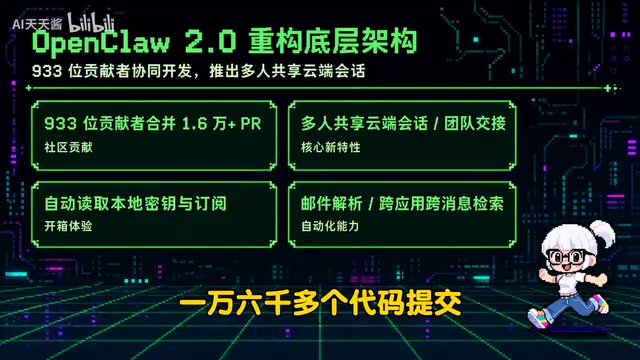
Beyond auto-detecting local keys for out-of-the-box usage, the most significant upgrade is the introduction of shared cloud sessions — team members can jointly access the same Agent's processing flow for task handoffs. Traditional AI Agent interactions typically follow a single-user session model, where one user starts an Agent instance with completely private context and state. Shared cloud sessions break this limitation: after one developer has the Agent complete the first half of a code review, a colleague can seamlessly take over the remaining fix work without re-describing the full background to the Agent. The technical challenges here lie in concurrent session state management and access control — ensuring that simultaneous multi-user operations don't create state conflicts while maintaining fine-grained permissions for sensitive information.
This feature is highly significant for collaborative automation scenarios: it evolves Agents from "personal tools" to "team assets," representing the progression of Agents from personal productivity tools to team collaboration infrastructure. Developers looking to set up automated assistants within their teams can save considerable redundant effort by upgrading to 2.0.
Embodied AI Open-Source Barrier Drops: A Bipedal Robot for Under $400
Beyond software-only Agents, the open-source barrier in embodied AI has also dropped significantly. Hugging Face's robotics team has open-sourced MicroDuck, a mini bipedal robot costing under $400.
This robot stands 25 cm tall, weighs 800 grams, runs on an RK3566 chip, and features 15 servos across its body. Its walking, fall-recovery, and grasping motions are entirely based on reinforcement learning — trained in simulation environments and seamlessly transferred to the real robot through Domain Randomization. Reinforcement Learning enables agents to learn optimal behavioral strategies through repeated trial-and-error interaction with the environment, making it particularly suited for locomotion control tasks like walking and balancing that are difficult to precisely program through rules. However, training robots directly in the real physical world is prohibitively expensive and risks hardware damage, so researchers typically first train policies in physics simulators (such as MuJoCo or Isaac Gym). The sim-to-real transfer faces the so-called "Reality Gap" — discrepancies in friction, inertia, sensor noise, and other factors between simulation and reality. Domain Randomization addresses this by randomizing these physical parameters during training, forcing policies to develop robustness to environmental variations so they remain stable when deployed on real hardware.
The underlying software is written entirely in Rust with support for automatic firmware rollback. Rust was chosen for its dual advantages of memory safety and real-time performance in embedded scenarios — Rust's zero-cost abstractions and garbage-collection-free design make it particularly well-suited for resource-constrained robot control systems.
This fully open-source hardware-software package is extremely attractive for developers looking to get started with embodied AI and reinforcement learning at low cost, making it an ideal choice for prototype validation. It marks the rapidly compressing entry cost for embodied AI.
ChatGPT Ad Platform Hits $1 Billion Annualized Revenue, Accelerating Commercialization
OpenAI announced that the ChatGPT advertising platform has surpassed $1 billion in annualized revenue within less than 200 days of launch, while simultaneously opening its self-serve advertising platform to over 40 countries worldwide. Annual Run Rate is a metric that extrapolates current revenue levels on an annual basis and doesn't equate to actual full-year revenue, but the $1 billion scale already demonstrates the commercial viability of advertising models in AI conversational products.

The company emphasized strict separation between ad content and conversational responses, stating that private chat records are never used for targeted advertising. The platform currently operates primarily through Conversion APIs and CPC (cost-per-click) bidding models. Unlike traditional search ads based on keyword matching, conversational advertising needs to understand semantic intent across multi-turn dialogues while ensuring recommendations don't intrude on the conversation experience. OpenAI's emphasis on "conversation isolation" implies that the ad system and conversation generation system are architecturally decoupled — the ad engine likely performs matching based on coarse-grained topic classification of conversations rather than reading specific conversation content. The Conversion API allows advertisers to feed offline or off-site conversion data back to the platform to optimize ad delivery, while CPC is the classic advertising billing model that charges per actual click.
While accelerated commercialization could make free-tier quotas more generous, how the balance between product experience and ad interference evolves remains worth watching.
A Dark Horse in Domestic On-Device Models Rises, Plus a Security Warning
In the on-device local model space, a domestic dark horse deserves attention. The latest MCP-specific testing report from the China Academy of Information and Communications Technology (CAICT) shows that the 27B local large model from Shanghai Yuandian Xinhui ranked second in multi-tool collaborative comprehensive evaluation, with a total score even surpassing previous lightweight models with over 200 billion parameters.
MCP (Model Context Protocol) is a standardized protocol proposed by Anthropic and gradually adopted by the industry, defining how AI models interact with external tools and data sources. MCP-specific testing focuses on evaluating models' accuracy, stability, and collaborative efficiency when calling multiple external tools — for example, whether a model can correctly parse structured data returned by tools and use it for subsequent reasoning. As China's authoritative ICT research institution, CAICT's test results carry significant industry credibility.
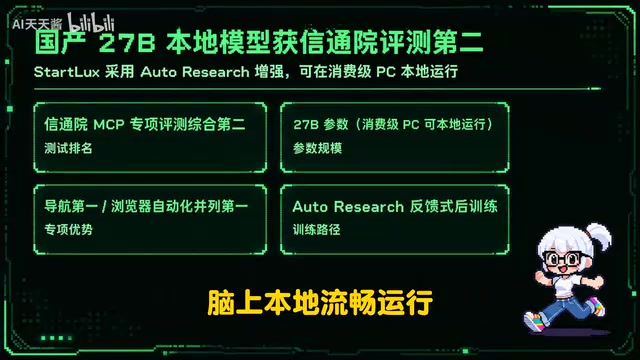
The model is built on the open-source Qwen (Tongyi Qianwen open-source series) as its base, enhanced with proprietary feedback training methods, reflecting the current mainstream technical approach of "open-source foundation + domain-specific enhancement." A 27B parameter model can run inference on consumer-grade GPUs with sufficient VRAM (typically 16GB or more). Its achievement of outperforming larger-parameter models in multi-tool collaborative tasks demonstrates that targeted training strategies can effectively compensate for parameter scale gaps in specific task scenarios. For individuals and small businesses who prioritize data privacy and prefer not to rely on cloud APIs, the practicality of smaller local models is improving dramatically.
Finally, a security reminder. Anthropic has urgently issued a security alert to some users: information-stealing malware has recently been specifically targeting login credentials stored in local browsers. These malicious programs (commonly known as Infostealers) scan browser-stored Cookies, Session Tokens, and saved passwords, exfiltrating them to attackers who can then use stolen session tokens to bypass passwords and even two-factor authentication to directly access victims' accounts. To prevent unauthorized excessive charges on affected accounts, Anthropic has revoked payment permissions and reset sessions for these accounts, while reminding developers to never download and use cracked tools or third-party clients from unknown sources. API keys and web sessions must be properly isolated — reset credentials immediately if anything unusual is detected.
Related articles

A World First in Australia: Delivery Riders to Receive Minimum Wage Guarantee
Australia introduces the world's first minimum wage guarantee for delivery riders, balancing gig flexibility with income protection. Explore the agreement's details, platform impacts, and global regulatory trends.
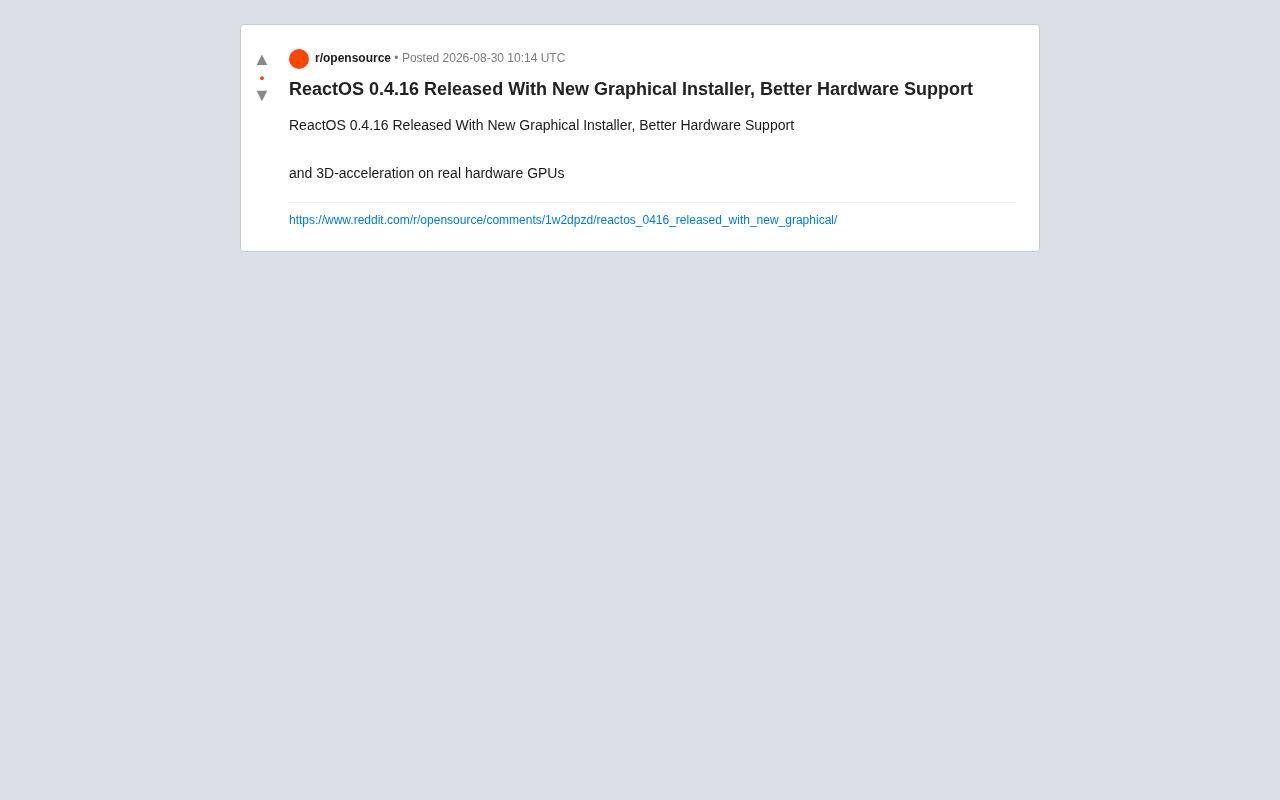
ReactOS 0.4.16 Released: Graphical Installer, 3D Hardware Acceleration, and Broader Hardware Support
ReactOS 0.4.16 ships with a new graphical installer, real hardware GPU 3D acceleration, and broader hardware compatibility for this Windows NT-compatible open-source OS.

Getting Started with Vibe Coding: Build Your First Project with AI from Scratch
Learn what Vibe Coding is and how to build your first project with AI tools like Cursor, Claude Code, and Codex — plus advance into Agent development and LangChain.