DeepSeek Open-Sources Its Inference Engine: Lowering the Barrier to LLM Deployment

DeepSeek quietly open-sources its inference engine, closing the private deployment loop for self-tuned inference.
DeepSeek announced its inference engine is open source via a brief Hacker News post. The engine handles graph optimization, KV Cache, batch scheduling, and quantization, determining throughput and deployment cost. Open-sourcing lets developers reproduce the official inference path, tune for their hardware, and close the private deployment loop from weights to runtime. Early community reaction was muted given established projects like vLLM and SGLang; differentiation and licensing are key watch points.
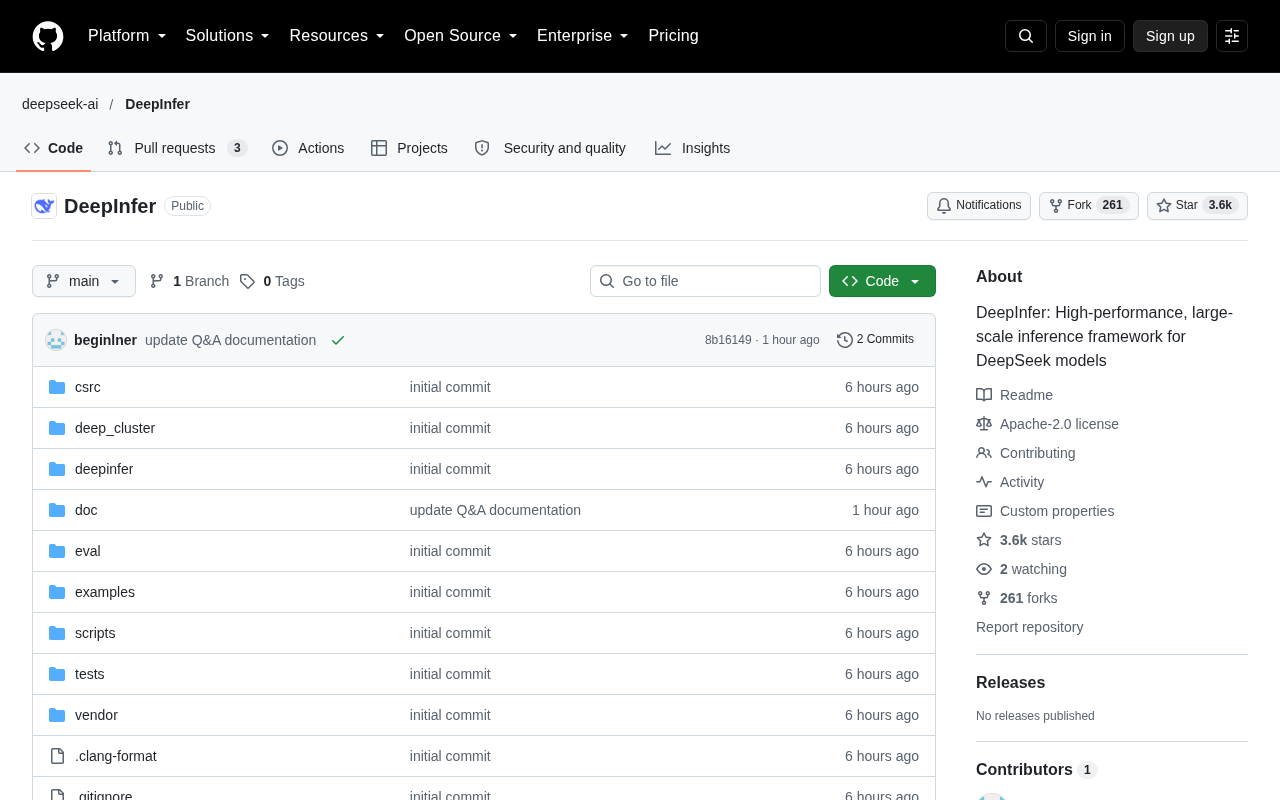
DeepSeekAd posted a brief message on Hacker News: its inference engine is now officially open source. No overwhelming marketing campaign, no lengthy technical blog post—just one sentence and a GitHub link. But the ripples this message set off in the developer community are far larger than they appear on the surface.
Why an Open-Source Inference Engine Matters
A large model's capability ceiling is determined by training, but the floor of its real-world experience is often determined by the inference engine. With the same model weights, swapping in a different inference implementation can mean several times the difference in throughput and dramatically different latency. The inference engine handles the "dirty work"—computation graph optimization, KV Cache management, batch scheduling, quantization strategy selection—and directly determines whether a model can actually run in real business scenarios and whether it runs cost-effectively.
In the past, these core components were mostly treated by each company as an engineering moat, offered externally only as APIs. DeepSeek's choice to open-source its inference engine in full means developers can locally reproduce the inference path of its official service, rather than guessing parameters against a black box.
KV Cache is the core memory structure in autoregressive inference for large models. When generating each new token, the model needs the Key and Value vectors of all previous tokens; if recomputed every time, the cost grows quadratically with sequence length. KV Cache stores these intermediate results so that each token in the decoding phase requires only one forward computation. The cost is that GPU memory usage rises linearly with context length—in long-context scenarios this is often the memory bottleneck. The inference engine must therefore balance paged management (such as PagedAttention), prefix sharing, quantized caching, and eviction strategies; these implementation details directly determine how long a context and how large a concurrent batch can be supported.
Batch scheduling refers to how the inference engine assembles requests arriving at different times and with varying lengths into batches sent to the GPU. Static batching waits for requests to accumulate, resulting in high latency; continuous batching dynamically inserts and removes requests at each decoding step, significantly improving throughput. The scheduler must also trade off throughput against latency, deciding preemption, priority, and fairness policies. This is precisely the key switch that closed-source API users cannot touch but that an open-source engine hands back to its users.
The Practical Value of an Open-Source Inference Engine
From "Usable" to "Tunable"
The typical dilemma of closed-source APIs is that you can only control input and output; every optimization switch in between is none of your concern. An open-source inference engine returns control over scheduling policies, memory allocation, and operator fusion to the user. For scenarios requiring long contexts or high-concurrency requests, this means targeted tuning for your own hardware configuration rather than passively accepting a provider's generic settings.
The Key Piece for Private Deployment
For data-sensitive enterprises, open-sourcing the inference engine solves the "last mile" problem. Model weights may be open source, but if the inference stack is not, private deployment still depends on a third-party runtime. With DeepSeek filling in the engine, the complete chain from weights to inference can be closed-loop within your own data center—directly appealing to industries with strict compliance requirements such as finance and healthcare.
Private deployment refers to enterprises deploying both model weights and inference runtime entirely within their own or dedicated cloud environments, with data never leaving the internal network. The complete chain typically includes: model weights, the inference engine (responsible for computation graph execution and scheduling), the service layer (request routing, authentication, rate limiting), and monitoring and operations tools. Open-sourcing weights only solves the first link; if the inference engine remains a third-party closed-source runtime, then performance tuning, troubleshooting, and security auditing are all subject to others. With the inference engine open-sourced, enterprises can perform code-level auditing and customization across the entire chain—particularly critical for regulated industries to satisfy compliance reviews.
The Community Can Participate in Performance Polishing
Performance optimization of inference engines depends heavily on specific hardware and workload characteristics. Once open source, the community can feed back performance data across different GPU models and different sequence-length distributions, driving targeted optimizations. This distributed polishing is often more efficient than a single team working behind closed doors.
Community Reaction and Potential Impact
The Hacker News discussion had only 3 comments and 34 points, but that number itself is telling: the news did not attract a large crowd in its early hours, and discussion heat was relatively restrained. This may be related to DeepSeek's low-key release style, or because open-sourcing an inference engine is no longer a rare move—projects like vLLM, SGLang, and TensorRT-LLM have somewhat diminished the marginal novelty of "yet another inference engine."
The real point of interest is differentiation. If DeepSeek's inference engine is deeply bound to its model architecture, its performance on its own models may exceed that of general-purpose frameworks. For developers building on DeepSeek models, this is an option worth benchmarking. But if it only supports its own models and has a closed ecosystem, its applicability will be limited.
Another dimension worth watching is the license. The open-source license of the inference engine determines whether it can be confidently integrated into commercial projects; this point was not elaborated in the original information and needs follow-up verification.
The vLLM, SGLang, and TensorRT-LLM mentioned in the article represent three current approaches to inference engines: vLLM is known for PagedAttention and ease of use, with an open ecosystem and broad model coverage; SGLang focuses on structured generation and prefix caching, with advantages in complex prompting scenarios; TensorRT-LLM is led by NVIDIA, deeply bound to its own hardware, and squeezes out extreme performance through compilation optimization. For a new engine to establish itself, it usually needs to differentiate through performance advantages on specific models, a lower deployment barrier, or a more permissive license—otherwise it will struggle to win users from mature projects.
Practical Advice for Developers
If you are evaluating inference deployment options, you can add DeepSeek's engine to your comparison list, but do not rush to replace your existing stack. Consider validating along the following path:
- First run the official benchmark scripts on your target hardware to confirm baseline throughput and latency numbers
- Compare against the framework you currently use (such as vLLM) under the same workload, focusing on the two extreme scenarios of long context and high concurrency
- Check whether the license terms match your distribution method
- Evaluate community activity and issue response speed—the long-term maintenance cost of an inference engine cannot be ignored
Open-sourcing an inference engine will not immediately change the market landscape, but it lowers the barrier to "controlling your own inference chain." For teams with customization needs and private deployment requirements, the emergence of such projects means one more option.
One-line Summary
DeepSeek quietly open-sources its inference engine, completing the private deployment loop and letting developers tune the inference chain themselves.
Paragraph Summary
DeepSeek announced the open-sourcing of its inference engine on Hacker News with one sentence and a GitHub link. The inference engine handles computation graph optimization, KV Cache management, batch scheduling, and quantization strategies, directly determining model throughput, latency, and deployment cost; it was previously often treated as an engineering moat and offered only as an API. With the open source release, developers can locally reproduce the official inference path, tune for their own hardware, and complete the private deployment loop from model weights to inference stack—especially attractive to compliance-heavy industries like finance and healthcare. Initial community reaction was restrained because projects like vLLM, SGLang, and TensorRT-LLM already occupy the market; differentiation and license terms become key points for follow-up observation. The article advises developers to first benchmark on target hardware and then compare with existing frameworks before deciding.
Related articles

JobRunner MCP Server: AI Agents Can Now Fix Failed Java Jobs
JobRunner launches an open-source MCP server enabling AI agents to view cluster status, diagnose failures, and recover Java jobs—incident response from any cloud coding environment or existing agent.

MLAI Digital Launches 9 Security Agents: MCP Server Safeguards the Full Lifecycle of Agentic AI
MLAI Digital launches Security MCP Server with nine built-in specialized security agents covering vulnerability discovery, attack simulation, prompt injection detection, API and infrastructure assessment, and accelerated remediation—embedding security validation across the full Agentic AI lifecycle from development to production.

Running Isaac Lab on H100 GPUs: Exploring Better Approaches
Exploring optimization methods for running Isaac Lab on NVIDIA H100 GPUs, including MIG configuration, mixed precision, TensorRT acceleration, and community experience to improve robotics simulation and reinforcement learning efficiency.