DeepSeek's Benchmark Cost Is Just 1/44 of Claude's Flagship, Meituan Open-Sources 1.6 Trillion Parameter Model

Claude Fable 5.2 tops the intelligence chart, but benchmark cost is 44x DeepSeek's as open-source players counter with cost-effectiveness.
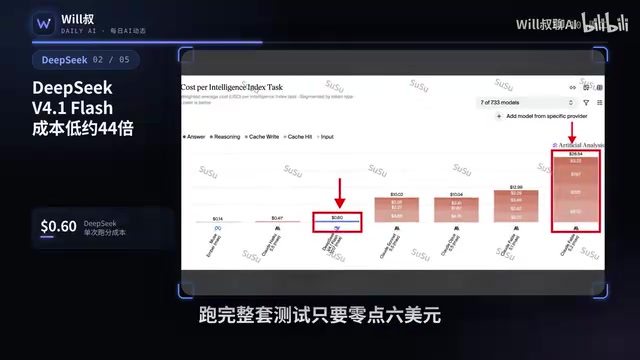
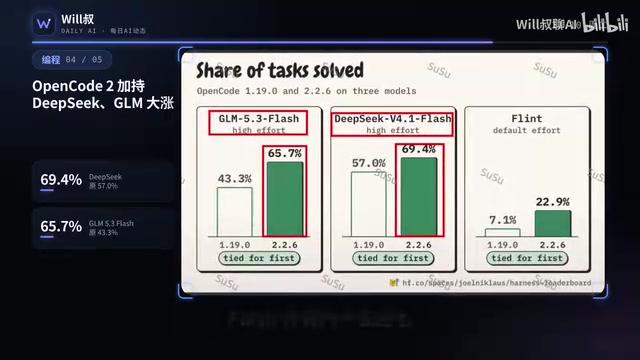
Anthropic's new flagship Claude Fable 5.2 scored 65 on the Artificial Analysis Intelligence Index, ranking first, with 81.2% on ARC AGI3. Despite a 20% price cut from the previous generation, running the full test suite still costs $26.54. By comparison, DeepSeek V4.1 Flash completes the same suite for just $0.6 — about a 44x gap — though the flagship still leads on complex reasoning. Meanwhile, Meituan open-sourced LongCat 2.5 with 1.6 trillion total parameters and ~48 billion activated, natively multimodal under the MIT license; after switching its coding agent to OpenCode2, DeepSeek V4.1 Flash's solve rate rose to 69.4% with per-problem cost down to $0.45; and ByteDance's Seed Dream 5.5 focuses on engineering refinements like transparent background output and text accuracy. The article distills three competitive logics: flagships defending the high end, open source driving down costs, and image models honing deployment details.
Anthropic's new flagship Claude Fable 5.2 has taken first place on the intelligence index, but a cost comparison from Artificial Analysis shows that running the same test suite costs just $0.6 with DeepSeek V4.1 Flash versus $26.54 with Fable 5.2 — a gap of about 44x. This news comes from the daily AI roundup by Bilibili creator "Will叔", alongside Meituan open-sourcing a massive model and ByteDance upgrading its image model.

Claude Fable 5.2 Tops the Chart, but Price Remains a Hard Barrier
Anthropic's Claude Fable 5.2 scored 65 on the Artificial Analysis Intelligence Index, ranking first overall, and achieved 81.2% on the ARC AGI3 standard test — a new high. On pricing, the new flagship is 20% cheaper than the previous generation — a significant concession that shows Anthropic is also feeling the pressure on cost-effectiveness.
But a 20% cut clearly isn't enough. According to Artificial Analysis data cited by the creator, running the full intelligence index test suite costs $26.54 for Fable 5.2. That number isn't outrageous among flagship models, but once you put it on the same table as open-source models, the gap becomes glaring.
The Artificial Analysis Intelligence Index is a comprehensive benchmark maintained by independent evaluation firm Artificial Analysis. It aggregates results from multiple public tests (math, science, coding, instruction following, etc.) into a normalized score for cross-vendor comparison of general intelligence. It's not a single exam score but a weighted composite, so rankings reflect multidimensional average performance — individual specialized capabilities may get flattened out.
ARC AGI3 comes from the ARC Prize competition, which uses visual grid puzzles that are solvable by human toddlers but require abstract reasoning. The problems are deliberately designed to avoid relying on pattern memorization from training data, and are often seen as a measure of "fluid intelligence" rather than knowledge. The significance of 81.2% is that it achieves high accuracy on problem types that differ substantially from the training distribution.
DeepSeek's Cost Advantage: Slightly Lower Scores, Crushing Cost-Effectiveness
On the same test suite, DeepSeekAd V4.1 Flash costs $0.6. Compared to $26.54, that's about a 44x difference.
To be clear, this doesn't mean DeepSeek's overall capability has caught up with Fable 5.2 — the flagship model does score higher and still has advantages on complex reasoning and difficult problems. But if you shift the perspective to "how much intelligence can you buy per unit cost," the conclusion is completely different: for high-frequency scenarios like bulk everyday tasks, agent calls, and code generation, a 44x cost difference is enough to change technology choices.
This is also a structural feature of the current model market: closed-source flagships hold the ceiling on absolute capability, open-source models keep pushing down the cost curve, and their intersection point is spreading into more business scenarios.
Meituan LongCat-2.5 Open-Sourced: 1.6 Trillion Parameters, MIT License
Meituan has open-sourced the model weights for LongCat 2.5: 1.6 trillion total parameters, approximately 48 billion activated, native multimodal design, with visual understanding and agentic coding as its two flagship capabilities, under the MIT license — meaning minimal commercial restrictions.
Trillion-parameter open-source models have been rare until now, and the 48 billion activation count indicates it follows a MoE approach: total parameters sustain knowledge capacity while activated parameters control inference cost. Native multimodality plus a permissive license makes it a ready-to-use option for teams wanting to build their own multimodal agent capabilities.

MoE (Mixture of Experts) is a sparse activation architecture: the model contains multiple "expert" subnetworks, and only a few are activated per forward pass. So "total parameters" measures the model's knowledge capacity ceiling, while "activated parameters" determine the compute cost of a single inference. With 1.6 trillion total parameters and 48 billion activated, its memory footprint and inference cost are roughly comparable to a medium-sized dense model, but with a broader accessible knowledge base.
The MIT License is among the least restrictive permissive open-source licenses: it allows commercial use, modification, redistribution, and even use in closed-source products, with the main obligation being to retain copyright and license notices. For teams wanting to do secondary training on the weights or embed them in commercial products, this license carries significantly lower legal risk than licenses with commercial-use restrictions.
Coding Agent Swaps Its Base: Solve Rate and Per-Problem Cost Change Together
The creator also mentioned a noteworthy detail: after the coding agent Harness switched to OpenCode2, DeepSeek V4.1 Flash's solve rate rose to 69.4%, Zhipu G1M5.3 Flash rose to 65.7%, and the cost per problem solved dropped to $0.45.
This data illustrates two things. First, agent performance depends not only on the underlying model — the fit between orchestration framework and toolchain is equally critical. The same model with a different Harness can show notable solve rate improvements. Second, at $0.45 per problem, the cost is approaching the "scalable deployment" range, and barriers to coding agents moving from small-scale experiments to everyday production tools are diminishing.
Harness (agent orchestration framework) refers to the entire loop wrapped around the underlying model: task decomposition, tool calling, code execution and feedback, error retry, context management, and more. The same model performs very differently under different Harnesses, because solve rate depends not only on the model's own reasoning ability but also on whether the framework can effectively feed failure information back to the model and reasonably control context length to contain costs. That's why "switching Harness improves solve rate" — the orchestration strategy fundamentally changes the information available to the model and the number of retry attempts.
ByteDance Seed Dream 5.5: Image Generation Targets Practical Details
ByteDance has released image model Seed Dream 5.5, with two very specific improvements: up to 100 consecutive refinement rounds on a single image, transparent background output, and text corruption rate reduced to 0.4%.
Transparent backgrounds and text accuracy are the two most common pain points when deploying image generation — the former affects whether assets can go directly into design workflows, the latter determines whether generated posters and UI mockups are usable. Optimizing these two metrics specifically shows that competition in image models has shifted from "does it look good" to "can it be used directly."
Three Competitive Logics in a Single Day
Looking at these news items together reveals three approaches in today's AI industry: Anthropic defends its high-end positioning with flagship capability while testing the waters with modest price cuts; DeepSeek and Meituan open up scalable scenarios with open source plus low cost; ByteDance goes deep on engineering details in image generation. For developers, factoring "how much effective intelligence per dollar" into technology choices may be more practical than fixating on the #1 spot on the leaderboard.
(The above information is compiled from the daily AI roundup by Bilibili creator Will叔; cost and benchmark data are cited from the Artificial Analysis test results he referenced.)
Related articles

Abnormal Error Rate Spike in Claude Mythos 5.2 and Fable 5.2
Claude Mythos 5.2 and Claude Fable 5.2 show an abnormal spike in request error rates, marked as investigating on the official status page. This article covers the incident overview, practical impact on developers, and recommended responses.

ReAct Runtime Context Trimming: Why Claude Code Acts at 70%
A deep dive into ReAct runtime context trimming: why Claude Code compresses at ~70% usage, why tool calls dominate, why messages must be dropped in pairs, and why codebases don't need RAG.

AI Agent vs LLM: How Cursor and Claude Code Actually Work
An in-depth analysis of the essential difference between AI Agents and LLMs: LLMs generate code suggestions, while Agents modify files and run tests via tool calls. Using a Spring Boot bug fix as an example, it breaks down the workflows, permission control, and verification mechanisms of Cursor and Claude Code.