DeepSeek's Open-Source Inference Engine DeepInfer Tested: The Truth Behind the "3x GPU Performance" Claim

DeepInfer's "3x GPU performance" is a misread baseline — it's an offline inference engine on par with VLLM and SGLang.
The article unpacks DeepSeek's "3x GPU performance" claim for its open-source engine DeepInfer. The 3x comes from dividing today's $38 per GPU-hour revenue by a theoretical baseline the company itself disavowed; under current off-peak pricing the multiple swings to nearly 12x. The $38 relies on DeepSeek's own pricing, a 96% cache hit rate, and imbalanced traffic. What ships is an offline engine for one model and two hardware types. In same-hardware tests, DeepInfer is roughly on par with VLLM and SGLang.
DeepSeek open-sourced DeepInfer, the inference engine behind its own service, and claims of "3x GPU performance" quickly spread. But after carefully unpacking the official data, it becomes clear that this 3x figure is not a performance gain delivered by the engine — it's an illusion created by the choice of baseline and the way the numbers are counted. This article, based on The Stack's hands-on analysis, clarifies what these numbers actually mean.
Where the 3x Comes From: A Misread Baseline
According to The Stack's tracing, the 3x claim originates from a report DeepSeekAd published earlier. That report estimated revenue for a given day based on theoretical full-load billing, which works out arithmetically to about $13 per GPU-hour. The $38 per GPU-hour mentioned in DeepInfer's deployment notes happens to be close to three times that figure.
The problem is that DeepSeek explicitly stated in the report that actual revenue was significantly lower than the theoretical value — V3 pricing is far below R1, web and app usage is free, nighttime discounts apply, and other factors all drag down real revenue. Using a theoretical upper bound that the company itself has disavowed as the denominator makes the resulting 3x unconvincing.
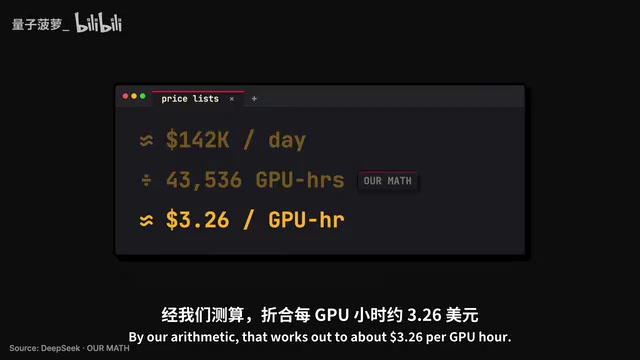
Switch to a different baseline and the conclusion flips entirely. According to The Stack's calculations, the same 2025 traffic priced at current V4.1 Flash off-peak rates yields only about $3.26 revenue per GPU-hour. Divide $38 by $3.26 and the multiple far exceeds 3x. In other words, change the baseline and the multiple swings by several times — which itself shows this metric cannot simply be treated as a measure of engine performance.
What the $38 Really Consists Of: Pricing, Caching, and Traffic Structure
The $38 per GPU-hour figure itself holds up to scrutiny. Applying DeepSeek's published online service table to its official price list produces roughly matching results. But what it measures is DeepSeek's own pricing system and traffic characteristics — not the engine's general-purpose performance.
Large-scale serving splits prefill (reading prompts) and decode (writing answers) across different GPU groups. When a request prefix has appeared within the past three days, the context is read directly from a shared SSD pool exceeding 100PB, billed at one-fiftieth of the normal input price. The cache is retained for 72 hours and can be reused across weekends.
DeepSeek's online traffic structure is highly imbalanced: for every token written, roughly 107 tokens of prompt context are read, of which 96% is already cached. Output tokens written account for less than 1% of total tokens but contribute 39% of revenue. This means the $38 figure depends heavily on its cache hit rate and read/write ratio — change the pricing, cache hit rate, or traffic structure, and the number changes with it.
Prefill/Decode Disaggregation is an architectural strategy for online LLM inference: the "prefill" stage, which processes user prompts and computes the KV cache, is deployed on different GPU clusters from the "decode" stage, which generates the answer token by token. The two stages have radically different compute characteristics — prefill is compute-intensive large matrix math, while decode is memory-access-intensive and serial, limited by memory bandwidth. Once separated, each can use the most appropriate parallelism strategy and hardware ratio, avoiding resource contention. The cost is the need to transfer the KV cache at high speed between the two GPU groups, which places high demands on network bandwidth. DeepSeek's 128-GPU minimum deployment unit (64 prefill + 64 decode) is a direct embodiment of this architecture.
KV Cache (Key-Value Cache) is a core mechanism in Transformer inference. During autoregressive generation, each time the model generates a new token it must compute attention over all previous tokens; to avoid redundant computation, the already-computed Key and Value matrices are cached and reused. The longer the context, the more GPU memory the KV cache consumes — which is the main reason long-context inference is expensive. DeepSeek places the cache in a shared SSD pool exceeding 100PB, reusing it on prefix hits, with hit pricing at one-fiftieth of the miss price. Cache hit rate thus becomes the decisive cost variable — which also explains why its $38 revenue depends so heavily on a 96% hit rate.
What You Actually Download: An Offline Inference Engine
The system earning $38 per hour is not in the download package. The repository README explicitly lists the components required for a complete inference service but not included in this release: the KV cache system that supports high cache hit rates, the physical separation of prefill and decode, and load balancing across data-parallel replicas. The official explanation is that these components are tightly coupled to internal infrastructure — almost identical to what DeepSeek said when it previously released its prefill model.
What is actually delivered is an offline inference engine that supports only a single model, DeepSeek V4.1 Flash, and only two hardware classes: NVIDIA Blackwell-class GPUs and Huawei Ascend 950. Even with Blackwell in hand, the official guidance states that the minimum efficient deployment unit is 64 prefill GPUs plus 64 decode GPUs — 128 in total. A community-contributed PR porting to Hopper (H20) remains unmerged, with maintainers responding that users can maintain it themselves. Since the released code cannot independently provide online service, the community has also submitted unmerged PRs, such as an OpenAI-compatible server, to fill the gap.
The 26,000 token/s Chart: A Best Case Under Ideal Conditions
The published benchmark peaks at about 26,300 output tokens per GPU per second, but this figure comes from 64 Blackwell chips forming a single decode group, with 256 sessions per card and about 16,000 concurrent streams for the whole group. In speculative decoding, the draft model's guess acceptance rate was not measured but simply assumed to be 75%, and the plotting script converts the numbers accordingly. The official benchmark documentation also states that decode throughput accounting does not consider the real acceptance rate.
MoE routing is handled the same way: the benchmark script forces perfectly balanced expert load through environment variables, eliminating the skew present in real traffic. And the point of a 64-GPU decode group is to boost single-user speed, not just throughput — if users are satisfied with about 100 token/s, the per-chip throughput of an 8-GPU group is very close to that of a 64-GPU group; but pushing a single user to 240 token/s, the official chart shows the 8-GPU group dropping to about 1,900 per chip versus about 15,700 for the 64-GPU group.
DeepSeek itself admits that the online service reaches only about 80% of this perfectly balanced offline benchmark, and that the public code is missing a hand-tuned low-level optimization, making the decode kernel another 5-10% slower than the internal version. So 26,000 is a real measurement — but it measures a best case that even the official service cannot reach.
Speculative Decoding is a technique for accelerating generation: a small "draft model" first quickly guesses several candidate tokens, then the large model verifies these guesses in parallel in one pass, accepting the correct ones. Because verification is computed in parallel, overall speed can improve significantly. The benefit depends heavily on the "acceptance rate" — the proportion of guesses the large model endorses. The higher the acceptance rate, the more pronounced the speedup; if guesses are frequently rejected, compute is wasted. Therefore, assuming a 75% acceptance rate without measuring it systematically overestimates throughput: in real traffic the acceptance rate varies with task type and often falls short of this ideal.
Head-to-Head: Nearly Neck-and-Neck with VLLM and SGLang
Within days of DeepInfer appearing on GitHub, the VLLM and SGLang teams published comparisons on the same hardware. VLLM says its decode throughput on GB200 is within 6% of DeepInfer's published curves — unsurprising given that DeepInfer's README states it was initially built primarily on VLLM. VLLM also estimates, at DeepSeek's off-peak prices, that its own full rack costs $38.96 per GPU-hour on an agentic coding benchmark.
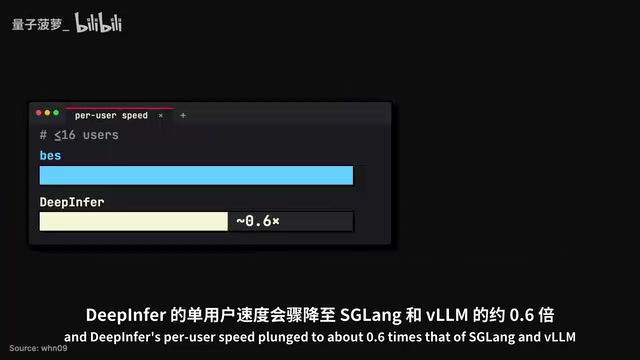
SGLang compared on the same hardware using DeepInfer's own scripts and reports prefill up to 4% faster and decode steps about 7% shorter (under balanced expert routing). Third-party GPUStack tested on a single 8-GPU B200 server: with speculative decoding off, DeepInfer's output speed was about 25% faster than VLLM, but time-to-first-token was about twice that of VLLM. Independent engineer Henan Wang ran agentic coding trajectories on 8 B200s: at 128+ concurrent streams DeepInfer led throughput by about 2%, but below 16 concurrent streams single-user speed fell to about 0.6x that of SGLang and VLLM, because its fused expert kernel still incurs fixed overhead per step on a single request.
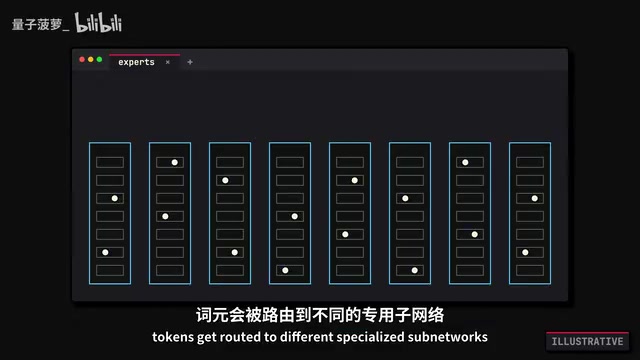
MoE Routing and Load Balancing is the key background for understanding throughput metrics. An MoE model contains multiple "expert" subnetworks, and each token has a few of them activated by a router. Ideally expert load is even and GPU compute is fully utilized; but in real traffic some experts are selected frequently, forming "hotspots" that overload some GPUs while others sit idle, reducing overall throughput. The benchmark script forces perfectly balanced experts via environment variables, effectively removing this real-world bottleneck and measuring an upper bound rather than a typical value. DeepSeek itself acknowledges that online service reaches only about 80% of this benchmark — partly for this reason.
How to Spot These Numbers: First Ask Which Tokens Are Being Counted
The label "tokens per GPU per second" is currently used for three completely different measurements. DeepSeek's 26,000 chart counts output tokens newly written during the decode stage; its prefill performance under the same label jumps to 1.5 million tokens per GPU per second, because it also counts prompt tokens that hit the cache; VLLM's reported 954,000 token/s for a full GB300 rack adds together cached input, uncached input, and output. Public leaderboards like InferenceX are similarly mixed, with the top entry for the same model at about 370,000 per GPU. Seeing 26,000 and 1.5 million under the same column heading — a nearly 60x gap — is not because the chip is faster, but because different things are being counted.
To judge whether a number can transfer to your own workload, check four conditions: which type of token is counted, at what price, what the real cache hit rate is, and how large the hardware group is. Among these, cache hit rate is the biggest lever DeepSeek's price list leaves to users — hit pricing is one-fiftieth of the miss price, so keeping the beginning of agent prompts (long system prompts, fixed tool lists) consistent across calls can significantly reduce costs.
As for "DeepSeek triples GPU performance," the answer is no. The 3x comes from dividing today's revenue by an old report based on different chips, a different model, and an old price list; in direct same-hardware comparisons, DeepInfer is essentially on par with VLLM and SGLang. Its underlying numbers are real, and it is a solid engine with a slight edge under many concurrent agent sessions; but the money comes from DeepSeek's own pricing, cache system, and large-scale decode groups — none of which were included in the release. Users running Hopper hardware or with modest traffic are safer sticking with VLLM or SGLang.
One-line Summary
DeepInfer's "3x GPU performance" is a misread baseline — in reality it's an offline inference engine on par with VLLM and SGLang.
Paragraph Summary
The article unpacks the widely circulated "3x GPU performance" claim behind DeepSeek's open-source inference engine DeepInfer. Tracing it back, the 3x comes from dividing today's $38 per GPU-hour revenue by a theoretical revenue baseline the company itself disavowed; priced at current off-peak rates, the multiple swings to nearly 12x, showing the metric cannot measure engine performance. The $38 itself depends on DeepSeek's own pricing, a 96% cache hit rate, and a highly imbalanced read/write traffic structure, and does not transfer. What is actually delivered is an offline engine supporting only a single model and two hardware classes, with the core cache and load-balancing components unopened. The 26,000 token/s peak comes from a 64-GPU decode group under ideal conditions assuming a 75% speculative acceptance rate and forced expert balance; even the official service reaches only about 80%. In same-hardware comparisons DeepInfer is roughly on par with VLLM and SGLang, slightly ahead at high concurrency and clearly behind at low concurrency.
Related articles

Prompt Engineering for Beginners: From Writing Prompts to Engineering Thinking
Starting from the essence and four functions of prompts, this article systematically explains the six-step process, four success criteria, learning value, and practical limitations of prompt engineering to help you build a complete understanding.

Anthropic Launches Nasdaq IPO: AI Giant's Listing and Risk Disclosures
Anthropic officially launches its Nasdaq IPO under ticker ANT, with market valuation expected to potentially exceed SpaceX's record. The prospectus devotes nearly 100 pages to AI risks, while first-half revenue grew over 14x but net losses widened sharply, reigniting the AI bubble debate.

Rust cURL Clone Uses 4,832 unsafe Blocks—Is the Memory Safety Myth Broken?
A Rust cURL clone uses 4,832 unsafe keywords, challenging Rust's memory safety narrative. We analyze what unsafe really means, compare Fil-C, and examine rewrite motives.