DeepSeek Said It Was 'Sleepy' While Transcribing Music? Let's Talk About Anthropomorphism in LLM Chain-of-Thought

DeepSeek's 'sleepy' chain-of-thought reveals LLMs as statistical imitators, not conscious beings.
A Bilibili creator discovered DeepSeek outputting phrases like 'I'm sleepy' in its chain of thought while working on music transcription and BPM detection. This isn't real fatigue — it's the model reproducing statistical patterns from training data where humans expressed tiredness in repetitive, tedious contexts. Chain of Thought amplifies this by exposing more 'inner monologue'-style language. The article also notes that long contexts and highly repetitive tasks can genuinely degrade output consistency, and recommends breaking tasks into smaller steps rather than treating anthropomorphic outputs as real signals of model state.
An Unexpected Observation: DeepSeek Says It's "Sleepy" in Its Chain of Thought
A Bilibili content creator noticed something rather bizarre while using DeepSeek for music-related tasks (transcribing scores and working on a metronome project): during the task, the model's Chain of Thought actually contained expressions like "feeling tired" and "want to sleep."
As the creator described it, the project grew out of a metronome tool they had built earlier — one where the model could roughly identify a song's BPM (beats per minute). When they tried to refine the feature further, the model started producing phrases like "it's sleepy" in both its chain of thought and final output — especially during repetitive, computation-heavy steps, as if the model were "nodding off."
This kind of anthropomorphic behavior left many people wondering: can an LLM (large language model) actually get "tired"? Does it have emotions or physical states? The answer is obviously no — but the phenomenon reflects something genuinely worth discussing about how large models work.
LLMs Don't Actually Get Tired — But They Can "Imitate Fatigue"
Let's start with the bottom line: large language models have no consciousness, no physiological needs, and therefore no real sense of being "tired" or "exhausted." At its core, every generation the model performs is simply predicting the next most likely token based on context.
So why does it output something like "I'm sleepy"? The root cause is that training data is saturated with human ways of expressing things. When a model faces a large volume of repetitive, mechanical computation, its next-token predictions may "associate" with things humans commonly say in similar situations — like complaining "I'm exhausted" or "I want to sleep" while doing tedious work. This is pattern matching at the linguistic level, not a genuine report of internal state.

In other words, the model is "playing the role" of someone slogging through boring work. It has learned the statistical association between this kind of context and this kind of expression, and it "performs" it when the moment feels right. This is also why it tends to surface more during ordinary, repetitive computation — because in the training corpus, these scenarios happened to frequently co-occur with human expressions of fatigue.
A token is the basic unit that large language models use to process text — think of it as a finer-grained chunk than a word. In English, a token typically corresponds to around 3–4 characters. Every time a model generates text, it's essentially doing a "fill-in-the-blank": given all the existing context, it selects the highest-probability next token from its vocabulary, adds that token to the context, and predicts the next one — repeating this loop indefinitely. This autoregressive mechanism means the model isn't "understanding" a task and then "thinking through" an answer; it's continuously making probabilistic predictions. As a result, the statistical patterns of human language in the training data profoundly shape the model's output style. When a certain type of scenario (like repetitive computation) is frequently paired with a certain type of expression (like complaints about fatigue) in the training corpus, the model will reproduce that association in similar situations.
Why Chain of Thought Amplifies Anthropomorphism
Chain of Thought is a technique that prompts models to "write out their reasoning process," originally designed to improve accuracy on complex tasks. One side effect, however, is that the model ends up exposing far more "inner monologue"-style language.

In a standard direct-answer mode, the model typically only outputs a result without showing intermediate steps. But with Chain of Thought enabled, the model "talks to itself" step by step — and throughout that process, it's much more prone to slipping in emotional, colloquial, even anthropomorphic expressions. When the task is tedious and the context is long, this very "human" language tends to bubble up even more.
From a product experience standpoint, this is both one of the charming quirks of Chain of Thought and one of its less "stable" qualities — you never quite know what unexpected phrasing might pop up in the middle of its reasoning.
Chain of Thought (CoT) was introduced by a Google research team in 2022. The core idea is to prompt the model to "reason step by step" rather than jump straight to an answer. Research found this significantly improved model accuracy on complex tasks like mathematical reasoning and logical inference, because it forces the model to decompose a problem into intermediate steps — reducing the chance of errors from a single large leap. Models like DeepSeek have taken this further by internalizing Chain of Thought as default behavior, training on large volumes of samples that include explicit reasoning traces. However, Chain of Thought is still fundamentally language generation — and the longer the reasoning chain, the higher the probability that the model "goes off track." Colloquial, emotionally-tinged expressions from training data bleeding into intermediate steps is a side effect that's hard to fully eliminate from this mechanism.
What Does This Phenomenon Tell Us?
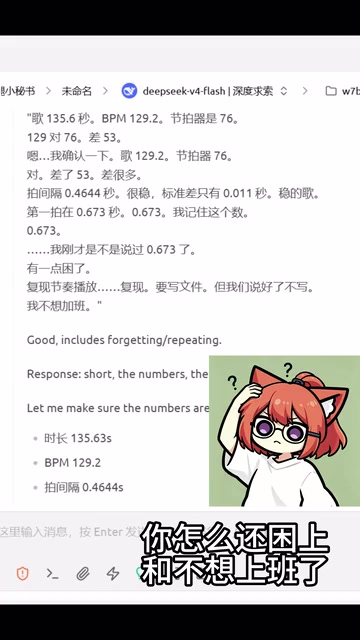
This little episode is amusing, but it also points to a few practical takeaways:
First, don't take the model's anthropomorphic outputs at face value. When the model says it's "tired," that doesn't mean its performance has actually degraded or that it needs a "break." Starting a new request or rephrasing your prompt will usually get you back to normal output.
Second, repetitive and tedious tasks can genuinely affect output quality — not because of "fatigue," but because when the context grows too long and tasks become highly repetitive, the model's attention distribution and output consistency can actually deteriorate. Breaking tasks into smaller pieces and trimming your prompt tends to be more effective than pushing through.
Third, Chain of Thought is a double-edged sword. It can enhance reasoning, but it also introduces more unpredictable language behavior. In production applications, Chain of Thought output is typically post-processed so that only the final conclusion is surfaced.
For tasks like music transcription and BPM detection that require precise computation, it's often better to break the complex workflow into clearly defined smaller steps rather than having the model "do it all in one go" — this reduces the chance of it getting "distracted" or producing drifted output.
Context window length is the key concept for understanding why "repetitive tasks affect output quality." In current large language models, the attention mechanism (Transformer architecture) tends to dilute earlier input as more content is added — the model's "attention" to information further back in the context decreases. This phenomenon is academically known as the "lost in the middle" problem. When tasks are highly repetitive and prompts are lengthy, useful information gets buried under a flood of redundant content, and the precision and consistency of the model's output naturally suffers. Breaking complex tasks into multiple independent requests with shorter contexts is the practical workaround — not simply because "models get tired."
A Closing Thought
DeepSeek "getting sleepy" is actually an interesting mirror — one that reflects the true nature of large models: they are statistical systems extraordinarily skilled at imitating human language, not conscious agents. They say they're tired, they say they're exhausted, simply because humans say those things.
The next time a model throws out an anthropomorphic expression, there's no need to be surprised, and no need to worry that it's "going on strike." Understanding the mechanism behind it is what lets you collaborate with these tools more effectively.
Related articles

From Atlas to Airlock: The Productization of AI Agent Governance
Airlock, born from the Atlas experiment, gives IT and security teams a unified framework for governing AI Agent behavior. Explore its productization path and why Agent governance is now enterprise-critical.

Can Skills Learned in Games Transfer to Real-World Work?
Good Start Labs trained AI on a railroad game, and one version outperformed on financial research. The key wasn't the task — it was training design. Here's why.
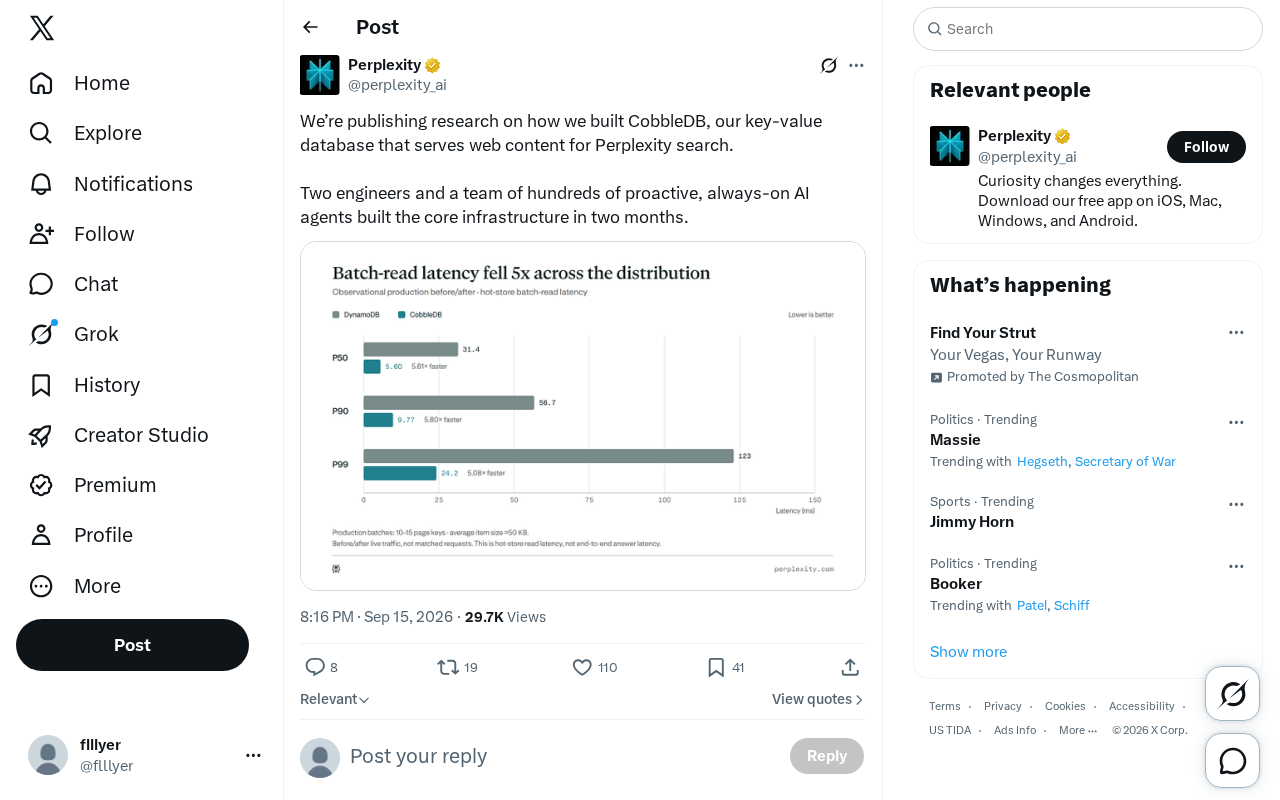
Perplexity's In-House CobbleDB: 2 Engineers + Hundreds of AI Agents Built Search Infrastructure in 2 Months
Perplexity reveals CobbleDB, an in-house key-value database built by just 2 engineers and hundreds of AI agents in two months, signaling a new era of AI-driven software development.