DeepSeek Training a 2 Trillion Parameter Model, With Eyes on an 8 Trillion Giant

DeepSeek is reportedly training a 2T parameter model with plans for an 8T giant, powered by MoE architecture.
Leaked reports suggest DeepSeek is training a 2 trillion parameter model and planning an eventual 8 trillion parameter system, though neither has been officially confirmed. Its current lineup spans Flash (~552B) and Pro (1.6T total, 49B active via MoE), with a rumored 10T Mythos/Fable model also mentioned. The MoE architecture — which decouples total parameter count from inference compute — is central to making such scale commercially viable. The article also cautions that parameter count alone doesn't determine model quality, and notes the broader implications for open-source AI and large-scale MoE deployment.
DeepSeek's New Push in the Parameter Race
According to posts circulating on Reddit and leaked information from X account WallstEngine, DeepSeekAd is currently training a 2 trillion (2T) parameter model, with plans to eventually build a massive 8 trillion (8T) parameter system. If accurate, this would mark a significant shift for the Chinese AI company — best known for its cost efficiency and open-source approach — as it pushes toward the very frontier of model scale.
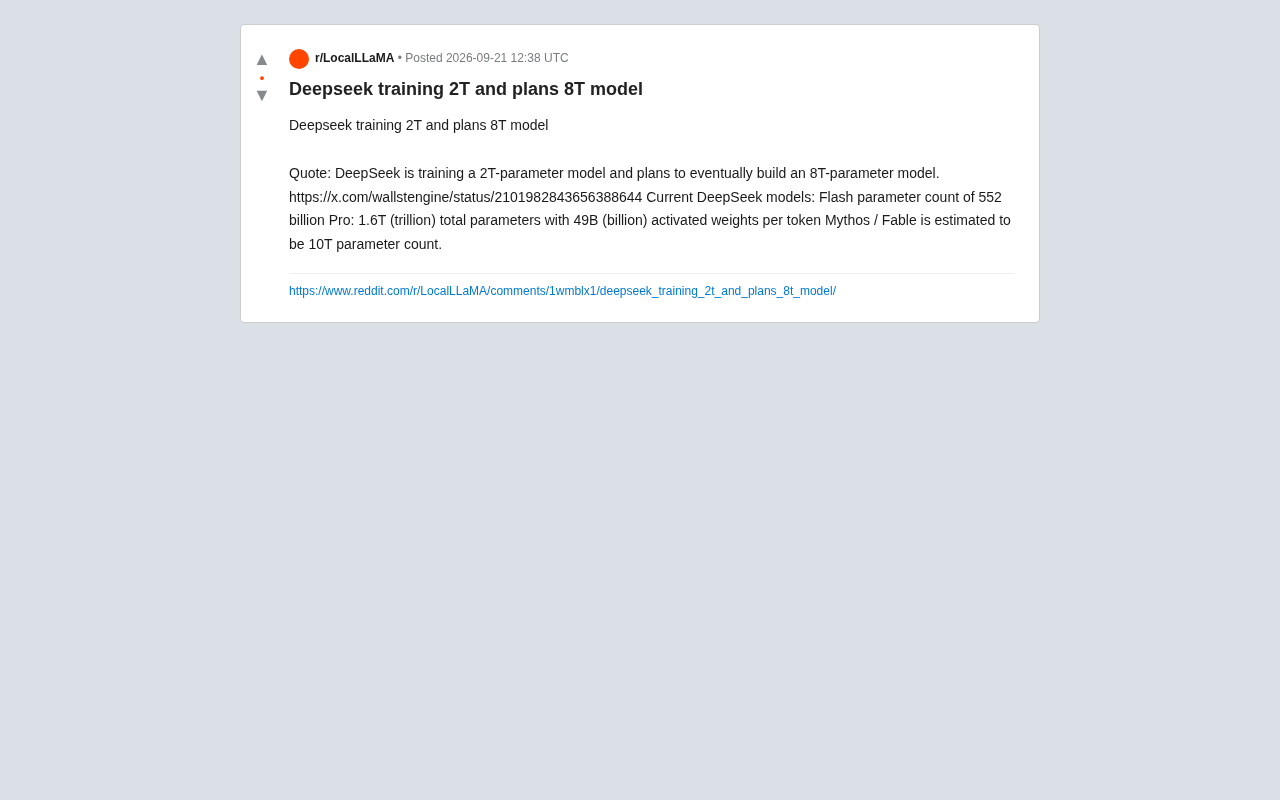
It's worth noting that this information comes from social media leaks and secondhand reports, and has not been officially confirmed by DeepSeek. Readers should treat it with appropriate skepticism. That said, the general direction — leading AI labs scaling toward ever-larger models — is consistent with broader industry trends.
The Current Model Lineup by Parameter Tier
Based on information that has been circulating, DeepSeek's existing model family already spans a clear range of parameter scales:
- Flash: approximately 552 billion (552B) parameters, positioned as a lightweight, efficient option
- Pro: 1.6 trillion (1.6T) total parameters using a MoE (Mixture of Experts) architecture, with only about 49 billion (49B) weights activated per token
The technical design of the Pro model is particularly noteworthy. With 1.6T total parameters but only 49B activated per inference, the activation ratio sits at roughly 3% — a textbook characteristic of MoE architecture. By sparsely activating only a fraction of parameters, the model maintains a vast knowledge capacity while keeping actual inference costs manageable. This is one of the core reasons DeepSeek has repeatedly sparked discussion about cost efficiency.
The leaks also mention models codenamed Mythos / Fable, estimated at up to 10 trillion (10T) parameters. If that estimate holds, DeepSeek's roadmap is far more aggressive than most outside observers had assumed.
Why MoE and Not Dense Models
Scaling from 2T to 8T or even 10T parameters under a traditional dense architecture would make training and inference costs grow linearly — or worse — rendering it commercially unviable. The MoE path demonstrated by DeepSeek Pro offers a realistic route to extreme scale.
The core logic of MoE is this: the model stores an enormous amount of knowledge across its total parameters, but each forward pass only activates a small subset of "expert" networks. This means an 8T-parameter MoE model might have per-inference compute costs equivalent to a dense model with just a few hundred billion active parameters. For a company as focused on cost efficiency as DeepSeek, this architectural choice is almost inevitable.
It's reasonable to assume that the upcoming 2T and 8T models will similarly be built on MoE or an evolved variant — not simply stacked dense parameters.
MoE (Mixture of Experts) architecture is not DeepSeek's invention — its conceptual roots trace back to Jacobs et al. in 1991, and it was reintroduced to the large model mainstream in recent years through Google's work on Switch Transformer, GLaM, and related research. The basic structure places multiple parallel "expert" sub-networks at the position of the feed-forward layer (FFN) in a Transformer, along with a lightweight "router" module that dynamically selects the Top-K experts (typically K=1 or 2) to activate for each token during the forward pass. Experts not selected are skipped entirely, effectively decoupling total parameter count from actual compute (FLOPs).
The engineering challenges this introduces are equally significant: load balancing across experts (preventing most tokens from routing to the same expert while others sit idle), the communication overhead of expert parallelism across devices, and training stability are all critical problems that must be solved at large scale. DeepSeek-V2 and V3 have made notable contributions in these areas — their proposed "auxiliary-loss-free load balancing" mechanism, for instance, is a direct engineering response to these challenges.
What Parameter Scale Does and Doesn't Tell You
Rising parameter counts are often treated as a proxy for model capability, but the industry increasingly recognizes that parameters are not the only deciding factor. Data quality, training strategy, architectural design, and post-training alignment all play equally important roles in shaping final performance.
The numbers 2T or 8T are therefore better read as signals about capability ceiling rather than report cards. A well-trained 2T MoE model with high-quality data may outperform a larger but sloppily designed one. DeepSeek's models have attracted attention precisely because they've consistently punched above their weight class at modest scale.
When measuring the "real compute cost" of a large model, the industry typically looks at active parameters and FLOPs per forward pass. For MoE models, total parameter count determines knowledge capacity and storage cost, while active parameters are what actually drive inference latency and compute spend.
Using DeepSeek Pro as an example: 1.6T total parameters with 49B active parameters means its inference cost is comparable to a dense ~49B model, while its knowledge capacity is roughly 32× larger. This ratio (total parameters / active parameters) is sometimes called the "sparsity factor" or "expansion ratio," and it's a key dimension for evaluating MoE efficiency.
This is why citing total parameter counts alone can be misleading when comparing models. An 8T MoE model's actual inference cost may be equivalent to a dense model in the hundreds-of-billions range — far less "heavy" than the headline number suggests.
Potential Industry Implications
If DeepSeek follows through on plans for 8T or even 10T models, the impact could be felt on several fronts:
First, it would push the parameter ceiling in the open-source community even higher. DeepSeek's past open-source releases have made frontier-level capabilities broadly accessible for research and deployment — continuing that approach at massive scale would have significant spillover effects for the entire ecosystem.
Second, it would intensify the compute and technology race among top-tier labs. Leaps in parameter scale require corresponding advances in training infrastructure, data pipelines, and systems engineering across the board.
Third, it would provide more real-world evidence for large-scale MoE deployment. The community is still actively exploring training stability and expert load balancing for ultra-large sparse models — DeepSeek's engineering practice would serve as a valuable reference point.
Closing Thoughts
All of the information discussed here remains in the realm of leaks and community speculation. The progress of the 2T model training, the concrete plans for an 8T system — none of it has official backing. But the reports at minimum reflect a clear industry signal: companies like DeepSeek are steadily advancing along the MoE path toward ever-larger parameter scales.
What's truly worth watching isn't how large the numbers get, but whether these models can continue finding a new equilibrium between cost and capability — which has always been DeepSeek's most compelling promise.
Related articles

JobRunner MCP Server: AI Agents Can Now Fix Failed Java Jobs
JobRunner launches an open-source MCP server enabling AI agents to view cluster status, diagnose failures, and recover Java jobs—incident response from any cloud coding environment or existing agent.

MLAI Digital Launches 9 Security Agents: MCP Server Safeguards the Full Lifecycle of Agentic AI
MLAI Digital launches Security MCP Server with nine built-in specialized security agents covering vulnerability discovery, attack simulation, prompt injection detection, API and infrastructure assessment, and accelerated remediation—embedding security validation across the full Agentic AI lifecycle from development to production.

Running Isaac Lab on H100 GPUs: Exploring Better Approaches
Exploring optimization methods for running Isaac Lab on NVIDIA H100 GPUs, including MIG configuration, mixed precision, TensorRT acceleration, and community experience to improve robotics simulation and reinforcement learning efficiency.