DeepSeek V4.1 Flash 1017 Breakdown: It Won the Benchmarks, But at What Cost?

DeepSeek V4.1 Flash minor update shows limited benchmark gains, wins on shorter output, but stability and total cost concerns remain.
DeepSeek V4.1 Flash 1017 launched on October 17, just 37 days after the previous version. Officially called a "minor version update" yet emphasizing "significant improvement." Based on a Bilibili creator's item-by-item reconciliation video, official model card, and third-party evaluations, this article reconstructs a fuller picture: architecture unchanged, still a 552-billion-parameter MoE with 8 billion activated, 1-million-token context; official 11 benchmarks show progress, but compared against old versions GPT-5.6 and OPUS-5, excluding the latest competitors, and versus OPUS-5 it wins 4 and loses 7, clearly specialized. Third-party tests show the main win is shorter output, with median math output down 33% and no significant accuracy change, plus more sensitive reasoning tier control. Pricing unchanged, but Agent task retries and multi-turn calls may eat the unit price advantage. A 5-hour service outage before launch exposed stability weaknesses, a dimension absent from benchmark tables. The article concludes with decision references for three types of users.
DeepSeek V4.1 Flash 1017 (internal codename) launched on October 17, just 37 days after the previous update. Officially called a "minor version update," yet in the same breath emphasized as a "significant improvement"—this contradiction in wording perfectly captures the subtlety of this release: it did get stronger, but only marginally, and with some non-negligible hidden costs.
This article is based on the item-by-item reconciliation video by Bilibili creator "测试的好兄弟" (Testing's Good Brother), combined with the official model card, third-party independent evaluations, and community discussions, to reconstruct a more complete picture.
Architecture Unchanged, Parameters the Same: A "Pareto Improvement" Style Iteration
Background first: V4.1 Flash 1017 did not change the model structure. It remains a 552-billion-parameter Mixture of Experts (MoE) architecture, with 8 billion activated parameters, 16 billion on the output side, a 1-million-token context window, and a maximum output of 384,000 tokens. The previous version was released on September 10, a 37-day interval.
Officially, this upgrade is defined as a "Pareto improvement in performance utilization"—translated to the model, this economic term means "no one loses, some gain": either do more with the same cost, or do the same with less money.
Looking at the 11 official benchmarks, there is indeed progress: Terminal Operation Test v4.0 rose from 31.2 to 42.3, Deep Software Engineering Test v1.1 from 74.2 to 77.0, Automated Testing reached 60.5, and the Agent Ultimate Exam scored 35.4.
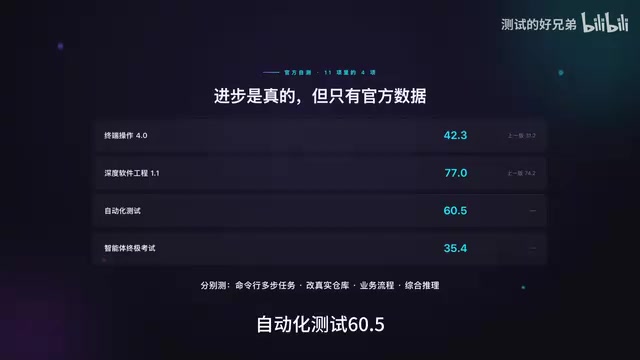
But there's a key detail here: the opponents in the official comparison table are GPT-5.6 and OPUS-5, while these two released OPUS-5.5 and GPT-6.1 on September 22 and September 29 respectively, neither of which entered the comparison table. It beat the "previous champions," so the value needs a discount.
The comparison with OPUS-5 is more telling: out of 11 items, it won 4 and lost 7; Human Last Exam 42.6 vs 56.3, Terminal Operation 42.3 vs 51.8—clearly specialized, stronger on agent and terminal tasks, but still lagging in high-difficulty comprehensive reasoning.
Mixture of Experts (MoE) architecture core idea is "divide and conquer": the model consists of multiple expert sub-networks and a gating network. Each input activates only a few experts, not all parameters. Thus the total parameter count can be very large (552 billion here), but the computation and memory usage per inference relate only to the activated parameters (8 billion), balancing effectiveness and cost. The DeepSeekAd series has long adopted this approach, which is key to offering large-model services at a lower unit price. Note that for MoE models, "total parameters" and "activated parameters" are different concepts; promotional parameter counts often refer to the former, while actual inference overhead is closer to the latter.
Context window refers to the total tokens the model can "see" in a single pass. 1 million tokens is roughly 700,000 to 800,000 Chinese characters, enough to hold an entire long novel or a large code repository. A larger window allows the model to handle long documents, multi-turn tool calls, and long-horizon tasks, but also drives up memory and attention computation costs during inference. The maximum output of 384,000 tokens limits the generation length per response or single-step task, especially important for Agent scenarios.
Third-Party Testing: Winning by "Getting Shorter," Not "Getting More Accurate"
Less than a day after release, third-party data is scarce, but one inference service team did something "dumb": same set of questions, same sampling, same GPU, only swapping models, running 1444 requests first to measure their own noise floor.
The conclusion is interesting: this version mainly wins by shorter output. The median output for math competition problems dropped from 1681 tokens to 1124, the longest reasoning chain from 3814 to 1880, while accuracy showed no significant change. The sample is small (10 questions per set), and the author marked a ±1 error margin; the direction is credible, but don't treat the scores as definitive.
Another detail: the reasoning tier used to be mostly decorative—even at the lowest setting it still spat out nearly 2000 tokens; this version's lowest tier produces 790 tokens, 60% less, and still solves problems correctly. The official claim of "shortened task runtime" is corroborated by third parties on the shorter output point, but runtime itself has no public data yet.
In translation: has this model "learned to shut up"? At least directionally, yes.
Reasoning tier (also called thinking budget or reasoning effort) is an adjustable parameter that lets the model perform internal reasoning of varying lengths before answering. Higher tiers generate more intermediate reasoning tokens, usually slightly higher accuracy but also higher latency and cost; lower tiers are the opposite. The article notes that the old model still output nearly 2000 tokens even at the lowest tier, indicating insensitive tier control and an "overthinking" problem. The new version's lowest tier drops to 790 tokens while still answering correctly, meaning improved controllability of reasoning length—a substantive improvement for batch calls and cost-sensitive applications, but third-party samples are limited and the actual trade-off between tier and accuracy still needs validation on your own tasks.
Cost Accounting: Cheap Unit Price Doesn't Mean Low Total Cost
Official pricing is unchanged: 8 yuan per million output tokens, half price during off-peak hours (2 AM slot), open weights for commercial use. Search and crawl APIs cost 5 yuan per 1000 calls—half a cent per query—billed only on success, 5 calls per second per API, returning 10 results by default. For Agent builders, this retrieval API may be more practical than the model itself—retrieval costs can finally be budgeted.
But cheap unit price and low total cost are two different things. This is especially true for Agent tasks: retries and counter-attacks all cost money, and tokens saved from shorter output may be eaten up by multi-turn tool calls. It's like a lower taxi flagfall, but the driver takes you around half the city, and the bill is higher.
The official cost comparison chart shows the new model's highest point at 77%, costing just over 2 yuan; OPUS-5 approaches 100 yuan at around 70%. The axes are self-defined; the magnitude is indicative, but don't take the ratios too seriously.

Retry and counter-attack costs in Agent tasks deserve elaboration. Agents typically require multiple rounds of "think—call tool—observe result—think again" loops; any failed step may trigger a retry, and retries re-consume input and output tokens. If the model's output shortens but tool-call rounds increase, total token consumption may not decrease; if interrupted due to stability issues, completed intermediate steps are wasted, and costs multiply. Therefore, when evaluating unit price, incorporate "total token consumption per completed task" and "failure retry rate" into the calculation, rather than just the listed price per million tokens. Off-peak half-price is effective for deferrable batch tasks but of limited help for real-time interactive Agents.
The Cost Ignored by the Benchmark Table: Stability
At 8:11 AM on October 15, DeepSeek services went down and recovered at 1:04 PM—nearly 5 hours. The official status page and multiple media outlets recorded it. The official response cited "comprehensive investigation, stripping single-point dependencies" and returned bonus credits for consumption between October 8 and 14. Some media counted this as at least the 18th outage this year (officially unconfirmed).
Someone put it well: the more AI resembles an employee, the more an outage resembles a work stoppage. If the employee goes missing for half a day, half-edited files and half-run toolchains all have to be redone.

Two threads opened in the overseas community that day, with both praise and criticism. Some said frontend and coding were smoother, while others found it significantly worse than GPT-5.6 in code review. The same model, treasured by some and dismissed by others—these are not controlled experiments, only clues.
There is a systematic bias between benchmark scores and production usability. Public benchmarks are typically measured under ideal conditions: fixed datasets, single calls, no interruptions, measuring peak model capability; production environments focus on success rates, latency distributions, and failure recovery under long online hours and high concurrency. Service interruptions, rate limiting, and timeouts don't show up in benchmarks but directly determine user experience and business losses. For workflows dependent on model output, an outage of several hours can lead to half-finished files, incomplete task chains, and extra manual repair costs. Therefore, when selecting a model, also examine the provider's status page history, SLA commitments, and failure compensation mechanisms, treating stability as equally important as accuracy.
Who Should Upgrade? Decision Reference for Three Types of Users
Hobbyists, small tools: Use it directly; the benchmark improvements are real, and the cost is low.
Migrating from the old version: Switch, but run your own evaluation set first. Focus on testing whether reconnection after disconnection holds up, and whether the reasoning tiers are accurate. Run production environments during off-peak hours when possible; half-price off-peak saves half.
Self-deployment: The weights are open, but with 552 billion parameters, just think about it for home GPUs.
Whether a model is worth using depends on how much you lose when it fails, not how high it can score at peak. Cheap saves you money, but stability makes you money—and stability has never been in the benchmark table.
One-line Summary
DeepSeek V4.1 Flash minor update shows limited benchmark gains, wins on shorter output, but stability and total cost concerns remain.
Paragraph Summary
DeepSeek V4.1 Flash 1017 launched on October 17, just 37 days after the previous version. Officially called a "minor version update" yet emphasizing "significant improvement." Based on Bilibili creator's item-by-item reconciliation video, official model card, and third-party evaluations, this article reconstructs a fuller picture: architecture unchanged, still a 552-billion-parameter MoE with 8 billion activated, 1-million-token context; official 11 benchmarks show progress, but compared against old versions GPT-5.6 and OPUS-5, excluding the latest competitors, and versus OPUS-5 it wins 4 and loses 7, clearly specialized. Third-party tests show the main win is shorter output, with median math output down 33% and no significant accuracy change, plus more sensitive reasoning tier control. Pricing unchanged, but Agent task retries and multi-turn calls may eat the unit price advantage. A 5-hour service outage before launch exposed stability weaknesses, a dimension absent from benchmark tables. The article concludes with decision references for three types of users.
Related articles

Chain of Thought Isn't Just for AI: How Humans Can Use CoT to Improve Thinking Quality
Chain of Thought isn't just a prompt trick for large models. Starting from a Hacker News discussion, this article analyzes why CoT works for human thinking too, breaks down actionable ways to transfer it, and highlights the key differences between human CoT and machine CoT.
Cloudflare Teams Up with OpenAI: Closi…
Cloudflare Teams Up with OpenAI: Closing the Loop from Vulnerability Discovery to Defense with AI
Cloudflare uses OpenAI Daybreak to investigate security vulnerabilities and generate reviewable remediation plans, while developers use Codex to boost coding efficiency and quality.

Orca Multi-Agent Orchestration in Practice: A Guide to Parallel Collaboration with Claude and Codex
Orca is Stable AI's free open-source agent workbench supporting 34 agents like Claude Code and Codex in parallel. Learn its Git worktree isolation, multi-model orchestration, and mobile management.