DeepSeek V4.1 Flash 1017 Free Hands-On Test: 7 Methods + Benchmark Breakdown

DeepSeek V4.1 Flash 1017 claims performance gains; hands-on test of seven free access channels shows each has pros and cons.
The article covers the DeepSeek V4.1 Flash 1017 variant, relaying official self-reported data: its own benchmark rose from 74.2 to 77.0, it leads Opus 5 on the automation benchmark 60 to 50, and it features a 1M token context, image input, and MIT license, with shorter outputs and faster speed. Based on a hands-on test video, it evaluates seven free access methods: the official web version gives unsatisfactory results and has version doubts; the desktop client and Car Nest allow explicit selection of 1017 and offer the highest certainty; the aggregation platform, Open Design, Orca Router, and Work Buddy AI each have hurdles like regional verification, daily quotas, or time-limited free access. The conclusion is to prioritize channels with visible versions and remain cautious about vendor self-reported benchmarks.
DeepSeek quietly released a new variant of V4.1 Flash, tagged with the version number 1017. The company stresses that this is more than a rename—it brings improvements in coding, reasoning, and agentic tasks, while completing tasks faster and producing shorter outputs. In benchmarks, DeepSeek claims an increase from 74.2 to 77.0, and on the automation benchmark it leads Opus 5 by scoring 60 versus 50.
More importantly, a creator hands-on tested 7 currently available free access methods. Based on that test video, this article summarizes the model's core changes, a comparison of each method's usability, and the issues exposed during testing.
Model Update: More Than a Rename
According to official data cited in the video, DeepSeekAd V4.1 Flash 1017 scores 77.0 on DeepSeek's own benchmark, higher than Opus 5's 75.0; on the automation bench, the 1017 version scores 60, while Opus 5 scores 50. This gap is worth noting in agentic task scenarios.
The model also claims a 1 million token context window, image input support, and continues under the MIT license. Shorter outputs and faster speed may mean reduced waiting time in coding and continuous tasks. However, these figures all come from DeepSeek's self-reporting; independent third-party verification has not appeared in the video material.
Context window refers to the maximum total number of tokens the model can "see" in a single call, including the input prompt and generated output. 1 million tokens is roughly equivalent to hundreds of thousands of Chinese characters or over a thousand pages of text, meaning an entire medium-sized code repository, a long document, or a continuous multi-turn conversation can be placed into context at once, reducing segmentation truncation and information loss. But context length does not equal effective utilization length: models are prone to "lost in the middle" in ultra-long contexts, and inference cost and latency rise with input length, so in coding and agentic tasks, actual performance still needs to be evaluated in combination with retrieval, segmentation, and caching strategies.
Agentic tasks refer to the model not only generating text but also autonomously planning steps, calling tools, reading and writing files, and completing goals across multiple rounds of interaction—for example, automatically modifying a codebase, operating a browser, or executing multi-step workflows. Such tasks place higher demands on instruction following, long-range consistency, and error recovery, so "automation benchmark" scores are often used to measure whether a model can reliably complete end-to-end processes, not just single-turn Q&A quality.
Hands-On Test of Seven Free Access Methods
The video author tested the following channels one by one and gave subjective assessments. The free quotas and stability of each method differ significantly, making them suitable for different scenarios.
Official Web Version: Questionable Experience
After enabling Deep Think and search on chat.deepseek.com, the author tested with an HTML generation task. It was fast, but the result was "not satisfactory enough." The author suspects the official site was still using the older 4.1 Flash rather than the 1017 variant at the time.
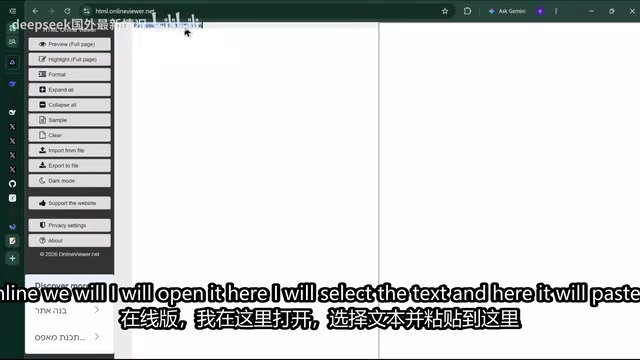
If you want certainty, the official site may not be the first choice; you need to verify the model version yourself.
Desktop Client: Can Manually Select 1017
After downloading the desktop app through official channels (supports Mac, Windows, Linux, plus a CLI and extension), installing, and logging in, the 1017 version can be selected directly in the interface. The author used it to generate "an interactive 3D animated pizza shop page in a single HTML file," and the model responded normally and began executing the task.
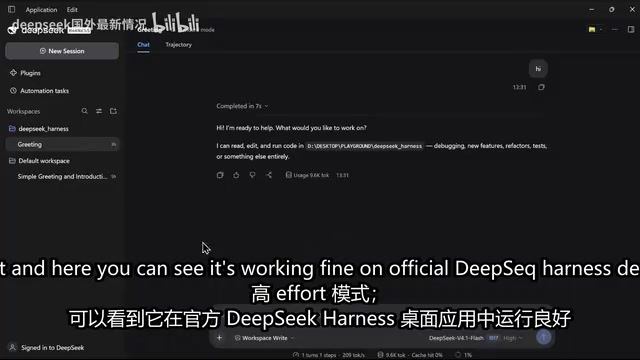
This method has a clear version, making it suitable for developers who need stable access to the new model.
DeepSeek Car Nest Desktop
This channel also provides a desktop app. After logging in, DeepSeek 4.1 Flash 1017 can be invoked in "high effort" mode, and the test task executed normally. Each registration grants 6 units of quota; pay attention to the quota consumption rules.
Third-Party Platforms and Routers: Free but With Hurdles
- An aggregation platform: Offers free use of DeepSeek 4.1 Flash 1017 and also provides access to an "uncensored" version. Some regions require $1 verification, which may be bypassed using a VPN; after verification, users can also receive 600 credits plus 100 credits per day.
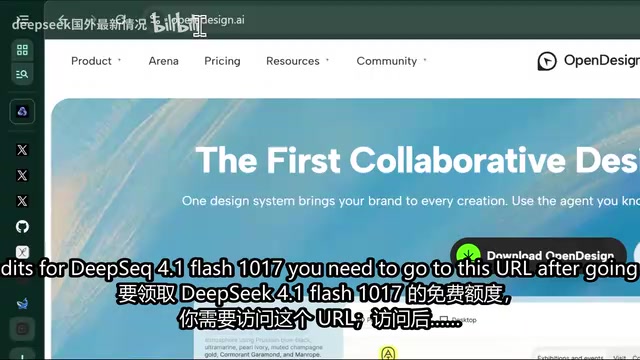
- Open Design: 100 free credits per day, with a monthly bonus quota for new users, and no installation or update required.
- Orca Router: Same model name, same API, with the backend already updated to 1017 and no code changes needed—suitable for projects that already have API integration.
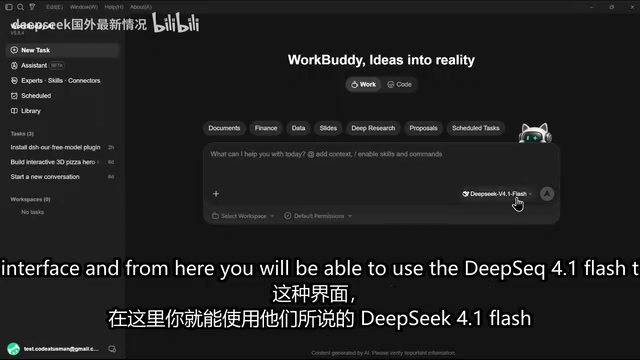
- Work Buddy AI: Claims to be free until October 31; the international version has been updated to 1017, with free quota after registration.
The author also mentions an installable DeepSeek harness plugin. After copying the link and installing it in any coding Agent, you can use the free model on desktop and generate project files. The generated 3D pizza shop page was "quite good," supporting rotation and shopping cart interaction.
API router is a forwarding layer between the user and the model service: the client still uses the same model name and the same API endpoint, while the routing service distributes requests to different providers or different model versions on the backend. This allows projects to switch to a new version without changing code, but it also means the model name users see does not necessarily correspond to the actual backend version. When using such channels, you should confirm whether the backend has been updated through response metadata, version number fields, or reproducible fixed tasks, to avoid result deviations caused by "same name, different version."
Issues Exposed by Testing and Selection Advice
The unclear official website version is the biggest uncertainty. The author's generation results on the official site were less ideal than on third-party channels and suspects it was the old model. If you rely on the official website, it is advisable to first test output quality with an identifiable task, or directly choose a client that can explicitly specify 1017.
Free strategies on third-party platforms generally come with conditions: regional verification, daily quotas, and time-limited free access. Work Buddy's free window is explicitly until October 31, and the aggregation platform's $1 verification is a hurdle for some users. The author also reminds that each method has different limitations—if one doesn't work, switch to the next.
From the testing, the desktop client and Car Nest offer the highest version certainty; Orca Router is suitable for existing API workflows; Work Buddy and Open Design are suitable for short-term trials. The official web version should be treated with caution.
The benchmark data in the video is all relayed from DeepSeek's official statements, and the author did not independently reproduce it. Model versions on free channels may also change at any time; before actual use, it is advisable to rely on the version number displayed in the client.
MIT license is a relatively permissive open-source license that allows use, modification, distribution, and even commercial use, requiring only that copyright and license notices be retained, and typically provides no warranty. For models, the license statement affects the conditions for using weights, code, or related tools, and is not equivalent to terms of service; free access channels may still impose regional restrictions, quotas, or data usage policies. To judge whether a channel can be used long-term, you should check both the model license and the platform's own terms, rather than just the word "free."
One-line Summary
DeepSeek V4.1 Flash 1017 claims performance improvements; hands-on testing of seven free access channels shows each has pros and cons.
Paragraph Summary
The article focuses on the DeepSeek V4.1 Flash 1017 variant, first relaying official self-reported data: its own benchmark rose from 74.2 to 77.0, and on the automation benchmark it leads Opus 5 by 60 to 50; it also features a 1 million token context, image input, and the MIT license, with shorter outputs and faster speed. It then evaluates seven free access methods one by one based on the hands-on test video: the official web version produces unsatisfactory results and has questionable version certainty; the desktop client and Car Nest can explicitly select 1017 and offer the highest certainty; the aggregation platform, Open Design, Orca Router, and Work Buddy AI each have hurdles such as regional verification, daily quotas, or time-limited free access. The conclusion is to prioritize channels with visible versions and remain cautious about vendor self-reported benchmarks.
Related articles

Chain of Thought Isn't Just for AI: How Humans Can Use CoT to Improve Thinking Quality
Chain of Thought isn't just a prompt trick for large models. Starting from a Hacker News discussion, this article analyzes why CoT works for human thinking too, breaks down actionable ways to transfer it, and highlights the key differences between human CoT and machine CoT.
Cloudflare Teams Up with OpenAI: Closi…
Cloudflare Teams Up with OpenAI: Closing the Loop from Vulnerability Discovery to Defense with AI
Cloudflare uses OpenAI Daybreak to investigate security vulnerabilities and generate reviewable remediation plans, while developers use Codex to boost coding efficiency and quality.

Orca Multi-Agent Orchestration in Practice: A Guide to Parallel Collaboration with Claude and Codex
Orca is Stable AI's free open-source agent workbench supporting 34 agents like Claude Code and Codex in parallel. Learn its Git worktree isolation, multi-model orchestration, and mobile management.