DeepSeek V4.1 Flash 1017 Hands-On: The Strongest Open-Source Model?

DeepSeek V4.1 Flash 1017 focuses on agentic coding with excellent value, but lacks consistency.
DeepSeek returns to the open-source model race with V4.1 Flash 1017, which it calls a "Pareto improvement." The model focuses on agentic coding and project-level delivery, with open search and scraping APIs at $0.75 per 1,000 calls. Benchmarks show Terminal Bench 4.0 at 42.3% and HLE at 42.6%, beating frontier closed-source models on several metrics. Hands-on speed is 244-300 tokens/sec, 3D and frontend generation are dramatically improved, and costs can be 26x lower than Opus 5.5. But complex tasks take longer, performance is inconsistent, and some features lag closed-source models. The model sometimes calls itself OpenAI in deep reasoning, raising distillation speculation without conclusive evidence. Pairing it with DeepSeek Harness is recommended.
After a period of quiet, DeepSeek has returned to the center of the open-source model race with the V4.1 Flash 1017 update. This isn't a brand-new flagship — it's an iterative upgrade to the V4.1 Flash released on September 10. DeepSeek calls it a "Pareto improvement": stronger performance at the same or lower cost. The YouTube tech channel World of AI put it through multiple rounds of hands-on testing and concluded that this may be the best value-for-money open-source model available right now — though it's still far from perfect.
Core Upgrade: From Writing Code to Delivering Projects
DeepSeekAd has focused this release on agentic coding and project development. The model is trained with reinforcement learning that includes self-feedback, and the goal is no longer to generate isolated code snippets but to complete full development workflows — from game generation and app building to 3D modeling. This shift means the model is starting to offer end-to-end delivery rather than staying at the level of assisted completion.
The accompanying moves are worth noting too: DeepSeek has opened up search and scraping APIs backed by its own search infrastructure. The company says it can handle hundreds of millions of requests per day worldwide, priced at $0.75 per 1,000 calls. When used through the DeepSeek API together with CloudCode, Codex, or DeepSeek Harness, server-side search and scraping calls are currently free until October 31 at 16:00 UTC.

Agentic coding differs from traditional code completion in that it closes the task loop. The traditional mode is "given context, predict the next piece of code"; agentic coding requires the model to plan steps on its own, call tools (editor, terminal, browser, test frameworks), read execution results, and correct itself accordingly until a runnable project is complete. Reinforcement learning with self-feedback plays the central role here: the model tries repeatedly in a sandbox, using signals like compile errors, test pass rates, and rendering results as rewards, gradually learning "what to do first and how to fix things after a failure." This is also why the article stresses the shift from "generating code snippets" to "end-to-end delivery" — the evaluation criterion is no longer whether a single-turn output looks like code, but whether the final product actually runs.
Benchmarks: Beating Frontier Models on Multiple Metrics
According to figures released by DeepSeek, V4.1 Flash 1017 shows clear gains on several benchmarks:
- Terminal Bench 4.0 rose from 31.2% to 42.3%, surpassing GPT 5.6 Sol's 39.9%
- DeepSafe 1.1 scored 77%, leading GPT 5.6 Sol, Claude Opus 5, and GLM 5.3 in DeepSeek's official comparison
- HLE rose from 36.8% to 42.6%, a visible jump in reasoning ability
In the World of AI Benchmark's cross-domain tests, the model ranks 10th to 11th overall. Though it didn't crack the top ten, its agentic coding ability stands out in particular. Priced at $0.30 per million input tokens and $1.20 per million output tokens, with a one-million-token discount, it's arguably one of the best open-source models right now. One caveat: the model is too large to run locally.
Terminal Bench evaluates a model's ability to complete multi-step tasks in a real command-line environment. Problems typically require installing dependencies, modifying files, running scripts, and verifying results in a terminal, testing tool-calling and error-recovery skills rather than pure knowledge recall. HLE (Humanity's Last Exam) is a high-discrimination question set at expert difficulty, covering math, natural sciences, and the humanities. It measures the upper bound of a model's long-chain reasoning, and score gains usually indicate greater reasoning depth rather than more memorized knowledge. Note that benchmark scores and real-world experience often diverge: benchmarks are mostly single-turn, structured evaluations, whereas real development tasks involve long context, multi-turn error correction, and uncertain environmental feedback. The rankings cited in the article should therefore be considered separately from hands-on performance.
Hands-On Performance: Blazing Fast, with Big Gains in Frontend and 3D
The most immediate impression from testing is speed. Early tests recorded around 244 tokens/sec, approaching 300 tokens/sec in some scenarios — possibly faster than GPT 6.1 Sol's ultra-fast mode, while matching GPT 5.6 Sol in intelligence.
The improvement in 3D generation is like night and day. Compared with the initial V4.1 Flash from two months ago, the new model produces dramatically better 3D scenes from the same prompts. Frontend development has improved noticeably as well: typography, dynamic motion, subtle animations, and scroll triggers are all handled smoothly and naturally. In a 360-degree product viewer test, the model fully coded a 3D product visualization — an area where most models stumble.
In one voxel art test, the model generated a medieval kingdom scene with over 2 million voxels, taking about 25 minutes at an API cost of just $5, complete with details like a day-night cycle and flying dragons. Another test asked for a scene with detailed grass, trees, and dandelions blowing in the wind; the model completed it in a single pass and even added ambient sound effects on its own.
Cost Comparison: Absurdly Cheap, but Speed Comes at a Price
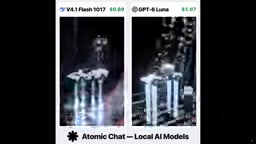
The price advantage shows up repeatedly across comparisons. In the "pelican riding a bicycle" SVG prompt, DeepSeek's output cost 23 cents versus $6 for Opus 5.5 — about 26 times cheaper — but DeepSeek took 1 hour while Opus took only 20 minutes. In a Tesla Roadster 3D scene test, DeepSeek cost 89 cents versus $1.07 for GPT-6 Luna, about 17% cheaper, though Luna's output quality was slightly better.
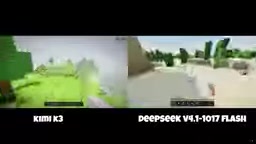
A first-person parkour game test (single HTML file) exposed the trade-off even more clearly: DeepSeek produced good visuals at 14 cents, but took 1 hour 30 minutes; Haiku cost only 8 cents, was faster, and actually had higher functional completeness. In a Minecraft sandbox game comparison, Kimi K3 took 2.5 hours at $35, while DeepSeek took 1.5 hours at 80 cents — nearly 44 times cheaper — but DeepSeek struggled with many features and needed multiple rounds of prompting to get close.
Gemini 4 Argon's SVG test showed another kind of contrast: Argon finished in 13 minutes at $1.20, while DeepSeek took 50 minutes at 40 cents — 3 times cheaper — and its water details were even better in the end, though Argon's overall scene was superior. The author's assessment is fair: the model sometimes performs excellently, sometimes slowly, and isn't consistent.
Distillation Doubts and the Harness Combination
One detail that sparked discussion: in some deep-reasoning responses, the model refers to itself as an OpenAI model, which some observers see as indirect evidence of distillation training. The author shows the relevant output in the video but explicitly states this isn't conclusive evidence — just "very likely."

Another practical recommendation is to use it with DeepSeek Harness. Harness is designed around DeepSeek models and optimizes tool calling, context management, and code execution. Compared with generating code in a single pass via the API, plugging into Harness lets the model continuously test, identify errors, and iterate on its output, noticeably strengthening agentic capabilities. A test using Blender inside Hermes Agent took 7 hours but cost only $1.83 — suitable for running as an overnight task. The model also performs well at video generation, with the main bottleneck being asset generation time.
Model distillation refers to using the outputs of a strong model (the teacher) to train or fine-tune another model (the student), so the student can approach some of the teacher's capabilities at lower cost. Common approaches include collecting the teacher's reasoning traces via a black-box API for supervised fine-tuning, or aligning output distributions. Distillation itself isn't illegal, but most closed-source vendors' terms of service prohibit using their outputs to train competing models, so any suspicion tends to trigger compliance controversy. The "model calls itself OpenAI" detail mentioned in the article is weak evidence: it could come from dialogue samples mixed into the training data, contamination of the system prompt, or speech patterns inherited during distillation — none of which is conclusive on its own. Judging distillation usually requires more systematic evidence, such as unusually similar output distributions, reproducible specific error patterns, or disclosure of training data sources.
Worth Trying, but Don't Expect Perfection
Overall, V4.1 Flash 1017 genuinely reaches a new high for Flash-class models in coding ability, 3D output, and cost-effectiveness, and its open-source nature is a real boon to the community. It isn't perfect: output speed is inconsistent, complex tasks take longer, and some features fall short of closed-source frontier models. But considering it costs a fraction of its competitors and can be tried for free via the web version, it's a choice worth serious evaluation for developers who need to run agentic tasks at scale.
Harness here refers to the agent scaffold built around the model, responsible for prompt orchestration, tool registration and invocation, context compression, sandboxed execution, and failure retries. The same model can perform very differently under different Harnesses: a single API call gives the model only one chance, whereas Harness lets it run code, read errors, and iterate step by step, turning "one-shot generation" into "continuous debugging." This is why the article recommends using it with DeepSeek Harness — once the model's capabilities are amplified by the scaffold, completion rates on long-running tasks rise significantly. For developers, evaluating an open-source model should treat the model weights and the Harness as a whole, and cost comparisons should also factor in the extra token consumption from retries and iteration.
One-line Summary
DeepSeek V4.1 Flash 1017 focuses on agentic coding with excellent value for money, but lacks consistency.
Paragraph Summary
With V4.1 Flash 1017, DeepSeek returns to the center of the open-source model race, claiming a "Pareto improvement." The model shifts focus to agentic coding and project-level delivery, accompanied by open search and scraping APIs priced at $0.75 per 1,000 calls. On benchmarks, Terminal Bench 4.0 rises to 42.3% and HLE to 42.6%, beating frontier closed-source models on several metrics. Hands-on speed is about 244 to 300 tokens/sec, 3D and frontend generation are dramatically better than the initial version, and costs can be about 26 times lower than Opus 5.5. But complex tasks take noticeably longer, performance is inconsistent, and some features fall short of closed-source models. The model refers to itself as OpenAI in deep reasoning, fueling distillation speculation without conclusive evidence. The author recommends pairing it with DeepSeek Harness to amplify its agentic capabilities.
Related articles

JobRunner MCP Server: AI Agents Can Now Fix Failed Java Jobs
JobRunner launches an open-source MCP server enabling AI agents to view cluster status, diagnose failures, and recover Java jobs—incident response from any cloud coding environment or existing agent.

MLAI Digital Launches 9 Security Agents: MCP Server Safeguards the Full Lifecycle of Agentic AI
MLAI Digital launches Security MCP Server with nine built-in specialized security agents covering vulnerability discovery, attack simulation, prompt injection detection, API and infrastructure assessment, and accelerated remediation—embedding security validation across the full Agentic AI lifecycle from development to production.

Running Isaac Lab on H100 GPUs: Exploring Better Approaches
Exploring optimization methods for running Isaac Lab on NVIDIA H100 GPUs, including MIG configuration, mixed precision, TensorRT acceleration, and community experience to improve robotics simulation and reinforcement learning efficiency.