DeepSeek V4.1 Flash 1017 Hands-On: The Strongest Open-Source Model or a Distillation Mystery?

DeepSeek V4.1 Flash approaches flagship models in coding and 3D generation at extremely low cost.
DeepSeek V4.1 Flash 1017 is a continued refinement of the September Flash series, claiming a Pareto improvement at equal or lower cost. It scores 39.9% on Terminal Bench 4.0 (beating GPT 5.6 Soul), raises HLE from 36.8% to 42.6%, and ranks 11th on World of AI. Tests show major leaps in 3D voxel and front-end generation—over 2M voxels per file at $5 API cost—and roughly 1/26 the cost of Claude Opus with surprisingly close quality. It reaches 244 tokens/s and can run for hours with Harness. Limitations: long task times for complex work, lower completion than Kimi K3.1, no local deployment, and OpenAI-style output that fuels distillation speculation without proof.
After a period of silence, DeepSeek is back in the spotlight with version V4.1 Flash 1017. This update is not a brand-new flagship, but a continued refinement of the Flash series released in September. The company claims it achieves a "Pareto improvement"—stronger performance at equal or even lower cost. Bilibili creator "World of AI" ran a comprehensive hands-on test, and this article combines the video content with benchmark data to break down the real capabilities of what is billed as "the strongest open-source model ever."
Benchmark Results: A Leap in Agentic Coding
DeepSeekAd V4.1 Flash 1017 delivers solid gains across multiple benchmarks. According to data cited in the video, it scores 39.9% on Terminal Bench 4.0, surpassing GPT 5.6 Soul; in DeepSeek's self-reported comparisons, it also beats Claude Opus 5 and GLM 5.3. HLE improves from 36.8% to 42.6%, a clear jump in reasoning ability.
More important are the efficiency metrics: it completes tasks faster, produces shorter outputs, and the price stays the same. In the World of AI benchmark's overall ranking, it places 11th—not in the top ten, but its agentic coding ability is "genuinely formidable." Pricing is 30 cents per million input tokens and $1.2 per million output tokens, with a 1M-token context window. At this price point and with these results, it becomes one of the most potent open-source models available—though it is too large to deploy locally.

The term "agentic coding" refers to models that are no longer limited to generating code snippets in a single turn, but instead autonomously plan steps, execute commands, read errors, and iterate over multiple rounds within an environment equipped with tool-calling capabilities, until a runnable piece of software or project is complete. Its core difference from traditional code completion lies in closed-loop feedback: the model can run the code it writes, observe the results, and correct accordingly. That is why benchmarks for agentic coding typically provide real environments such as terminals and file systems, rather than merely comparing final code text. This capability directly determines whether a model can handle workflows like "leave it running for hours and it completes the project automatically," and it is one of the main battlegrounds in the current frontier model competition.
3D and Front-End Generation: Low Cost Approaching Flagship
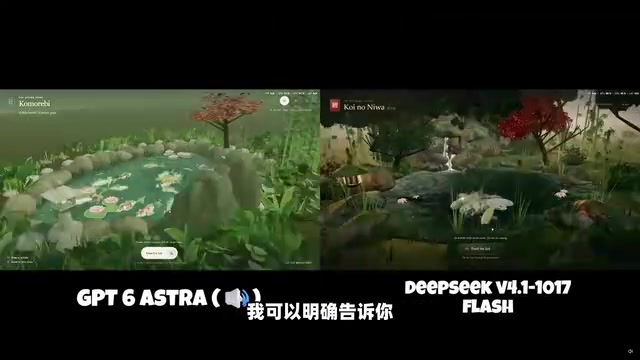
The most surprising part of the hands-on test is 3D scene generation. The creator compared the old Flash version from two months ago with the new one: the old version's scenes were "barely passable," while the new version is "like night and day." In a voxel art test, the model generated over 2 million voxels in a single file, building a richly detailed medieval kingdom scene in about 25 minutes at an API cost of just $5, and it even added a day-night cycle and elements like dragons on its own.
Front-end development is another strength. A 360-degree product viewer, scroll-triggered animations, and typography details were all handled smoothly and naturally—the creator said outright that the output quality "feels a bit like something OpenAI generated." In an SVG generation test, it delivered results in 40 cents and 50 minutes that were very close to Gemini Argon's $1.2 and 13 minutes, with some water details even better.
Cost-Performance Showdown: What's the Price of Being 26x Cheaper?
The most striking comparison in the video comes from a same-prompt showdown between DeepSeek V4.1 Flash and Claude Opus 1.5. Opus took 20 minutes and cost $6, with noticeably better animation and sound details; DeepSeek took an hour and cost only 23 cents—about 26 times cheaper—with a basically complete structure but some small errors. The creator's verdict: "The quality isn't in the same league, but at that much lower a price, it's surprisingly close."
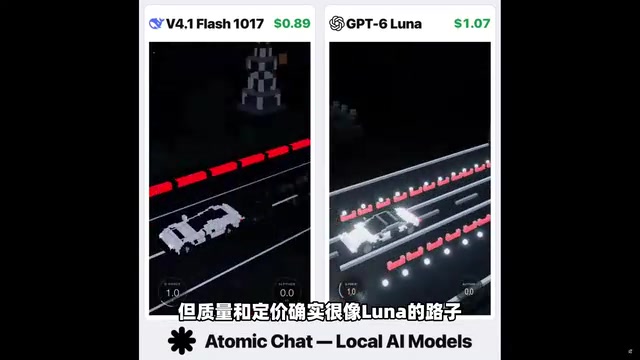
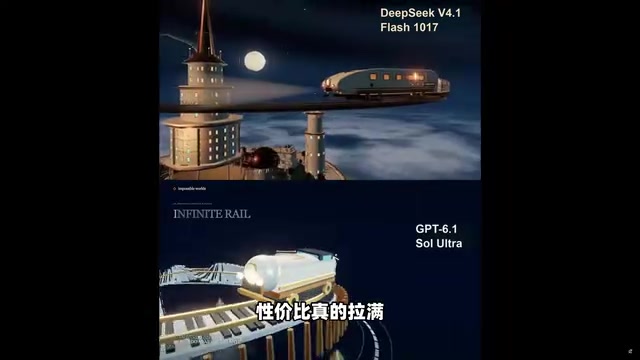
The comparison with GPT-6 Luna is closer to same-price competition: recreating the Tesla Roadster launch event scene, DeepSeek cost 89 cents versus Luna's $1.07—about 17% cheaper—but Luna's output quality was still slightly better. Against GPT 6.1 Soul Ultra, DeepSeek's cost was about 90% lower (44 cents), yet the output was "quite stunning."
Distillation Mystery and OpenAI-Style Output
The creator repeatedly mentioned an intriguing phenomenon: during deep reasoning, the model occasionally identifies itself as an OpenAI model, and its output style carries obvious OpenAI traces. This has fueled speculation about distillation training. The creator cautiously stated that "this is not hard evidence," but believes the DeepSeek team has very likely been distilling OpenAI models, while adding that "every model vendor is actually doing this."
This similarity is especially obvious in realistic 3D scene tests—grassy hillsides, dandelions drifting in the wind, and sound effects matched to the scene, all completed in a single pass. The creator remarked, "You'd think Opus made it." Still, he emphasized that distillation is only speculation and that what deserves more attention is the model delivering near-flagship results at extremely low cost as a Flash variant.
"Distillation" refers to using a more capable "teacher model" to generate a large number of input-output samples, then training a smaller "student model" on those samples to transfer the teacher's behavioral patterns, problem-solving paths, and even expressive style. It is far more cost-effective than pretraining from scratch, but it typically relies on the teacher model's API outputs and may violate terms of service. Determining whether a model has been distilled is not easy: similar output style, occasionally self-reporting an identity, and exhibiting error patterns highly consistent with a particular model on specific problem types are all indirect clues rather than evidence. A truly reliable approach would require comparing training data sources or internal model representations, which are not externally accessible—which is exactly why the "distillation mystery" can only remain speculation.
Toolchain Completion: Search API and Harness Combination
DeepSeek has also opened up a search and scraping API, powered by its own infrastructure, which it claims handles hundreds of millions of requests globally per day at just 75 cents per thousand calls. Calls made through server-side tools are free until 16:00 UTC on October 31, and there are no limits when used with tools like Claude Code, Codex, or DeepSeek Harness.
The creator especially recommends Harness as the best companion: it optimizes tool calling, code execution, and complex task workflows around DeepSeek models, allowing the model to continuously test, find problems, and improve its output rather than generating code in one shot. In a Blender task, the model with Harness attached ran for about 7 hours and completed a 3D project for just $1.83—ideal for a workflow where you leave it running before bed and collect the results when you wake up.
Harness, in the context of AI engineering, refers to an execution framework wrapped around the model: it is responsible for decomposing user tasks, scheduling tool calls, running generated code, feeding execution results and error messages back to the model, and managing context and loop termination conditions. The model itself is only responsible for "deciding what to do next," while the Harness is responsible for "actually doing it and bringing back the results." This is why tasks can run for hours once Harness is attached—it turns one-shot generation into a continuous loop of trial, error, and correction. Claude Code, Codex, and similar tools are frameworks of the same kind, and choosing a Harness deeply adapted to your own model often significantly improves the success rate and stability of tool calls.
Speed and Limitations: The Trade-offs Behind 244 Tokens/s
Speed is another ace up its sleeve. Reports say the model reaches 244 tokens per second, with early tests approaching 300 tokens/s—possibly faster than GPT 6.1 in ultra-fast mode. But the creator also honestly pointed out shortcomings: some tasks take noticeably longer (the SVG task took 50 minutes vs. Argon's 13 minutes), completion of complex features falls short of competitors like Kimi K3.1, and the 11th-place World of AI ranking shows there are still a few areas where it's "a bit behind."
It's worth noting that Kimi K3.1 produced more stunning depth in the Minecraft sandbox test, but took two and a half hours and cost $35; DeepSeek took an hour and a half and cost 80 cents—nearly 44 times cheaper—with quality not in the same league but basic functionality complete. This "trade time for cost" characteristic makes it better suited to batch, non-real-time agent tasks.
Conclusion: The Cost-Performance King Among Flash Variants
Overall, DeepSeek V4.1 Flash 1017 is "absurdly strong" across three dimensions: coding, 3D generation, and cost-performance. It is not a perfect model—speed is inconsistent, completion of complex tasks is limited, and the distillation mystery remains unresolved—but as a Flash variant, delivering near-flagship output at a fraction of the cost of flagship models is itself a breakthrough. As the creator summed up: "Being able to go toe-to-toe with frontier models that cost far more is genuinely exciting." For developers who need large-scale agentic coding and are cost-sensitive, this model deserves a place in the toolbox.
One-line Summary
DeepSeek V4.1 Flash approaches flagship models in coding and 3D generation at extremely low cost.
Paragraph Summary
DeepSeek V4.1 Flash 1017 is a continued refinement of the September Flash series, which the company says achieves a "Pareto improvement" at equal or lower cost. On benchmarks, Terminal Bench 4.0 scores 39.9%, surpassing GPT 5.6 Soul; HLE rises from 36.8% to 42.6%; and it ranks 11th overall on World of AI. Hands-on tests show major leaps in 3D voxel scenes and front-end generation—over 2 million voxels in a single file at an API cost of just $5. The same task costs about 1/26 of Claude Opus, and while output quality still lags, it is surprisingly close. The model reaches 244 tokens/s, and with Harness it can run for hours to complete projects. Limitations include long task times for complex work, completion quality below competitors like Kimi K3.1, and no local deployment; its output carries a clear OpenAI style, fueling distillation speculation without hard evidence.
Related articles

Gemini 4 Argon Hands-On: AI Builds Board Games, Constructs Temples, and Trains Robots Autonomously
Gemini 4 Argon hands-on roundup: AI autonomously builds a desk racetrack and temple in Blender, writes a ray tracing engine, trains a humanoid robot to sink 7 shots, plus API pricing and developer access.

The Magic Octagonal Coin: Why Only 9% of People Can Predict Its Flip?
Only 9% of people can correctly predict the Magic Octagon coin flip. This article explains its spatial rotation mechanism, common cognitive pitfalls, and a new hypothesis based on Relevance Theory, exploring the limits of human spatial reasoning.

Sam Altman: AI Is Entering the Era of Scientific Discovery — Math Breakthroughs Will Replicate in Biology and Energy
Sam Altman says AI is entering the era of scientific discovery — math breakthroughs will replicate in biology, materials science, and energy to help develop new drugs and energy sources.