DeepSeek V4.1 Flash 1017 (Max) Ignites Hacker News: Re-examining Model Version Naming and Iteration Logic

DeepSeek V4.1 Flash 1017 (Max) trends on Hacker News, shifting community focus from benchmarks to usability and migration costs.
A post titled "DeepSeek V4.1 Flash 1017 (Max)" scored 74 points and 21 comments on Hacker News, but lacked official release notes, model cards, or API documentation, with discussion centered on the meaning of the version identifier. "Flash" typically denotes a low-latency, low-cost version, while "Max" often indicates a flagship variant; their combination creates semantic tension, and "1017" is speculated to be an internal build date. Community focus centered on API availability, pricing tiers, behavioral differences from existing versions, and context window changes rather than benchmark scores, reflecting that mature vendors' release narratives have shifted toward migration costs for existing users. The article notes that version naming chaos is an industry-wide issue, recommends integrators treat model versions as dependencies to be pinned, and emphasizes significant information gaps in the material, making no conclusions about actual capabilities.
A Low-Key Release, Why Did It Hit the Hacker News Front Page?
A post titled "DeepSeekAd V4.1 Flash 1017 (Max)" appeared on Hacker News, quickly accumulating 74 points and 21 comments, entering the day's front-page spotlight.
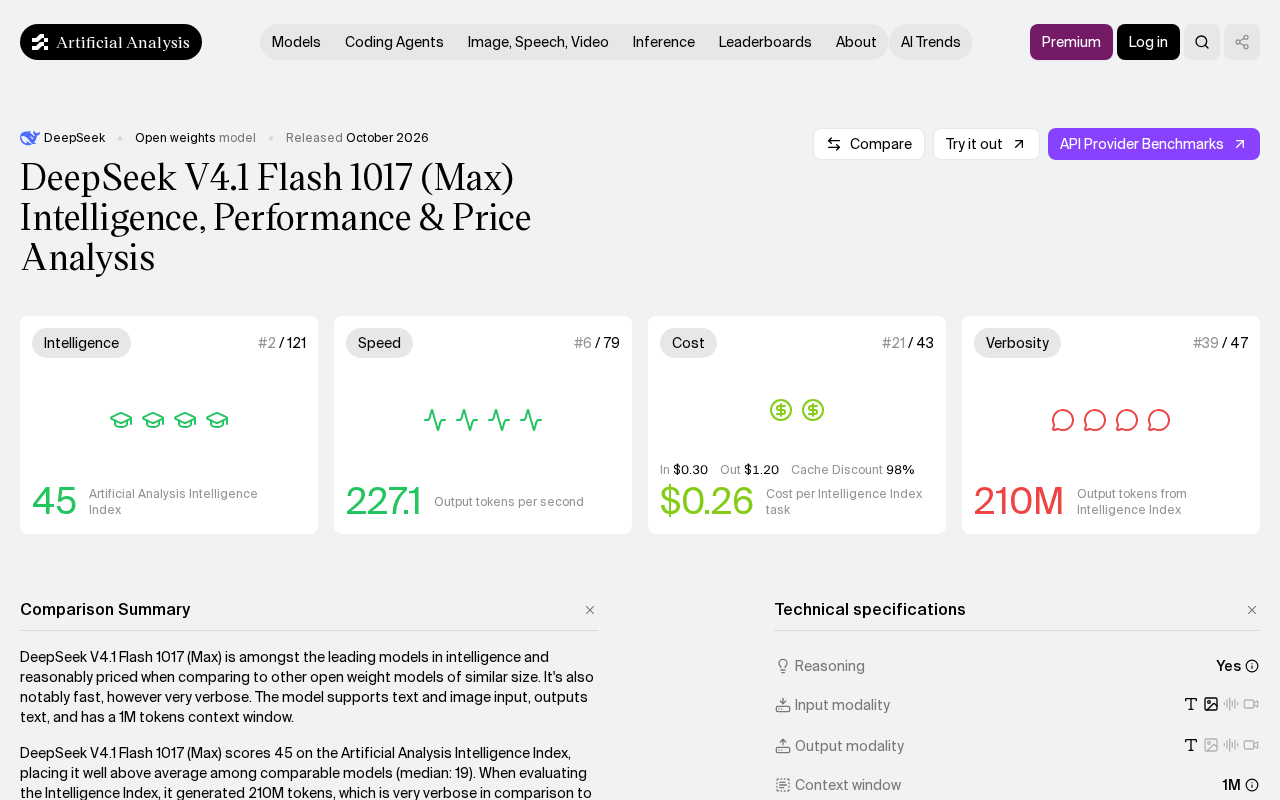
Judging by the title, this appears to be a version identifier for DeepSeek with multiple suffixes, "Flash," "1017," and "Max." However, the post itself includes no links to a release blog, model card, or API documentation. The discussion mainly revolves around "what exactly is this"—whether it's an official release, an internal experimental branch, or the community's misreading of some endpoint. Currently, there is a lack of primary source material to corroborate.
What Do the Three Suffixes in the Title Mean?
"Flash" in mainstream large model naming conventions typically points to low-latency, low-cost inference-optimized versions, sacrificing some capability for throughput and response speed. "Max," on the other hand, is the opposite, often used to mark flagship variants within the same generation with larger parameter counts, longer context, or higher inference budgets. The simultaneous appearance of both words inherently creates a tension: is it a lightweight version or a full-powered one?
According to discussions in the Hacker News comment section, some users speculate that "1017" might be an internal build date or iteration number rather than a semantic version number intended for the public. Such date-stamped naming is common in fast-iterating labs, but once it appears in public channels, it easily confuses developers when choosing a model—if the version number doesn't convey capability information, integrators have to rely on empirical testing to confirm behavioral differences.
Hacker News Ranking Mechanism: Hacker News ranking is not a simple accumulation of votes but a decayed score calculated by combining votes, posting time, and comment activity. A score of 74 on HN is above average, typically meaning the post received steady, non-explosive attention within hours of posting; 21 comments indicate high discussion density, with participants willing to engage in substantive dialogue. This mechanism makes the combination of "74 points + 21 comments" more reflective of the tech community's true interests than the score alone: not short-lived clicks from clickbait, but developers' persistent questioning of version usability.
Community Focus: Not Benchmarks, but Usability
It's worth noting that there is almost no comparison of benchmark numbers in this discussion. Comments focus more on several engineering-side questions: whether this version is available through the official API, what the pricing tiers are, how large the behavioral differences are compared to existing versions, and whether the context window has changed.
This shift in focus itself indicates that for mature model vendors, the narrative focus of new version releases has moved from "which leaderboard did we top this time" to "how high is the migration cost for existing users." A score of 74 isn't a blockbuster, but the density of 21 comments shows a group of developers is seriously evaluating whether to switch.
Model Version Pinning: Refers to explicitly specifying a model's concrete version identifier (e.g., deepseek-v4.1-1017) in application configuration rather than using floating aliases (e.g., latest). This is akin to locking dependency versions in software engineering, aimed at avoiding behavioral drift caused by silent vendor updates. For products calling large model APIs, version pinning must be paired with regression test sets: before switching versions, use fixed prompts and scoring criteria to verify whether key tasks (e.g., structured output, tool calling, long-context retrieval) have degraded. Without a pinning mechanism, a single backend update by the vendor could silently change online performance, with extremely high troubleshooting costs.
Version Naming Chaos Is an Industry-Wide Problem
DeepSeek is not the only vendor facing this issue. Version identifiers with dates, codenames, and capability modifiers are proliferating in both open-source and closed-source models, resulting in model selection degrading from "choosing by name" to "choosing by docs + testing."
For integrators, a viable response is to treat model versions as dependencies that need to be pinned: fix specific version identifiers in configuration, establish small-scale regression test sets, and verify key task performance before switching. On the vendor side, clearer version semantics are needed—at minimum, release announcements should clarify capability boundaries, pricing, and deprecation timelines.
Why Semantic Versioning (SemVer) Is Hard to Apply to Large Models: SemVer uses "major.minor.patch" to express compatibility commitments, but "compatibility" for large models is hard to define—parameter updates may not change the API shape but can significantly alter output distributions. Thus, vendors often switch to date stamps, codenames, or capability modifiers (Flash, Max, Turbo) to mark iterations, and these identifiers carry no comparable capability information. The result is a lack of unified dimensions across different suffixes from the same vendor, making it impossible for integrators to judge solely by name which version is stronger or cheaper. The industry currently has no universal model versioning standard, which is the root cause of "choosing by name" degrading to "choosing by docs + testing."
A Rational View: Information Gaps Remain Significant
It must be pointed out that this material only provides a title and community engagement data, lacking official release notes, model cards, pricing pages, and empirical data. Therefore, this article makes no assertions about the actual capabilities of this version. For developers following DeepSeek's updates, it is recommended to consult official documentation and API changelogs directly, relying on primary information rather than inferring from headlines on aggregator platforms.
Related articles

Chain of Thought Isn't Just for AI: How Humans Can Use CoT to Improve Thinking Quality
Chain of Thought isn't just a prompt trick for large models. Starting from a Hacker News discussion, this article analyzes why CoT works for human thinking too, breaks down actionable ways to transfer it, and highlights the key differences between human CoT and machine CoT.
Cloudflare Teams Up with OpenAI: Closi…
Cloudflare Teams Up with OpenAI: Closing the Loop from Vulnerability Discovery to Defense with AI
Cloudflare uses OpenAI Daybreak to investigate security vulnerabilities and generate reviewable remediation plans, while developers use Codex to boost coding efficiency and quality.

Orca Multi-Agent Orchestration in Practice: A Guide to Parallel Collaboration with Claude and Codex
Orca is Stable AI's free open-source agent workbench supporting 34 agents like Claude Code and Codex in parallel. Learn its Git worktree isolation, multi-model orchestration, and mobile management.