DeepSeek V4.1 Flash Deep Dive: The Architectural Revolution Behind Its Rock-Bottom Pricing

DeepSeek V4.1 Flash uses CED and CSA2 to slash AI agent costs toward zero while outperforming flagship models on agentic benchmarks.
DeepSeek V4.1 Flash reshapes AI inference costs through two architectural innovations: CED reduces activated parameters to 8B during input and 16B during output, cutting the compute overhead of agents repeatedly re-reading context; CSA2 sparse attention with FP4 quantization compresses KV Cache to 890 bytes per token — 437x smaller than V1 — dropping time-to-first-token to 2.3 seconds. A new 1–100 controllable reasoning intensity parameter lets users trade speed for accuracy on demand, using ~30% fewer completion tokens than its predecessor at 60% lower pricing. While it beats Claude Opus and other expensive flagships on agentic benchmarks, it lags significantly on research-intensive tasks. DeepSeek's forced migration of V4 Pro users sparked enterprise developer backlash, exposing a structural tension between performance gains and behavioral predictability in production AI deployments.
DeepSeek's V4.1 Flash model, released on September 10th, is pushing the entire AI industry to rethink the relationship between cost, speed, and intelligence through extreme cost optimization. This isn't a simple promotional price cut — it's the inevitable result of fundamental architectural innovation. As cheap, fast models begin to match or even surpass expensive flagships on mission-critical tasks, a pressing question emerges: are large, expensive AI models being gradually displaced by smaller, cheaper architectures?
Architectural Innovation: How CED and Sparse Attention Drive Costs Down
According to DeepSeekAd's technical report, V4.1 Flash is a Mixture of Experts (MoE) model with 552 billion parameters. But what truly sends its efficiency through the roof is an architectural design called CED (Causal Encoder-Decoder). The model has 40 structural layers, and the CED architecture splits them directly in half.
The key lies in differentiated parameter activation: during the input stage (the prefill phase where your submitted prompt or long document is processed), only 8 billion parameters are activated per token; during the output stage (the decoding phase where answers are actually generated), activated parameters double to 16 billion. This design strikes at the core pain point of AI agents — when an agent is executing an ultra-long task, it spends the vast majority of its time repeatedly re-reading its own context to determine what to do next. By dramatically reducing the compute required for "reading," the overall energy consumption and runtime of the agent is significantly cut.
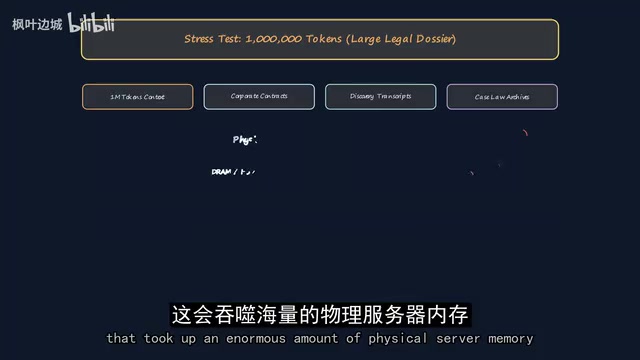
Compute is only half of server costs — the other half is memory, particularly KV Cache (the short-term memory during a conversation). In older models, processing over a million tokens (such as uploading an entire folder of legal documents) consumed enormous physical server memory, because every layer of the AI had to maintain its own high-resolution copy of that memory, making scaling extremely difficult.
Mixture of Experts (MoE) is a foundational concept for understanding V4.1 Flash's efficiency advantages. Traditional dense neural networks activate all model parameters when processing each token. The MoE approach splits the model into several "expert" sub-networks, with a routing mechanism dynamically selecting a small number of experts to participate in each inference. This means the model's total parameter count (which determines knowledge capacity) can be very large, while the activated parameter count during actual runtime (which determines compute consumption) can be far smaller. The stark gap between V4.1 Flash's 552 billion total parameters and its 8–16 billion activated parameters is a textbook example of MoE architecture. The CED design goes further, building on MoE by allocating different activation budgets to the two computationally distinct phases — "reading input" and "generating output" — making efficiency optimization even more granular.
CSA2 and FP4: Compressing Memory by 437x
V4.1 Flash addresses the memory problem with a new technique called CSA2 (Compressed Sparse Attention 2), combined with FP4-format data caching.
Think of it this way: imagine 40 researchers (representing the AI's layers) all studying the same massive encyclopedia. The old system required physically printing 40 separate complete copies, filling an entire room — extremely inefficient. CSA2's approach is to place one core copy at the center of the table and give each researcher a lightweight, personalized bookmark index pointing to the pages they actually care about. The core data is shared, while each person retains their own dynamic, ultra-lightweight access method. Add FP4 format on top, and it's like compressing the core text while preserving dynamic range and important details — memory doesn't degrade or blur.
The results are remarkable: global KV Cache usage is compressed to just 890 bytes per token — 4x smaller than the previous-generation V4 Flash and 437x smaller than DeepSeek V1. This directly explains the speed metrics being discussed on Reddit and Discord — time to first token dropped from roughly 6 seconds with V1 to 2.3 seconds with V4.1.
KV Cache (Key-Value Cache) is the core source of memory consumption in large language model inference, and understanding it is essential for evaluating V4.1 Flash's engineering breakthroughs. In the Transformer architecture, the attention mechanism requires each current token to "see" information from all historical tokens in context. This is accomplished by computing Key and Value matrices at each layer. To avoid recomputing already-processed content when generating each new token, these matrix results are cached — that's the KV Cache. The problem is that cache size scales proportionally with the number of layers, sequence length, and per-layer precision. A large model with dozens of layers processing a million-token document can easily fill tens of gigabytes of GPU memory, severely limiting concurrent user capacity and the maximum context length. FP4 (4-bit floating point) quantization is a compression approach at the precision level: traditional FP16 or BF16 formats use 16 bits to store a single value; FP4 uses only 4 bits, achieving a direct 4x reduction in memory footprint at the cost of some reduction in numerical range and precision.
Inference Efficiency Improvements and Controllable Reasoning Intensity
Beyond architecture, V4.1 Flash also brings meaningful improvements to reasoning token management. Reasoning tokens are essentially the AI's "invisible thinking steps" before printing an answer. The older V4 had an infamous bug: it would sometimes burn through massive amounts of reasoning tokens (spinning its wheels in the mud), only to return nothing to the user — a nightmare for anyone paying per token.
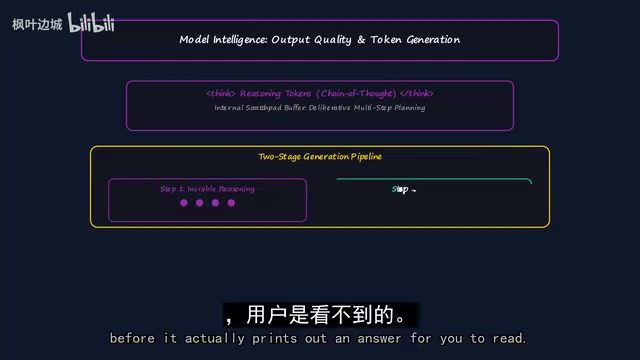
V4.1 fundamentally fixes this efficiency issue. User feedback indicates it uses roughly 30% fewer completion tokens than V4 Flash to arrive at the same answer. More importantly, DeepSeek introduced a "controllable reasoning intensity" integer parameter: you can set a dial from 1 to 100 in your API request, explicitly trading off between inference cost and accuracy. Set it to 10 for a quick email summary to avoid waste; crank it all the way to 100 when writing complex, high-security server code.
Benchmarks: Matching Flagships, But With Real Weaknesses
The leaner, faster architecture hasn't hurt overall intelligence. V4.1 Flash scores 90.9 on the GPQA Diamond benchmark and achieves a 3471 rating on Codeforces — both very solid results.
What truly stands out is its performance on agentic benchmarks — which measure an AI's ability to independently use tools, browse the web, and autonomously solve multi-step problems. V4.1 Flash scores 74.2 on DeepSWE and 54.8 on Automation Bench, actually beating expensive flagship frontier models like Claude Opus and Flash.
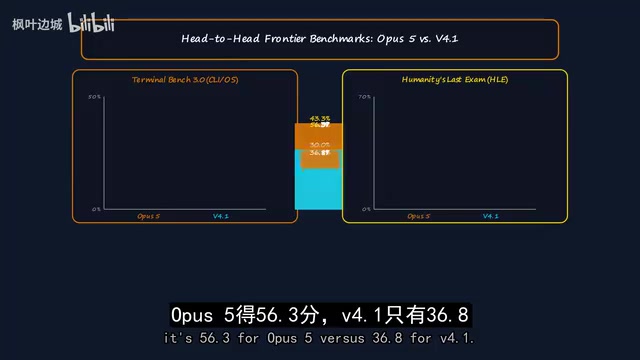
But for a complete picture, its weaknesses must be acknowledged. On purely knowledge-intensive, science-oriented tasks, it falls noticeably behind Opus 5. On Terminal Bench 3.0, Opus 5 leads with 43.3 versus V4.1's 30.0; on Humanity's Last Exam, Opus 5 scores 56.3 while V4.1 manages only 36.8 — a significant gap. This reinforces a core debate in the AI industry today: at the level of general utility, the gap between cheap models and expensive flagships is narrowing in meaningful ways; flagship models are retreating to elite research domains, while models like V4.1 Flash are demonstrating they can handle nearly everything else the global economy actually needs.
The benchmarks mentioned each have distinct design goals, and understanding their purposes helps correctly interpret the score differences. GPQA Diamond (Graduate-Level Google-Proof Q&A) consists of PhD-level science questions deliberately screened to exclude answers directly searchable on the internet, testing a model's internalized deep reasoning and specialized knowledge. Humanity's Last Exam (HLE) is designed to be one of the hardest knowledge-intensive benchmarks currently available, with questions contributed by top scholars worldwide covering frontier interdisciplinary areas in mathematics, physics, history, and more — aimed at probing the ceiling of a model's knowledge. By contrast, DeepSWE and Automation Bench are agentic action benchmarks, evaluating whether a model can call tools, execute multi-step operations, and complete open-ended tasks in real environments — with much higher relevance to actual production deployment. The divergence in scores across these two categories — V4.1 Flash lagging in the former, leading in the latter — directly reflects an emerging division of labor between "flagship models specialized for research" and "efficient models built for production."
The Forced Migration That Sparked Developer Backlash
Despite V4.1 Flash's strong capabilities, speed, and low price, DeepSeek's aggressive rollout strategy triggered serious backlash from its top developers. DeepSeek officially announced the direct retirement of the older V4 Pro model — starting September 14th, all V4 Pro API requests would be intercepted and automatically routed to V4.1 Flash, billed at the cheaper Flash pricing and technically on a better model.
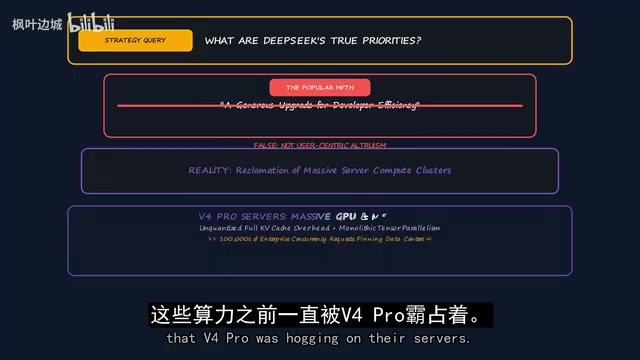
That sounds like good news — but DeepSeek severely underestimated one thing: in enterprise software, predictability is often more valuable than raw performance. Imagine a legal tech company whose software uses AI to retrieve case precedents and format them into legal briefs. Even if the new engine is cheaper and smarter, any slight difference in behavior — a changed paragraph format, slightly different terminology — can break the entire automated pipeline. You'll spend weeks rewriting manuals, testing systems, and updating prompts just to get back to where you started.
Some suspect this aggressive migration wasn't really about giving users a better product, but rather a strategy to free up compute capacity: by pushing everyone off the heavy V4 Pro model, the freed compute could be reallocated to training the next generation of models. DeepSeek apparently feels confident enough to absorb some PR blowback from angry developers, because its pricing is simply unmatched — off-peak cached input pricing has dropped to just $0.003 per million tokens, a 60% reduction compared to the older V4 Flash.
What It Means When the Cost of Intelligence Approaches Zero
Driving the cost of intelligence toward zero is the ultimate double-edged sword. It empowers all participants equally, regardless of intent. The same low-cost programming capabilities that let small startups build useful applications can also allow malicious actors to scale their operations on minimal budgets.
But the direction is clear: if you want to build complex, multi-step AI agents that run continuously in the background — managing schedules, researching topics, drafting code, organizing your life — it's now financially feasible on an ordinary person's budget. You no longer need venture capital to afford API costs. The economics of software development are fundamentally different from what they were a week ago.
Perhaps the future doesn't belong to some massive, expensive, all-knowing "god-tier AI," but to swarms of cheap, fast, disposable AI agents handling 95% of everyday work, while expensive frontier models are strictly reserved for breakthrough scientific research in the lab. This may be what AI democratization actually looks like when it lands in the real world.
Related articles

Chain of Thought Isn't Just for AI: How Humans Can Use CoT to Improve Thinking Quality
Chain of Thought isn't just a prompt trick for large models. Starting from a Hacker News discussion, this article analyzes why CoT works for human thinking too, breaks down actionable ways to transfer it, and highlights the key differences between human CoT and machine CoT.
Cloudflare Teams Up with OpenAI: Closi…
Cloudflare Teams Up with OpenAI: Closing the Loop from Vulnerability Discovery to Defense with AI
Cloudflare uses OpenAI Daybreak to investigate security vulnerabilities and generate reviewable remediation plans, while developers use Codex to boost coding efficiency and quality.

Orca Multi-Agent Orchestration in Practice: A Guide to Parallel Collaboration with Claude and Codex
Orca is Stable AI's free open-source agent workbench supporting 34 agents like Claude Code and Codex in parallel. Learn its Git worktree isolation, multi-model orchestration, and mobile management.