DeepSeek V4.1 Flash Hands-On: 3D Capabilities Transformed, Full Test Suite Cost Only $4

DeepSeek V4.1 Flash iterated in 40 days with generational 3D gains, all tests costing only $3.93.
DeepSeek quietly launched V4.1 Flash 1017 about 40 days after V4, releasing the Hugging Face model card and API directly. A Bilibili creator's 24-hour hands-on test shows its 3D generation is "like a different species" compared to the old version: the subway FPS scene ran completely, and Blender snail modeling, browser OS interface, Corvette sports car, and isometric basketball game all exceeded expectations. The full test cost about $3.93, with output priced at about $1.2 per million tokens. But basic issues remain: reversed control keys, flipped vehicle orientation, robotic arm failures, and rendering-layer occlusion. Full deployment needs about $30,000 in hardware, with community quantized versions expected to lower the bar.
DeepSeek V4.1 Flash Hands-On: 3D Capabilities Transformed, Full Test Suite Cost Only $4
DeepSeekAd released the V4.1 Flash 1017 version 40 days after V4 launched. No countdown teasers, no launch-event hype — the model went straight to Hugging Face and the API. A Bilibili creator ran an intensive 24-hour hands-on test, and the conclusion was blunt: its 3D generation capability compared to the previous generation "is like a different species," and running the entire test suite cost only $3.93.
A Launch So Low-Key It's Almost Abnormal
According to the creator, DeepSeek V4.1 Flash 1017 came only about 40 days after the previous V4, featuring a new architecture and a smaller Flash size. Unlike many vendors' habitual "mysterious countdowns," DeepSeek simply dropped the model card on Hugging Face and brought the API online simultaneously. The model card shows a context window of up to the million-token level — a clear advantage over common models — though running the full million-token context requires some tricks.
The hardware bar is not low: the creator notes that full operation requires 4 DGX B200-class devices, with hardware costs around $30,000, making local deployment difficult for ordinary enthusiasts. However, he also predicts the community will likely release efficient quantized versions later, enabling consumer dual-GPU setups to run it.

Context window refers to the total number of tokens a model can process in a single inference, including input prompts and output content. A million-token level means the model can read about 700,000 Chinese characters or hundreds of pages of technical documentation at once, suitable for long codebase analysis, multi-file project comprehension, and similar scenarios. But "running full" is not the default state: limited by VRAM capacity and the complexity of attention mechanisms, practical use often requires techniques like segmented input, sliding windows, or retrieval augmentation to approach the nominal上限 (upper limit).
DGX B200 is an integrated AI computing system from NVIDIA, typically housing multiple Blackwell-architecture GPUs per unit, aimed at large model training and inference. The article's mention of "4 DGX B200-class devices, about $30,000" refers to the hardware threshold for fully loading the model weights and running inference — far above ordinary consumer GPUs, which is the main reason local deployment is difficult.
Pricing: A Cap of $1.2 per Million Output Tokens
Cost is another highlight of this hands-on test. According to the pricing cited by the creator, the maximum cost is about 30 cents per million input tokens and about $1.20 per million output tokens, with the cache mechanism bringing actual spending even lower. The full test suite (including multiple 3D game generation tasks) cost about $3.93 in total, with the first two test groups costing $1.54 and $2.39 respectively, and the final basketball game about $0.59.
This price point is clearly on the low end of the current model market, especially considering the task types are 3D modeling and game prototyping — major token consumers.
Cache mechanism in API billing usually refers to prompt caching: when multiple requests share the same prefix content (such as system prompts, long documents, or codebase context), the server reuses already-computed key-value caches to avoid redundant computation. Cached portions are billed at a lower input price, sometimes with discounts of several times. For 3D modeling or game generation tasks that repeatedly call the same long context, caching can significantly reduce the actual bill — which is why the article mentions "with the cache mechanism, actual spending can be even lower."
3D Capabilities: From "Unwatchable" to "Surprisingly Good"
The most convincing part of the TEST is the direct comparison with the old version from 48 days earlier. The creator ran the same subway FPS scene on both the old and new versions, and the result "was so different it didn't even seem like the same model" — the old version couldn't even get the character onto the train properly, while the new version ran the scene completely.
On specific projects, performance varied noticeably:
- Blender snail modeling: On its first try, it generated a usable snail 3D model in Blender, at decent speed.
- Browser OS interface: The creator rated the generated interface "better than Windows and Mac UIs," and even considered using it as a reference for a Linux desktop theme.
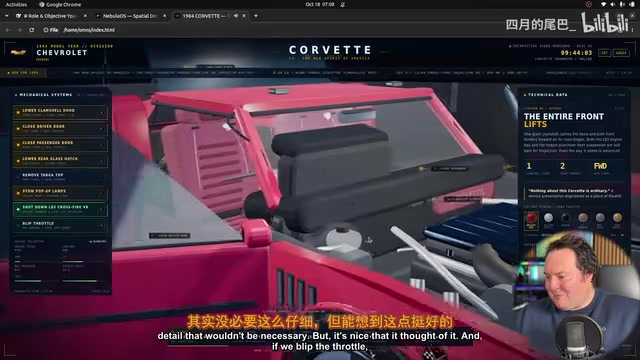
- Corvette sports car model: A car model that all previously tested models (including the best-performing OPS 5.5) failed to do well — this time it produced a wedge-shaped body, round taillights, openable doors and hood, with the logo position and seat texture basically correct. The creator called the result "surprisingly good."
- Isometric basketball game: Given only a single simple instruction and without relying on RayLib, the model hand-wrote a 3D renderer, character animations, dynamic soundtrack, and sound effects in C++, with playability that surprised the creator.
Blender is an open-source 3D creation suite supporting modeling, rendering, animation, and script extensions. The model "generating a usable snail model in Blender" usually means driving Blender via its Python API to automatically create meshes, materials, and scenes, rather than directly outputting images. Such tasks require the model to understand 3D coordinates, topology, and software interfaces, making them a common way to test 3D generation capabilities.
RayLib is a lightweight C/C++ game development library that wraps low-level interfaces for windows, graphics, and audio. The article's emphasis on "not relying on RayLib, hand-writing a 3D renderer in C++" means the model had to implement graphics fundamentals like projection, lighting, and depth sorting itself — significantly harder than calling an existing engine, which is why the basketball game's playability surprised the tester.
Failure Scenes: Reversed Controls and an Arm That Wrapped Under Its Body
Capability improvements don't equal full reliability. The failures in the test are equally typical:
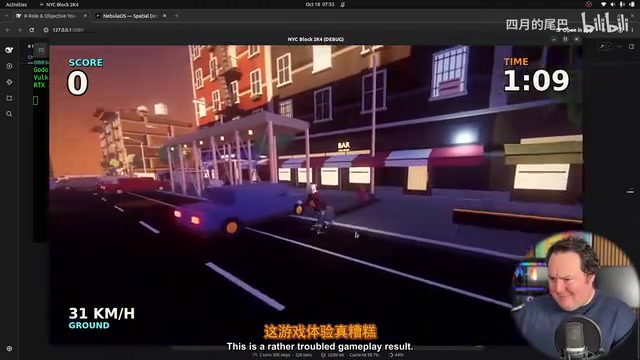
In the C++ skateboarding game, the left and right control keys were completely reversed — "I wanted to turn right but went left." In the massive 3D skateboarding game built with Blender + Godot, the vehicle's front and rear orientations were flipped, causing the body to slide sideways. The robotic arm test was "simply terrible" — the arm wrapped under its own body and couldn't run at all, so the creator just shut it down.
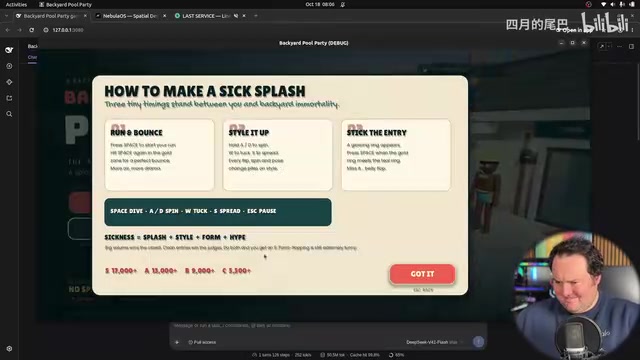
One more detail worth noting: in the party game scene, background shadows completely covered the text, which the creator bluntly called "a total waste." Such rendering-layer issues show the model still hasn't fully mastered the logic of compositing UI with 3D scenes.
The Asymmetry Between Inference Cost and Capability
An easily overlooked data point: the party game scene took 53 minutes and 40 seconds to complete all character parts at the highest reasoning intensity, and the creator says that under similar prompts, a model reasoning at full capacity for one to two hours is "totally normal." This means V4.1 Flash has also improved inference efficiency while maintaining low prices.
Looking at the test overall, the model also performed well on "unseen tasks," leading the creator to believe this 3D improvement is not overfitting to a specific test set. But he also reserved judgment: basic errors like geometry problems and reversed control logic still need improvement, and some results "may not be suitable for standard discussion."
Summary
DeepSeek V4.1 Flash 1017 sends two core signals: first, 3D generation capability made a generational leap within 40 days; second, the cost of trying out this capability has been pushed below $4. For indie developers and AI enthusiasts, this means low-cost 3D mini-game prototyping and rapid validation of modeling ideas have become realistic. But control logic, geometric orientation, and rendering layers — these "last mile" problems — remain the threshold for it to go from toy to tool.
Related articles

Chain of Thought Isn't Just for AI: How Humans Can Use CoT to Improve Thinking Quality
Chain of Thought isn't just a prompt trick for large models. Starting from a Hacker News discussion, this article analyzes why CoT works for human thinking too, breaks down actionable ways to transfer it, and highlights the key differences between human CoT and machine CoT.
Cloudflare Teams Up with OpenAI: Closi…
Cloudflare Teams Up with OpenAI: Closing the Loop from Vulnerability Discovery to Defense with AI
Cloudflare uses OpenAI Daybreak to investigate security vulnerabilities and generate reviewable remediation plans, while developers use Codex to boost coding efficiency and quality.

Orca Multi-Agent Orchestration in Practice: A Guide to Parallel Collaboration with Claude and Codex
Orca is Stable AI's free open-source agent workbench supporting 34 agents like Claude Code and Codex in parallel. Learn its Git worktree isolation, multi-model orchestration, and mobile management.