DeepSeek V4.1 Flash Joins Token Pass: One $30 Subscription, Multiple Models

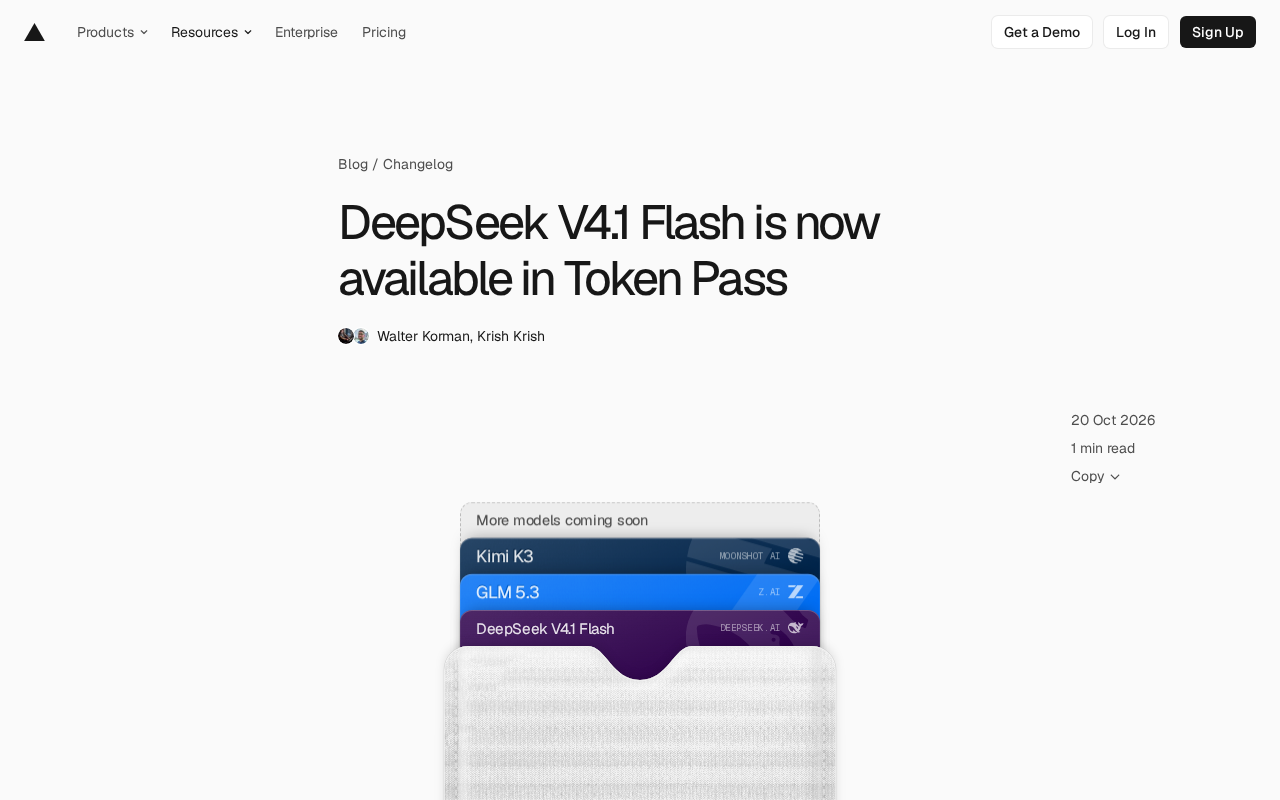
DeepSeek V4.1 Flash joins Token Pass, alongside Kimi K3 and GLM 5.3.
Token Pass is a monthly subscription for Pro teams at $30/month with $80 credit, routing all calls through AI Gateway so developers avoid separate accounts and payments per model. DeepSeek V4.1 Flash is now the third model, using the latest 1017 weights, joining Kimi K3 (Moonshot AI) and GLM 5.3 (Z.ai), each via its preferred provider. It works with coding Agents like fx, Pi, Cline, and Command Code, supports AI SDK integration, and enables Zero Data Retention by default. More models are teased.
Token Pass has added another model to its lineup. DeepSeek V4.1 Flash is now officially integrated into this subscription service, joining Kimi K3 and GLM 5.3 as the third flagship-grade model accessible through a unified entry point. The company also teased that more models will be added in the future.
What Is Token Pass: One Subscription, Multiple Models
Token Pass is a monthly subscription service designed for Pro teams, priced at $30/month with $80 of credit each month. All calls are routed through AI Gateway. Its core selling point is "aggregation"—developers don't need to open separate accounts and pay separately for each model; instead, they can switch between models from multiple vendors within a single subscription.
This mechanism is especially friendly for teams that need to compare model performance side by side or implement multi-model fallback in production environments. Credits and subscription are tied to the team account, making management costs lower than purchasing APIs individually.
The AI Gateway is a unified proxy layer between applications and model providers: applications simply send requests to the gateway, which handles authentication, billing, routing, and retries. It allows teams to switch upstream models or providers without changing code, and centralizes usage, quotas, and key management. Common capabilities include weighted or cost-based routing, failover to backup models, unified logging, and rate limiting. For multi-model subscriptions, the gateway also handles credit accounting, enabling cross-vendor calls to share a single monthly quota.
Three Models Side by Side, Each with Its Preferred Access Channel
Currently available models in Token Pass include:
- DeepSeekAd V4.1 Flash (DeepSeek.ai) — using the latest weights (1017)
- Kimi K3 (Moonshot AI)
- GLM 5.3 (Z.ai)
Each model is accessed through its "preferred provider," which is worth noting: aggregation service does not equal a unified backend—model routing and service quality still depend on their respective upstream channels. DeepSeek V4.1 Flash uses the 1017 version weights, meaning subscribers get a relatively recent model version rather than an early snapshot.
How to Use It: Compatible with Major Coding Agents
Token Pass is quite open in how it can be used. The official documentation states it can be used with any coding Agent, listing tools such as fx, Pi, Cline, and Command Code, and also supports building your own call logic via AI SDK.
For developers already accustomed to a particular coding assistant, this means no need to change workflows—just switch the underlying model to the channel provided by Token Pass. Zero Data Retention, enabled by default, is also a security feature worth noting—request data is not retained, which is a plus for teams handling sensitive codebases.
Zero Data Retention means the service provider does not persistently store prompts and outputs after completing request processing, retaining only necessary billing and operational metadata. It is different from "data not used for training": the latter constrains usage, while the former constrains storage duration. For teams handling private codebases, zero retention reduces the risk of code leakage and compliance audit issues, but it typically also means you cannot trace back original request content during debugging, so you need to keep logs locally.
Integration Steps and What's Next
Adding it is straightforward: add DeepSeek V4.1 Flash on the Token Pass page in your team's AI Gateway dashboard. For specific configuration, refer to the Token Pass documentation.
Looking at the product cadence, Token Pass is moving from "a few models for trial" to "a multi-model shelf." The side-by-side availability of Kimi K3 and GLM 5.3, the addition of DeepSeek V4.1 Flash, and the teaser that "more models are coming" all point in the same direction: subscription-based pricing is becoming a viable business model for multi-model calls. For developers, the real test lies in whether the credits are sufficient, whether routing is stable, and how the models actually differ in performance on specific tasks.
FAQ
How much does Token Pass cost? $30/month, for Pro teams, including $80 of credit per month.
Which models are supported? Currently DeepSeek V4.1 Flash, Kimi K3, and GLM 5.3, with more to be added.
Which tools can it work with? Coding Agents such as fx, Pi, Cline, and Command Code, or self-integration via AI SDK.
Is data retained? Zero Data Retention is enabled by default.
One-line Summary
DeepSeek V4.1 Flash joins Token Pass, alongside Kimi K3 and GLM 5.3.
Paragraph Summary
Token Pass is a monthly subscription service for Pro teams, priced at $30/month with $80 of credit. All calls are routed through AI Gateway, so developers don't need separate accounts and payments for each model. DeepSeek V4.1 Flash is now the third model integrated, using the latest 1017 weights, joining Kimi K3 (Moonshot AI) and GLM 5.3 (Z.ai), each accessed through its preferred provider channel. The service works with coding Agents such as fx, Pi, Cline, and Command Code, supports self-integration via AI SDK, and has Zero Data Retention enabled by default. The company teases more models to come.
Related articles

Chain of Thought Isn't Just for AI: How Humans Can Use CoT to Improve Thinking Quality
Chain of Thought isn't just a prompt trick for large models. Starting from a Hacker News discussion, this article analyzes why CoT works for human thinking too, breaks down actionable ways to transfer it, and highlights the key differences between human CoT and machine CoT.
Cloudflare Teams Up with OpenAI: Closi…
Cloudflare Teams Up with OpenAI: Closing the Loop from Vulnerability Discovery to Defense with AI
Cloudflare uses OpenAI Daybreak to investigate security vulnerabilities and generate reviewable remediation plans, while developers use Codex to boost coding efficiency and quality.

Orca Multi-Agent Orchestration in Practice: A Guide to Parallel Collaboration with Claude and Codex
Orca is Stable AI's free open-source agent workbench supporting 34 agents like Claude Code and Codex in parallel. Learn its Git worktree isolation, multi-model orchestration, and mobile management.