DeepSeek V4.1 Flash Lands on Cursor: Leading the Cost Frontier Across Every Tier

DeepSeek V4.1 Flash comes to Cursor with every effort tier on the cost frontier at $0.60–$0.98 per task.
DeepSeek V4.1 Flash is now officially available in Cursor and can be enabled directly in Settings > Models with no extra configuration. Official data shows it sits on the cost frontier at every effort tier on CursorBench, with per-task costs of $0.60–$0.98 and no same-price model scoring higher. Full-tier frontier performance indicates smooth scaling between reasoning intensity and cost. For developers, this means finer-grained cost control; for budget-sensitive teams, it's a viable default candidate. The article notes the official benchmark data still needs third-party reproduction.
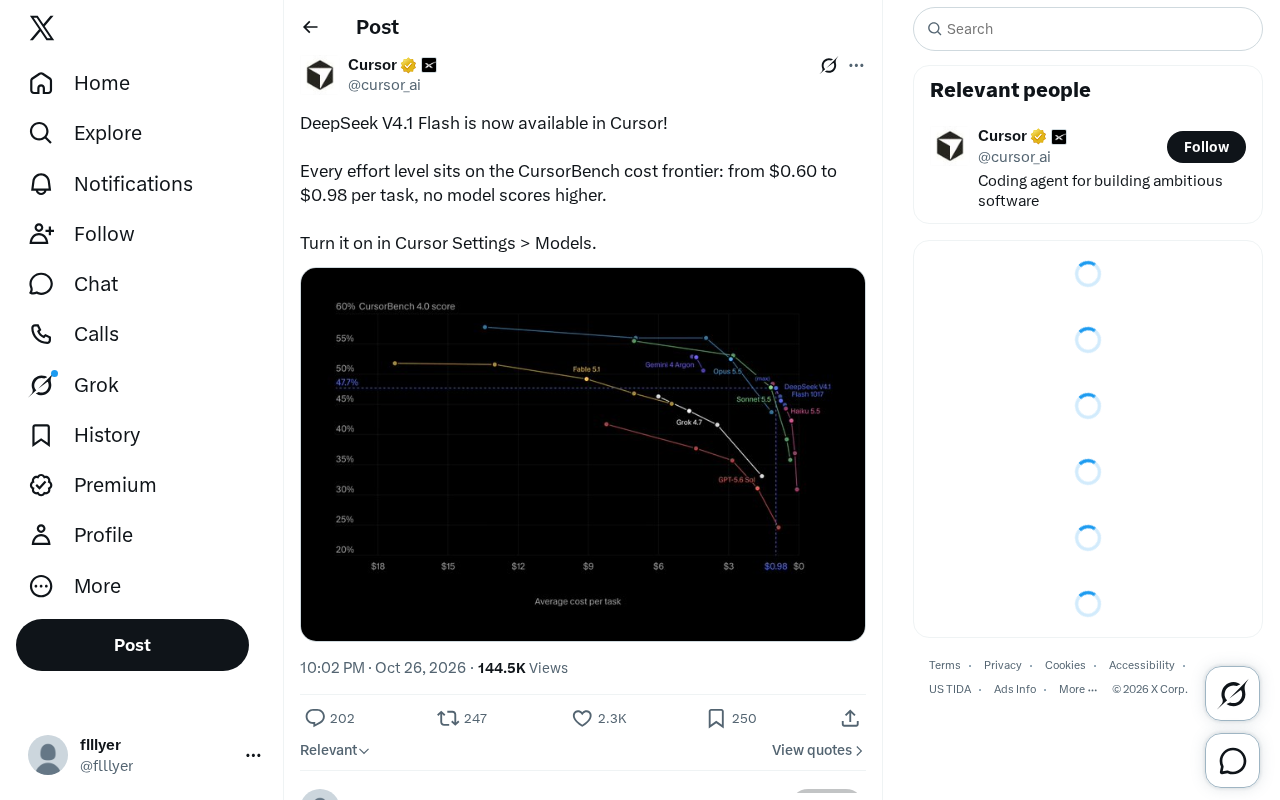
DeepSeek V4.1 Flash is now officially available in Cursor. According to the official announcement, the model sits on the cost frontier at every effort tier in the CursorBench benchmark — with per-task costs ranging from $0.60 to $0.98, no model at the same price point scores higher.
Access and Availability
Users can enable DeepSeekAd V4.1 Flash directly in Cursor under Settings > Models, with no additional configuration required. This gives Cursor users yet another low-cost, high-performance option when choosing a model.
For developers who rely on Cursor daily for code completion, refactoring, and debugging, every expansion of the model list directly affects both usage cost and response quality. The addition of DeepSeek V4.1 Flash gives the "cheap but good enough" tier a new contender.
Cursor is an AI coding editor built on a VS Code fork. Its core capabilities include inline code completion, conversational rewriting of selected code, cross-file refactoring, and multi-step task execution in agent mode. Its model integration uses a "multi-model routing" architecture: users enable or disable specific models in Settings > Models, and the tool decides which one to call based on task type and user configuration. This design makes adding a new model nearly zero-cost for end users — no new API key to request, no workflow changes, just a checkbox in the list. Precisely for this reason, a model's entry into the Cursor list is itself viewed as a market signal: it means the model has passed the tool provider's integration adaptation and baseline evaluation.
What the Cost Frontier Means
The "cost frontier" is a core concept for evaluating model cost-effectiveness: at a given cost level, the models that achieve the highest scores form the frontier curve, and a model on that curve means no other model can deliver better performance at the same price.
Official data shows that DeepSeek V4.1 Flash has a per-task cost range of $0.60 to $0.98 on CursorBench. The key point isn't the absolute price level, but that every effort tier sits on the frontier — from low effort to high effort, cost rises in step with performance, and no tier is surpassed by a competitor at the same price.
What this reflects is the model's efficiency consistency across different reasoning intensities. Many models are cheap at low effort but see a marked drop in quality, while at high effort quality improves but cost spikes, leaving the middle tiers off the frontier. DeepSeek V4.1 Flash's performance across all tiers shows a relatively smooth scaling relationship between reasoning intensity and cost.
Effort tiers (reasoning intensity levels) refer to the levels of "thinking effort" a model invests when generating a response, typically implemented by controlling chain-of-thought length, sampling count, or an internal reasoning budget. Low effort tiers respond quickly, consume fewer tokens, and cost less per call, making them suitable for patterned tasks like code completion; high effort tiers expand longer reasoning chains and try more candidate paths, so they score higher but cost more. Different vendors name and split their tiers differently, but the common thread is this: tier selection is essentially about letting developers use explicit configuration options to trade off latency, cost, and quality — without having to switch models themselves.
Cost frontier derives from the Pareto frontier concept in economics and multi-objective optimization. Set per-task cost on the horizontal axis and benchmark score on the vertical axis, and each model (or each tier of the same model) corresponds to a point on the plane; the curve connecting all points not dominated by another point that is "both cheaper and higher-scoring" is the cost frontier. Being on the frontier means that point is Pareto-optimal within the currently available set: to raise the score you must pay more, and to lower the cost you inevitably lose score. So "all tiers on the frontier" is a much stronger claim than "cheap at a single point" — it requires that the model is not dominated by same-price competitors anywhere along the entire cost-performance curve.
Practical Impact for Developers
For Cursor users, this integration brings more granular cost-control flexibility. Developers can choose different effort tiers based on task complexity: low-cost tiers for simple completions, high-effort tiers for complex refactoring, with each tier staying in the optimal performance range for its price point.
This also means that in budget-sensitive team scenarios, DeepSeek V4.1 Flash can be a candidate for the default model. With a per-task cost of under $1 combined with frontier-level scores, it offers teams that use AI coding assistants heavily a predictable cost model.
CursorBench is Cursor's internal benchmark for evaluating how models perform in its real product scenarios, typically covering categories such as completion, editing, multi-file refactoring, and agent tasks, while recording both scores and per-task cost. Compared with general code-generation benchmarks (such as HumanEval and SWE-bench), its distinguishing features are that it closely mirrors real editor workflows and treats cost as a first-class metric in its reports. Note that vendor-built benchmarks may differ from third-party evaluations in task distribution and scoring criteria, so their published cost-frontier conclusions are better treated as an initial reference for selection rather than a final verdict — which is also why the original article stresses the need for community reproduction.
Competitive Landscape Observations
As a representative product among AI coding tools, the composition of Cursor's model list reflects, to some extent, where market competition is heading. DeepSeek V4.1 Flash enters with full-tier coverage of the cost frontier, putting direct pressure on other models in the same price range.
What's worth tracking is the results of subsequent third-party reproduction tests — the officially published CursorBench data is persuasive, but real-world performance in development scenarios still needs community validation. If independent tests can confirm this cost-frontier conclusion, DeepSeek V4.1 Flash is likely to become a permanent fixture in the cost-effectiveness tier of the Cursor ecosystem.
For now, users only need to enable it in settings to try it out. For developers currently evaluating model cost and performance, this is a new option worth adding to the comparison list.
One-line Summary
DeepSeek V4.1 Flash comes to Cursor, with every effort tier on the cost frontier and per-task costs of $0.60–$0.98.
Paragraph Summary
DeepSeek V4.1 Flash is now officially available in Cursor, and users can enable it directly in Settings > Models with no extra configuration. Official data shows that the model sits on the cost frontier at every effort tier on CursorBench, with per-task costs ranging from $0.60 to $0.98 — no model at the same price point scores higher. Frontier performance across all tiers indicates a relatively smooth scaling relationship between reasoning intensity and cost, rather than an edge at just one tier. For developers, this means more granular cost control: low-cost tiers for simple completions, high-effort tiers for complex refactoring, with each tier in the optimal range for its price point. For budget-sensitive teams, it can serve as a default model candidate, offering a predictable cost model. The article also notes that the official benchmark data still needs third-party reproduction and validation.
Related articles

Running Real-Time Local Voice AI on a Single 12GB GPU: Full Pipeline with a 35B Model and Voice Conversation
A developer shows how to run a 35B MoE LLM, Whisper ASR, and Breeze TTS2 locally on a single 12GB GPU, cutting end-to-end voice chat latency from 8s to 2–3s via streaming, parallel synthesis, and quantization, plus Agent tool-calling integration.

Qwen4 Architecture Preview Open-Sourced: 125B Parameters, 512 Experts, Designed for VRAM-Constrained Hardware
Qwen4 isn't released yet, but its architecture is previewed via open-source Qwen3.8 Flash Next: 125B params, 6B activated per token, 512 experts, 262K context, built for VRAM-limited hardware. This article covers official confirmations, key config.json metrics, and local deployment tests on 24G memory.

Run 8K Images on 6GB VRAM! Hands-On Test of Fudan's Open-Source MOSS-Image Model
Fudan OpenMouse team and Shanghai MOSS Intelligence open-source MOSS-Image, a 500M-parameter DT architecture text-to-image model that runs locally on 6GB VRAM with precise text rendering, structured layout control, and 4K Token prompt support—ideal for e-commerce posters and local deployment by individual creators.