DeepSeek V4.1 Flash Open-Source Hands-On: Faster, Cheaper, and Runs on Consumer Hardware

DeepSeek V4.1 Flash 1017 community hands-on: clear gains in capability and cost, but token consumption and deployment barriers still limit its audience.
After DeepSeek V4.1 Flash 1017 went open source, the community contributed extensive hands-on data: a coding agent passed all 30 runs across 10 real tasks at about 4.5 cents per task but consumed about 550,000 tokens each; local deployment with the ported Tensor4 engine was 2.1–2.3x faster than VLLM, and 64k long-text needle-in-a-haystack time fell from 80 to 36 seconds; a developer's Soto engine ran the 552B model on a single 4090 at about 27 tokens/s. RedPlate's default provider will switch from Anthropic to OpenAI, with Claude still selectable. The article also recommends an MCP server security tutorial emphasizing read-only defaults and audit logs.
The open-source release of DeepSeek V4.1 Flash-1017 has prompted the community to contribute a large amount of hands-on data within just a few days. From the task pass rate of coding agents, to running a 552B-parameter model on a gaming PC, to extreme optimization of inference engines, this feedback from frontline developers paints a fairly concrete picture: the new version has indeed improved in capability, speed, and cost, but its resource consumption characteristics and deployment barriers also mean it is not suitable for everyone.
Coding Agent Hands-On: 30/30 Passes, About 4.5 Cents per Task
According to a Bilibili creator citing a small benchmark by a developer working on coding agents and evaluation at Navius, the developer tested DeepSeekAd V4.1 Flash 1017 using 10 real tasks from their daily work, running each task three times and validating with hidden tests. In Highdown (as in the original) mode, all 30 runs passed, at a cost of about 4.5 cents per task—clearly stronger and faster than the old September version.
This result needs to be understood in context: the sample size is only 10 tasks, the test conditions are limited, and the author himself acknowledges this. Its reference value lies in the fact that the tasks come from real work scenarios rather than synthetic benchmarks. One notable weakness is token consumption—in this test, each task consumed about 550,000 tokens, whereas the compared Opus 5.5 low tier used only about 30,000. This means that in token-billed scenarios, the per-task cost advantage may be partially offset by consumption volume.
The developer also compared two agent frameworks, PI and DeepSeek, and found that the latter's built-in file read/write tools were better suited to this model. This detail points to an often overlooked issue: model capability depends not only on the weights, but also on how well the framework and tools match the model.
Inference Tokens and Pay-Per-Use Billing
LLM API billing is usually split into "input tokens + output tokens," and coding agent tasks are characterized by a very high share of output tokens: the agent repeatedly reads files, executes commands, observes results, and decides the next step, with each step resending the context into the model and accumulating over multiple rounds. Therefore, "550,000 tokens consumed per task" does not mean the user entered 550,000 characters; it is the total generated by repeated calls throughout the entire agent loop. In long-context scenarios, this overhead often determines real spending more than the cost of a single generation.
Agent Frameworks and Tool Calling
The agent framework is responsible for parsing model output into tool calls (reading/writing files, running tests, executing shell commands) and then stitching the results back into the context. Different frameworks vary greatly in prompt organization, tool description format, and error retry strategies, and the same model can show noticeably different pass rates after switching frameworks. The article mentions that DeepSeek's built-in file read/write tools are better suited—essentially because the tool schema is closer to the model's training distribution, reducing format errors and无效 rounds, which indirectly lowers token consumption.
Official Release Highlights: Better Capability, Shorter Runtime, Open Weights
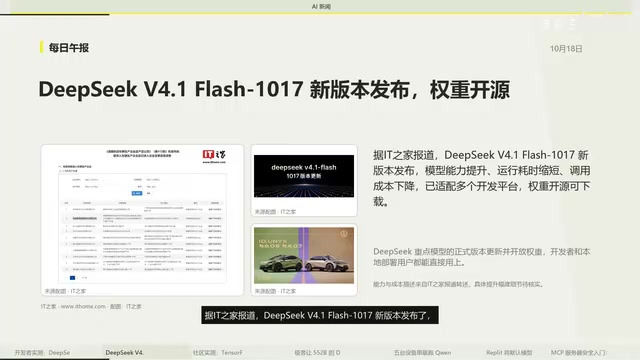
According to IT之家, the DeepSeek V4.1 Flash 1017 release has several key changes: improved model capability, shorter runtime, lower calling cost, open-source weights available for download, and multiple development platforms reporting that they have completed adaptation.
The report also mentions an interesting phrase—"wishful programming": after training, the model can directly generate runnable projects even with limited materials. For ordinary users, lower calling costs mean spending less on the same tasks; for local deployment enthusiasts, open weights mean they can run it themselves immediately. The community's subsequent hands-on tests precisely verify how well these two points hold up in actual use.
Local Inference Optimization: 2.1 to 2.3 Times Faster Than VLLM
On the local deployment side, a community author ran DeepSeek V4.1 Flash 1017 on two DGX Sparks using the Tensor4 engine ported based on Bertholomeus, measuring about 57 tokens/s for text decoding and up to 92 tokens/s in coding scenarios (under the same weights and prompts). Compared with the VLLM solution, it was about 2.1 to 2.3 times faster; the "needle-in-a-haystack" time for 64k long text dropped from 80 seconds to 36 seconds; prefill reached over 2,000 tokens/s at 32k length, and the EM context also ran successfully.
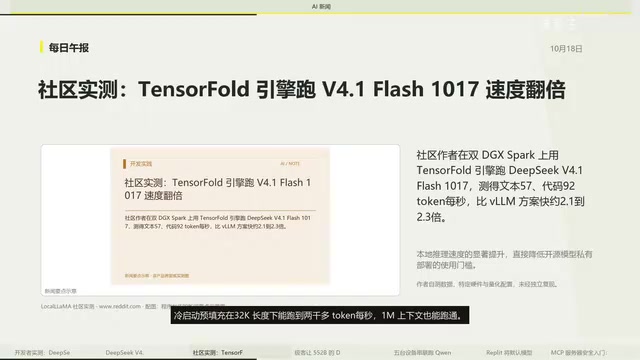
The author also mentioned some host tuning tips, such as disabling swap, which will be updated to the repository later. These data are self-test results under specific hardware and quantization configurations and may not be directly transferable, but the direction is clear: there is still ample room for optimization in open-source inference engines, and more hardcore exploration is yet to come.
Prefill and Decode, KV Cache
Local inference performance is usually split into two stages: prefill processes the entire input at once and builds the KV Cache, while decode generates output token by token. The article's "prefill over 2,000 tokens/s" and "decode 57 tokens/s" are precisely metrics for these two stages. The reason the long-text "needle-in-a-haystack" test dropped from 80 seconds to 36 seconds mainly depends on prefill efficiency and KV Cache memory management.
VLLM and PagedAttention
VLLM is currently the mainstream open-source inference engine, centered on PagedAttention, which manages the KV Cache in blocks to reduce memory fragmentation and improve batching throughput. It has obvious advantages in multi-user concurrent serving scenarios, but in single-machine, single-request, long-context local deployments, scheduling and memory management overhead may not be optimal. Ported engines like Tensor4 make more aggressive cuts for specific hardware and quantization formats, so a 2x-level gap is not surprising, but such comparisons usually hold only under specific configurations and cannot be directly extrapolated to production serving.
Fitting 552B Parameters into a Single 4090: The Extreme Attempt of the Soto Engine
A more aggressive effort comes from Soto, an inference engine written by a developer. He squeezed the entire 552B-parameter DeepSeek V4.1 Flash into an ordinary gaming PC: a single 24G 4090, 90G of RAM, plus NVMe storage. The weights are stored in a distributed manner, and each token pulls only the experts it needs on demand. Measured decoding was about 27 tokens/s, with prefill at 180 to 320; under a 512k context, human evil (as in the original) 21t all passed, and attack calls and agent bug fixing also ran.
He is currently downloading and calibrating the new 1017 version because all the weights have changed and quantization needs to be redone, with release expected in a few days. This kind of玩法 is still out of reach for ordinary users, but it shows that the possibility of running very large open-source models on consumer hardware is being opened up bit by bit.
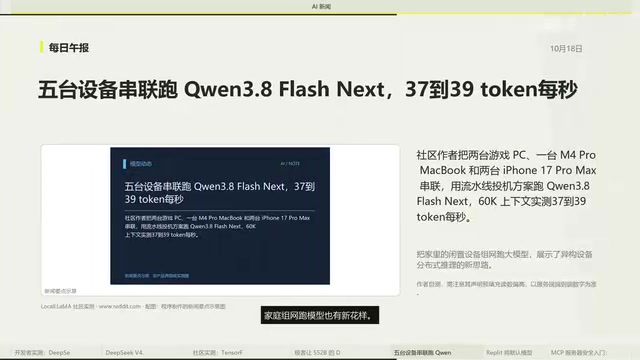
A similar wild idea is running models over a home network: one author chained together two gaming PCs, an M4 Pro MacBook, and even two iPhone 17 Pro Max devices to run Kun 3.8 Flash Next (as in the original)—a 48-layer MoE model with 512 experts per layer. The layer partitioning was carefully designed: the MacBook handles the middle layers, the two phones share part of the expert computation via USB-C, each averaging 2.2 tokens, using pipeline speculation to avoid devices waiting on each other. Measured 37 to 39 tokens/s under a 60k context. The author also reminds readers that the prefill reading on the video dashboard is too high and that the real server-side numbers in the subtitles should be taken as authoritative. This kind of setup has limited practical value, but the idea is certainly thought-provoking.
MoE and On-Demand Expert Loading
The DeepSeek series uses a Mixture-of-Experts (MoE) architecture: each layer contains a large number of expert networks, but each token activates only a few of them. This means inference does not require putting all 552B weights into memory at once; only the experts hit by the current token need to be loaded. The Soto engine's approach is precisely to shard the weights across memory and NVMe, dynamically pulling the required experts per token, trading storage bandwidth for memory capacity. The cost is I/O latency on every pull, so decoding is only about 27 tokens/s and is very sensitive to NVMe random read performance.
Quantization and Recalibration
The article mentions that "all the weights have changed and quantization needs to be redone," referring to compressing high-precision weights into low-bit representations (such as 4bit or 8bit) to reduce size and bandwidth requirements. Quantization usually requires a small batch of calibration data to estimate activation distributions; after a version change, the distribution shifts, and old calibration parameters no longer apply and must be redone, otherwise accuracy loss will be significantly amplified.
Ecosystem Changes and Security Reminders: Default Model Switch and MCP Server Risks
There is also a noteworthy change at the ecosystem level. According to CTEC Crunch (as in the original), RedPlate's CEO confirmed over the weekend that OpenAI will replace Anthropic as the platform's default model provider; however, Claude has not been removed, and platform customers can still choose for themselves. The default model seems like just a small setting, but most users will not actively change it, so this switch will genuinely affect the daily coding experience of a group of developers. As for the cost, performance, or business considerations behind the change, the report does not elaborate.
Finally, an MCP hands-on tutorial aimed at developers is worth recommending. MCP has now basically become the default way to connect AI assistants to tools and data, but the tutorial author reminds readers that the caller of an MCP server is a model that may be misled, injected, or make mistakes. So "it works" is not the bar; the goal must be that "even if it makes a mistake, the consequences are small and visible." The article builds a small server from scratch in TypeScript that exposes order queries and refund requests, with core security patterns including strict input schemas, read-only by default, write operations that only create pending-review requests, and complete call audit logs. If you are about to connect internal systems to an agent, this set of ideas is worth reading first.
What Is MCP
MCP (Model Context Protocol) is a protocol that lets AI assistants connect to external tools and data sources in a standardized way: servers expose tools, resources, and prompt templates, and clients (the model side) initiate calls according to schemas. It solves the fragmentation problem of "connecting each tool separately for every model," which is why it quickly became the default way for agents to connect to internal systems. But precisely because it exposes real system capabilities to the model, and the caller is a model that may be prompt-injected or misjudge, the security boundary must be guarded by the server side itself—this is exactly why the article emphasizes strict input schemas, read-only by default, write operations that only create pending-review requests, and complete audit logs.
Conclusion
Community feedback on DeepSeek V4.1 Flash 1017 presents a clear outline: high coding task pass rates, ample room for inference engine optimization, and running very large models on consumer hardware is no longer fantasy. But high token consumption, limited self-test conditions, and many deployment pitfalls also remind users not to be misled by isolated data points. For ordinary users, lower calling costs are a direct benefit; for local enthusiasts, open weights open up experimental space; for developers, framework matching and security design are the keys to using the model well.
One-line Summary
DeepSeek V4.1 Flash 1017 community hands-on: clear gains in capability and cost, but token consumption and deployment barriers still limit its audience.
Paragraph Summary
After DeepSeek V4.1 Flash 1017 went open source, the community contributed a large amount of hands-on data within days: a coding agent passed all 30 runs across 10 real tasks at about 4.5 cents per task, but consumed about 550,000 tokens per task, far more than the compared model; local deployment with the ported Tensor4 engine was 2.1 to 2.3 times faster than VLLM, and 64k long-text needle-in-a-haystack time dropped from 80 seconds to 36 seconds; a developer's self-written Soto engine ran the 552B-parameter model on a single 4090 gaming PC at about 27 tokens/s decoding. On the ecosystem side, RedPlate's default model provider will switch from Anthropic to OpenAI, while Claude remains selectable. The article also recommends an MCP server security tutorial emphasizing read-only by default, strict schemas, pending-review writes, and audit logs. Overall, lower calling costs are a direct benefit for ordinary users, open weights open up local experimentation, but high token consumption, limited self-test conditions, and many deployment pitfalls mean users should not be misled by isolated data points.
Related articles

Chain of Thought Isn't Just for AI: How Humans Can Use CoT to Improve Thinking Quality
Chain of Thought isn't just a prompt trick for large models. Starting from a Hacker News discussion, this article analyzes why CoT works for human thinking too, breaks down actionable ways to transfer it, and highlights the key differences between human CoT and machine CoT.
Cloudflare Teams Up with OpenAI: Closi…
Cloudflare Teams Up with OpenAI: Closing the Loop from Vulnerability Discovery to Defense with AI
Cloudflare uses OpenAI Daybreak to investigate security vulnerabilities and generate reviewable remediation plans, while developers use Codex to boost coding efficiency and quality.

Orca Multi-Agent Orchestration in Practice: A Guide to Parallel Collaboration with Claude and Codex
Orca is Stable AI's free open-source agent workbench supporting 34 agents like Claude Code and Codex in parallel. Learn its Git worktree isolation, multi-model orchestration, and mobile management.