DeepSeek V4.1 Flash Real-World Testing: Efficiency Revolution or Cherry-Picked Benchmarks?

DeepSeek V4.1 Flash offers genuine efficiency gains for input-heavy agents, but its 'beats frontier' benchmark claims rely on outdated competitors.
DeepSeek released V4.1 Flash on September 10th under MIT license with 552 billion total parameters, but only 8 billion activated per token during reads thanks to MoE and a novel encoder-decoder separation design. Its 890-byte KV cache footprint makes million-token contexts practical, and cached input pricing is ~25x cheaper than Gemini Flash. However, its benchmark leads over Claude Opus 5 and GPT-5.6 Sol vanish on harder tasks, the competitors were superseded 12 days after release, and the same model scores nearly 9 points differently depending on the evaluation harness. Independent testing also flags excessive output verbosity and weak factual recall. The real value proposition is cost-efficient agentic inference, not frontier-level capability.
What DeepSeek V4.1 Flash Actually Is
DeepSeekAd's newly released V4.1 Flash scored 90.6 on Terminal Bench 2.1, surpassing Claude Opus 5's 89.1 and GPT-5.6 Sol's 88.8. Even more striking: it activates only 8 billion of its 552 billion parameters per input token. The numbers look impressive — but after one tech blogger dug through the model card, technical report, and independent evaluations, the story turns out to be more complicated. Is this a genuine efficiency leap, or a carefully curated chart?
What DeepSeek Actually Released
V4.1 Flash launched on September 10th under MIT open-source weights, with DeepSeek calling it the "smallest" model in their new architecture family. But small is relative: it has 552 billion parameters — nearly twice the size of the V4 Flash it replaces (284 billion).
Three core updates stand out: native vision capabilities, where images and text are jointly trained from pretraining on 45 trillion tokens (replacing the deprecated experimental vision model); a 1-million-token context window; and an architecture redesigned specifically to make "input-heavy" agentic tasks cheaper.
One side note: DeepSeek initially announced that V4 Pro requests would be redirected to V4.1 Flash starting September 14th, but reversed course after user pushback. V4 Pro remains available at the same pricing, so Flash isn't replacing the flagship model — and the official announcement points toward a not-yet-released V4.1 Pro.
One Screenshot In, a Three-File Patch Out
The most compelling demo the blogger found came from Datacamp. Data engineer Khalid Abdulladi built a small Flask dashboard called Nimbus Analytics, then planted one bug each in three files: a calculation error in Python, a color error in CSS, and a mismatched Canvas ID in JavaScript. The agent had no prior knowledge of where the bugs were — it only received a reference screenshot of the "correct" result, plus tools to list files, read files, run tests, take headless browser screenshots, and batch-edit files.
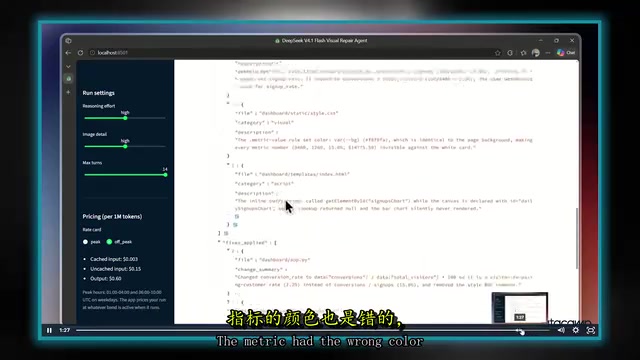
It didn't rush in. The first two rounds were pure observation, the third ran tests, and only on the fourth round did it submit a patch: the conversion rate formula was using visitor count instead of registration count, metric colors were wrong, and JavaScript was pointing to the wrong canvas. All five tests passed.
But there's a detail the blogger saved for last: the tests went green, yet every new screenshot still showed a 15% conversion rate and blank charts. The reason was that the server was still running the old code — it had been started with debug mode off, with no mechanism to reload the patched Python or templates. Only the CSS change had taken effect. The agent correctly diagnosed this problem on round 14 (the final round), but had no tool to restart the server — that had to be done by a human.
The honest read: the model fixed the code and correctly identified why it couldn't verify the result, but couldn't finish the job independently. The author's conclusion was that what was missing was a "restart tool," not another patch. The entire run cost about 15 requests, roughly 157,000 input tokens (87% cache hits), 11,000 output tokens, and approximately one cent at off-peak rates.
Why 552 Billion Parameters Can Be This Cheap
The answer is in the architecture. The blogger identified three key tricks.
First is Mixture of Experts (MoE). Each layer has 1 shared expert and 384 routed experts, but each token only activates 6 of those routed experts — most of the network is idle at any given moment.
Second is a novel encoder-decoder separation design. The prefill phase (reading the prompt) is handled by a 20-layer encoder, and the decoding phase's memory is projected directly from the encoder's final output rather than computed layer by layer. DeepSeek says this means 8 billion parameters are activated per token during reading and 16 billion during writing. By comparison, the old V4 Flash activated 13 billion per token, and V4 Pro activates 49 billion — a larger, newer model that uses fewer parameters for reading.
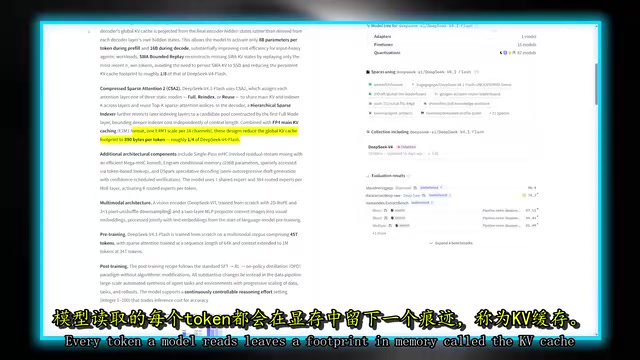
Why design it this way? Because agentic tasks are input-heavy. In the Datacamp run, the model read about 14 tokens for every 1 it wrote, and each round re-sent files, tool outputs, and history. Making reads cheaper hits the biggest slice of the token budget.
The other key to affordable long context: how much KV cache memory each read token leaves behind. V4.1 Flash uses just 890 bytes per token — about a quarter of V4 Flash, and reportedly ~437x smaller than DeepSeek's first model. One million tokens times 890 bytes is under 1 GB (a rough calculation by the blogger, not accounting for other state) — which explains why a million-token window isn't a memory nightmare here.
Mixture of Experts (MoE) replaces a single large feed-forward network with multiple parallel "expert" sub-networks, with a lightweight router dynamically deciding which few experts handle each token. Because only a fraction of experts are activated at any time, total parameter count (which sets the model's ceiling) is effectively decoupled from inference-time compute (which determines speed and cost) — this is the fundamental reason V4.1 Flash can have 552 billion total parameters while activating only 8 billion for reads. Routing strategy design is its own challenge: overly concentrated expert assignments cause some experts to be overloaded while others sit idle (called "load imbalance"). DeepSeek addresses this with 384 routed experts plus 1 shared expert — the shared expert handles universal features needed by all tokens, while routed experts capture more specialized patterns, balancing generalization and specialization.
Encoder-decoder separation is unusual for large language models. The mainstream decoder-only architecture uses the same stack of layers for both reading and generation, while V4.1 Flash isolates prefill into a 20-layer encoder, with the decoder projecting its initial memory directly from the encoder's final hidden state — skipping the overhead of "replaying" the input layer by layer. This pays off significantly for long prompts, since the encoder only needs a single forward pass over the input, and the result can be cached and reused without recomputing input attention for each generation round.
The Benchmark Table Everyone Is Screenshotting
DeepSeek compares V4.1 Flash at maximum reasoning intensity against Claude Opus 5, GPT-5.6 Sol, and others. Its leads cluster around "easy" tasks: Terminal Bench 2.1 at 90.6, DeepSWE at 74.2 vs. Opus 5's 74.0 (a margin of just 0.2), and CyberGym at 88.1 vs. 84.5.
Harder benchmarks tell a different story: Terminal Bench 3.0, 30.0 vs. Opus 5's 43.3; Terminal Bench 4.0, 31.2 vs. Opus 5's 51.8; no-tools "Humanity's Last Exam" at 36.8 vs. Opus 5's 56.3. The blogger's take: easy tests are bunched at the top, and the harder tests expose the gaps.
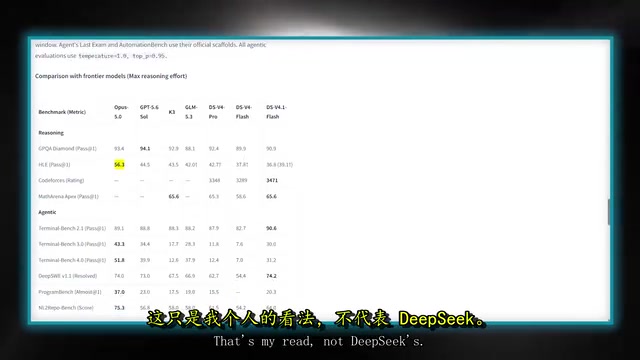
DeepSeek's own model card includes a caveat: the same model on DeepCWE scores anywhere from 65.5 to 74.2 depending on the agent framework (harness). The headline number uses the official harness — the top of that range — while under Claude Code's harness it's only 69.8.
More critically, there's the problem of who it's competing against. The table was published September 10th, and Anthropic released Opus 5.5 on September 22nd, with OpenAI releasing GPT-6 Sol and Luna the same day. Twelve days after launch, both main competitors in the table had been superseded. V4.1 Flash is a fast, low-cost model — its real peer group should be Gemini 3.8 Flash and GPT-6 Luna. Against Gemini Flash, the gaps are 1.2 and 0.5 points — smaller than the variance introduced by different harnesses.
The fair summary: DeepSeek is competitive in the current fast-tier, but the "beats frontier" framing rests on outdated competition.
Benchmark harness refers to the complete evaluation framework built around testing model capabilities, including how tasks are formatted, how tools are called, how results are judged, and how context and execution environments are managed across multi-turn agentic tasks. Dramatically different scores from the same model under different harnesses are not unusual — the 65.5 to 74.2 swing on DeepCWE in the model card is a textbook example. This means statements like "scored Y on benchmark X" carry an implicit qualifier: "under a specific harness." Cross-model comparisons without this caveat are easily misleading. The enormous gap between Terminal Bench 2.1 and 3.0/4.0 scores (30 vs. 90) also illustrates how task difficulty distribution can make the same model look radically different — and it's well understood in the industry that developers tend to highlight benchmarks where they have an advantage, which is precisely why independent evaluation bodies exist.
What Independent Evaluations Add
Artificial Analysis's independent testing supports some of DeepSeek's claims: the new Flash scores 39 on their Intelligence Index, beating the larger V4 Pro's 36 and well above the open-source model median — but below the leading frontier models. They measured roughly 232 tokens/second, which is quite fast, though time-to-first-token including thinking is around 10 seconds.
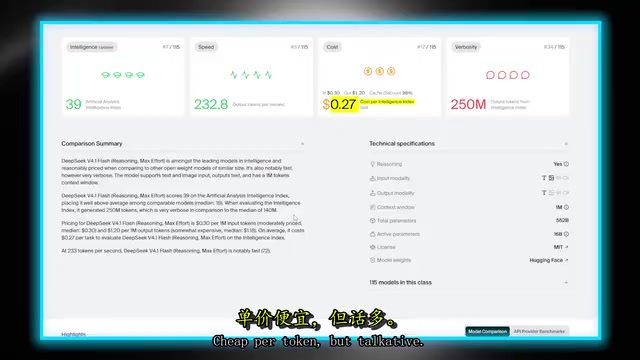
The trade-off is verbosity. Completing the full index, it generated 250 million output tokens — versus a peer median of 140 million — at $0.27 per task. Cheap per token, but it produces a lot of them. On SimpleQA, a factual recall test, V4.1 Flash scored just 42.3, compared to 55.2 for the larger V4 Pro base model. Efficiency has its costs.
On pricing, DeepSeek is no longer the cheapest option: on September 22nd, OpenAI's GPT-6 Luna came in at $0.10 per million input tokens and $0.50 per million output tokens — below DeepSeek's off-peak list price. The one area where DeepSeek still stands out is cached input: $0.003 at off-peak rates, roughly 25x cheaper than Gemini 3.8 Flash. For agents that resend the same history every round, this makes input costs extremely low.
As for self-hosting: the weights are open, but the checkpoint weighs 510 GB, and the hosting guide recommends 4x Blackwell or 8x H200 cards — making the API the realistic path for most people. The circulating claim of "98% of GPT-6 quality at 1% of the cost" is nowhere to be found in the model card, technical report, or independent evaluations, and should be treated as unverified.
KV cache (Key-Value Cache) is the data structure used in Transformer inference to store intermediate attention results. During autoregressive generation, the model computes attention between every new token and all historical tokens. Without caching, this grows quadratically with sequence length. KV cache stores the Key and Value vectors for historical tokens in GPU memory — trading space for time. For long-context models, KV cache memory footprint often becomes the bottleneck: a million-token context window with a few KB per token can consume tens of gigabytes of VRAM. V4.1 Flash compresses this to 890 bytes per token, a reduction typically achieved through fewer or smaller attention heads (as in Multi-Query Attention/Grouped Query Attention) or quantization techniques. This brings million-token windows into manageable memory territory, and also makes API-side cache hit pricing commercially viable.
The Bottom Line: This Is an Efficiency Story
V4.1 Flash's core value is efficiency: half the active compute during reads, a quarter the cache size, and cached input costs a fraction of a cent in the open-source tier. This makes long, input-heavy agentic loops affordable — and that claim holds up in DeepSeek's documentation, the Datacamp demo, and independent evaluations.
What doesn't hold up is "beats frontier." It falls behind on harder, longer tasks; it's roughly on par with the latest fast-tier competitors; and its pricing advantage was compressed the moment GPT-6 Luna launched.
The blogger's recommendation: if your agent does a lot of reading (codebases, screenshots, logs) and you're budget-sensitive, it's worth trying — but it's not the first choice for the hardest long-horizon tasks. If you're building on it, the Datacamp checklist is worth following: cap rounds and cost, restrict file access, validate every tool parameter, and give the agent a way to restart the environment under test.
There's also a bigger question lurking: agents spend most of their tokens on reads. If other labs start copying this "make reads cheap" design, the significance of this release will extend well beyond any leaderboard.
Related articles

Chain of Thought Isn't Just for AI: How Humans Can Use CoT to Improve Thinking Quality
Chain of Thought isn't just a prompt trick for large models. Starting from a Hacker News discussion, this article analyzes why CoT works for human thinking too, breaks down actionable ways to transfer it, and highlights the key differences between human CoT and machine CoT.
Cloudflare Teams Up with OpenAI: Closi…
Cloudflare Teams Up with OpenAI: Closing the Loop from Vulnerability Discovery to Defense with AI
Cloudflare uses OpenAI Daybreak to investigate security vulnerabilities and generate reviewable remediation plans, while developers use Codex to boost coding efficiency and quality.

Orca Multi-Agent Orchestration in Practice: A Guide to Parallel Collaboration with Claude and Codex
Orca is Stable AI's free open-source agent workbench supporting 34 agents like Claude Code and Codex in parallel. Learn its Git worktree isolation, multi-model orchestration, and mobile management.