DeepSeek-V4.1-Flash Released: Breaking Down the 552B MoE Architecture and Engram Memory
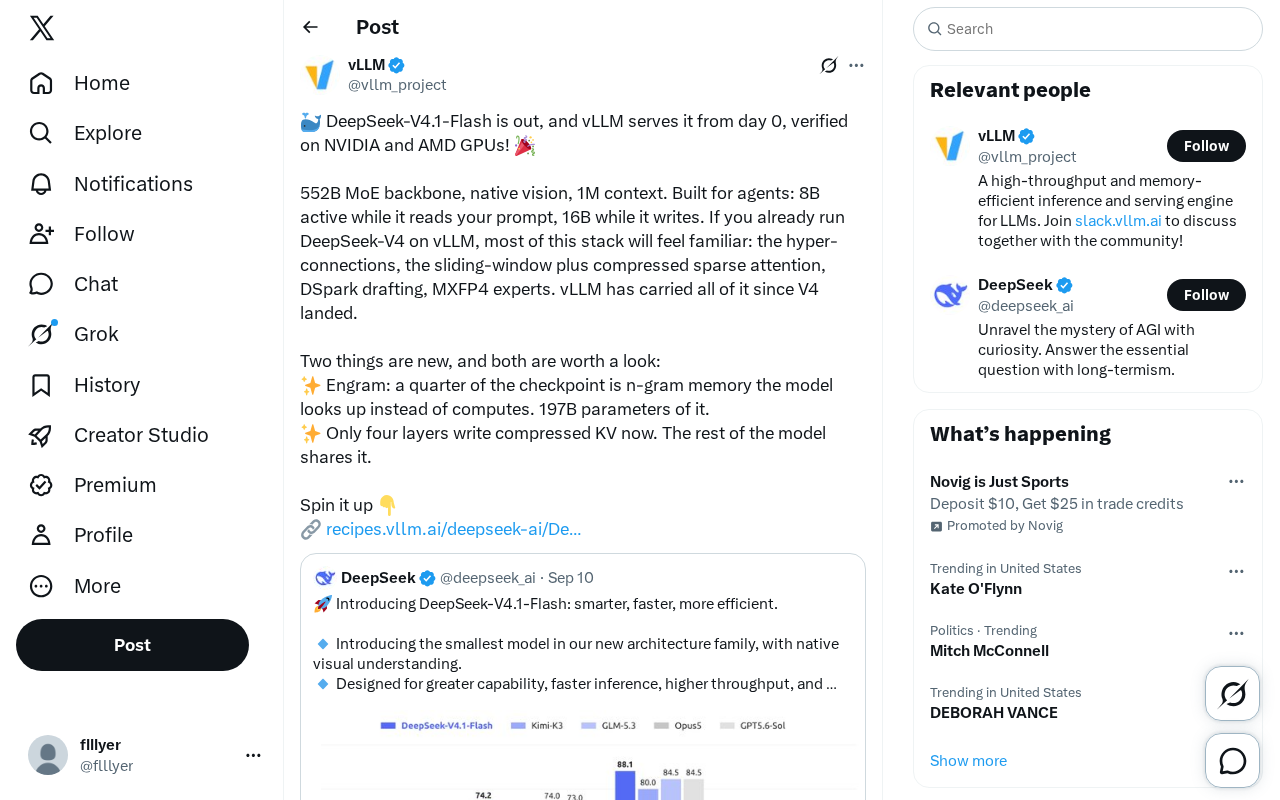
DeepSeek-V4.1-Flash brings 552B MoE, Engram memory, and compressed KV sharing with day-0 vLLM support.
DeepSeek-V4.1-Flash is a 552B MoE model with native vision support and a 1M-token context window, featuring differentiated activation for agent scenarios — 8B parameters during prompt reading and 16B during generation. Building on V4's mature stack, it introduces two key innovations: Engram dedicates 197B parameters as an n-gram memory table, replacing real-time computation with lookup; and a compressed KV sharing mechanism where only four layers write to the KV cache, drastically reducing memory pressure for long-context inference. vLLM provides day-0 support validated on both NVIDIA and AMD hardware.
DeepSeek-V4.1-Flash is officially available, with vLLM providing native support from day one — validated on both NVIDIA and AMD GPU platforms. This release builds on the V4 tech stack while introducing two noteworthy architectural innovations.
Core Specs: A Sparse Architecture Built for Agents
DeepSeek-V4.1-Flash features a 552B-parameter MoE (Mixture of Experts) backbone with native vision support and a context window extending to 1 million tokens. These numbers are impressive on their own, but the more intentional design choice lies in its activation strategy.
The model is specifically optimized for agent scenarios: it activates only 8B parameters during the prompt-reading phase and 16B parameters during generation. This "read light, write heavy" dynamic activation means the model maintains extremely low computational overhead when processing long-context inputs, only calling on additional compute when reasoning and generation are actually required. For agent workflows that frequently read large amounts of context but generate output intermittently, this is a well-matched approach to resource allocation.
What is MoE? Mixture of Experts is a sparsely activated architecture: the model consists of many "expert" sub-networks, and during each forward pass, a gating router selects only a small subset of those experts to participate in computation rather than activating all parameters. This decouples total parameter count (which determines knowledge capacity) from actual compute (which determines inference cost) — 552B total parameters does not mean every inference run requires 552B worth of computation. DeepSeek-V4.1-Flash takes this further by differentiating between the prompt-reading and token-generation phases, activating 8B and 16B parameters respectively — essentially applying MoE sparsity differently across distinct stages of the inference pipeline.
A Familiar Tech Stack: Carried Over from V4
If you've already run DeepSeek-V4 on vLLM, most of V4.1-Flash's tech stack will look familiar. The announcement explicitly notes that the following capabilities have been fully supported in vLLM since V4 launched:
- Hyper-connections: A connection mechanism that improves information flow between layers
- Sliding window + compressed sparse attention: Balancing long-context efficiency with attention quality
- DSpark drafting: A draft mechanism for speculative decoding to accelerate generation
- MXFP4 experts: Expert layers using MXFP4 low-precision format to reduce memory and compute demands
This technical continuity is good news for production deployers — existing inference stacks can migrate to the new model without significant rework.
Two New Features: Engram Memory and Shared KV
The genuinely new changes are concentrated in two areas, both of which the team specifically highlights as worth examining.
Engram: Turning Memory into Lookup Rather Than Computation
Engram is the most striking design choice in this release. It dedicates one quarter of the entire checkpoint's capacity — specifically 197B parameters — as n-gram memory. When the model encounters content covered by this portion, it performs a lookup rather than a computation.
In other words, instead of repeatedly running forward-pass computations on high-frequency language patterns, the model retrieves pre-stored n-gram memories like consulting a dictionary. This shifts part of the language modeling burden from real-time computation to in-memory lookup, theoretically reducing inference costs and improving response speed in specific scenarios. The 197B parameter scale also signals that the DeepSeek team is making a substantial bet on this approach.
Background on n-grams and Engram: An n-gram is a classic NLP concept referring to a sequence of n consecutive words (or tokens) in text. Traditional language models implicitly encode high-frequency n-gram patterns into weights during pretraining, but still need to "recompute" those patterns through full matrix multiplications at inference time. Engram's approach is to explicitly materialize this knowledge as a retrievable memory table — similar to compiling common phrases into a dictionary and looking them up directly rather than re-deriving them each time. The 197B parameter scale means this "dictionary" covers a vast number of high-frequency language fragments. This shares conceptual similarities with Retrieval-Augmented Generation (RAG), but Engram is part of the model's internal weight structure rather than an external knowledge base call — making it fundamentally different in terms of latency characteristics and system complexity.
Compressed KV Sharing: Only Four Layers Write
The second change targets the KV cache. In V4.1-Flash, only four layers are responsible for writing compressed KV; the rest of the model shares this cache.
KV cache is one of the primary memory bottlenecks in long-context inference. By having the vast majority of layers share the compressed KV written by just a few layers, the model significantly reduces KV cache memory pressure. Considered alongside the 1 million token context capability, this design is essentially a prerequisite for long-context deployment to be viable at all — without it, the KV cache overhead for million-token contexts would be prohibitive.
Background on KV Cache: The KV cache (Key-Value Cache) is a core mechanism in Transformer inference: during autoregressive generation, each layer's attention computation produces Key and Value matrices. To avoid recomputing these for historical tokens, the matrices are cached in GPU memory for reuse by subsequent tokens. As context length grows, KV cache memory usage expands linearly — for million-token contexts, maintaining a full KV cache for every layer independently often consumes more memory than the model weights themselves, becoming the biggest obstacle to long-context inference. DeepSeek-V4.1-Flash's "only four layers write, all others share" strategy is an extremely aggressive form of KV cache compression: by drastically reducing the number of layers that need to independently store KV, memory pressure is compressed to a tiny fraction of the original, at the cost of some layers losing independent attention expressiveness. This shares the spirit of Multi-Query Attention (MQA) and Grouped-Query Attention (GQA), but with coarser sharing granularity.
The Engineering Significance of Day-0 Support
The fact that vLLM supports this model from launch day — with validation on both NVIDIA and AMD hardware — is not a minor detail. For developers and enterprise users, no matter how capable a model is, deployment costs remain high without a mature inference framework and cross-hardware support.
The close collaboration between DeepSeek and vLLM means this complex architecture — encompassing hyper-connections, sparse attention, speculative decoding, low-precision experts, Engram memory, and shared KV — works out of the box on the open-source inference stack. Cross-NVIDIA/AMD validation also means users have greater flexibility in hardware selection, without being locked into a single vendor.
Summary
DeepSeek-V4.1-Flash continues V4's mature sparse and low-precision tech stack while pushing inference costs lower for long-context and agent scenarios through two innovations: Engram memory and compressed KV sharing. The 552B MoE backbone, 1M-token context, native vision support, and vLLM's day-0 cross-platform availability together form a complete solution oriented toward real-world deployment. For teams focused on open-source LLM engineering, this is a version worth evaluating sooner rather than later.
Note: This article is based on official release information. Some architectural details await further verification from more comprehensive technical documentation.
Related articles
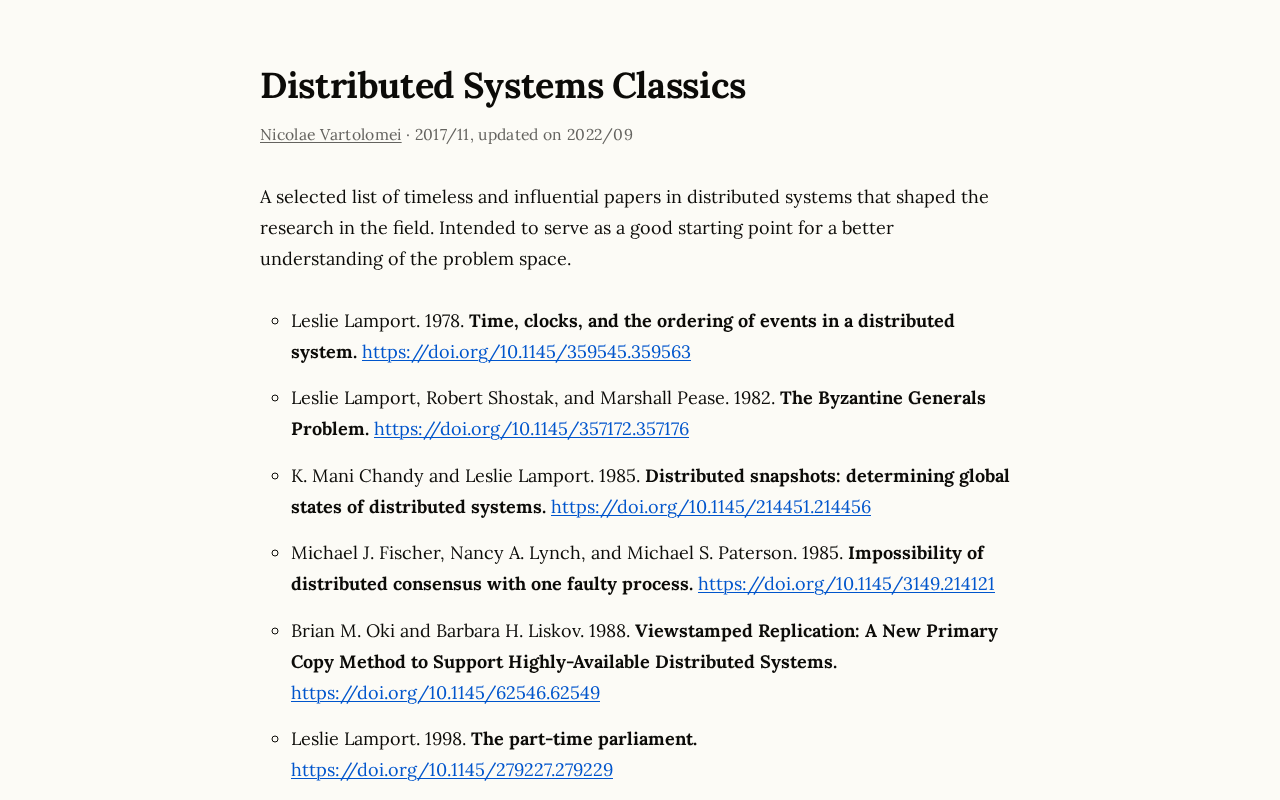
A Reading Guide to Distributed Systems Classic Papers: From Beginner to Expert
A viral Hacker News list of distributed systems classic papers covering consensus algorithms, logical clocks, and the CAP theorem — a structured learning path for engineers.
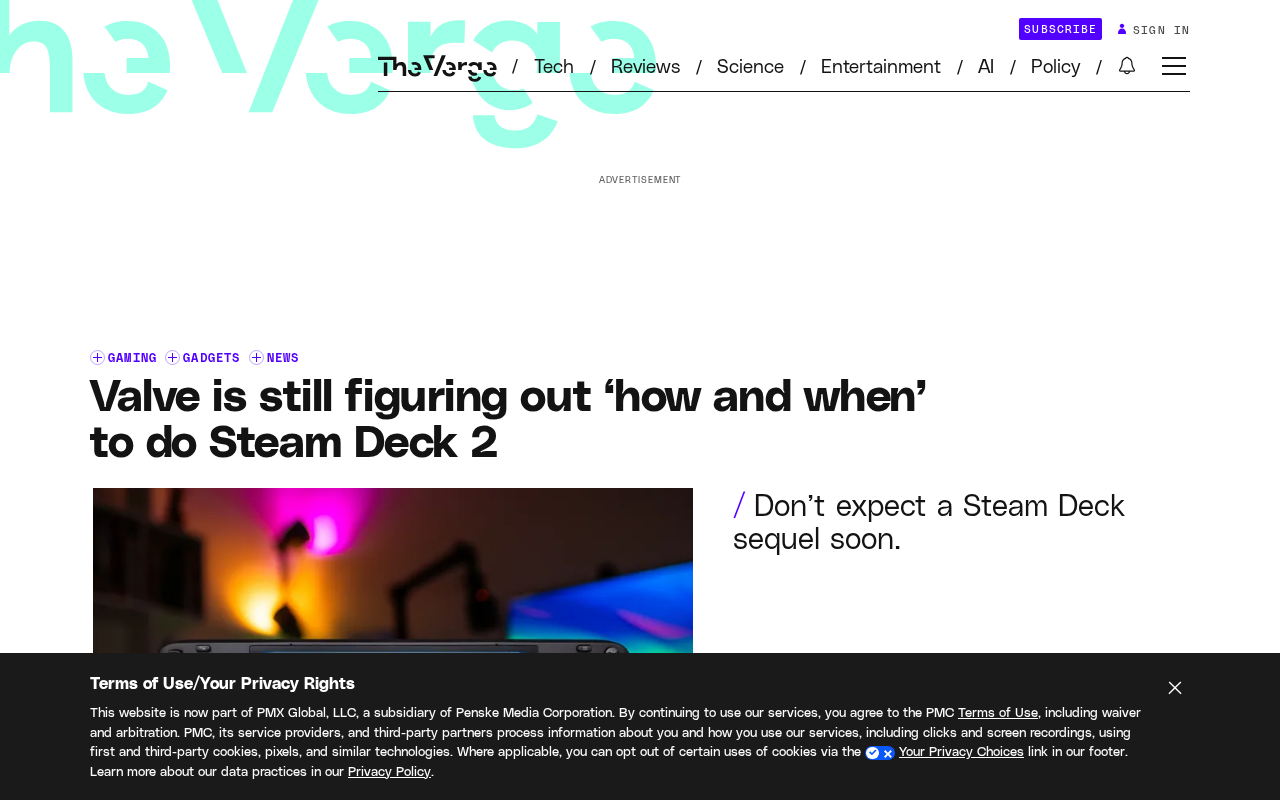
Valve Is Still Weighing When and How to Launch Steam Deck 2
Valve has completed its 2026 hardware lineup with Steam Controller, Steam Machine, and Steam Frame, but Steam Deck 2 still has no set timeline. Valve says it's still weighing "how and when" to launch.
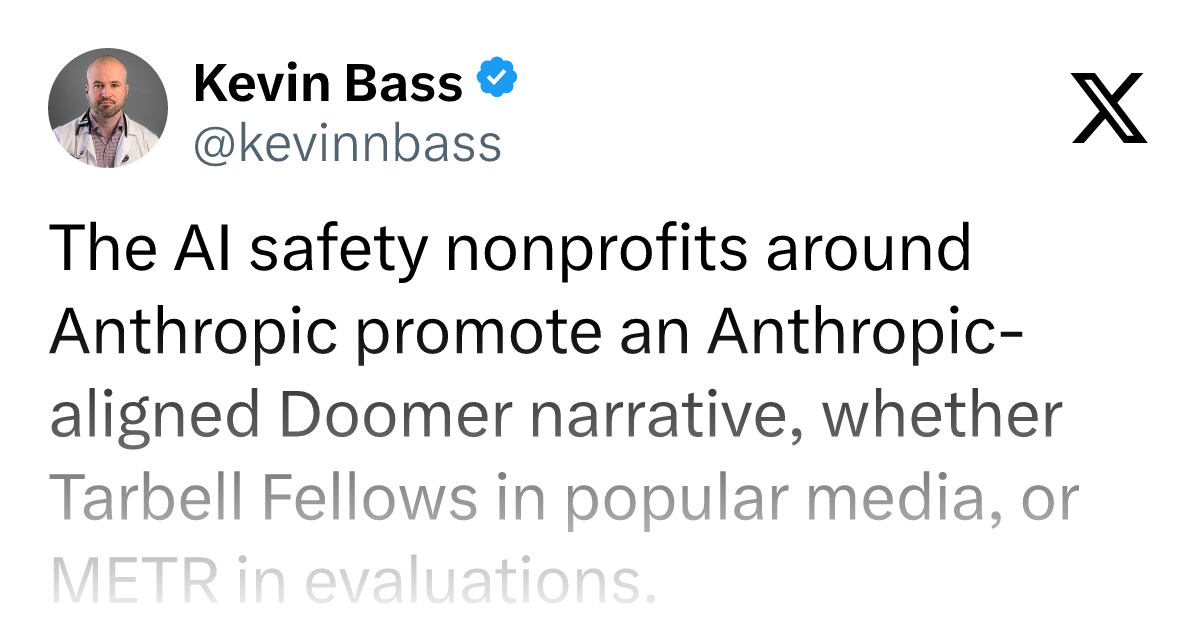
Regulatory Capture Accusations: The Controversy Over Anthropic's Capital and Policy Loop
A Hacker News post questions whether Anthropic is caught in a regulatory capture financial loop. We unpack the concept and why it's being aimed at top AI firms.