DeepSeek V4.1 Flash Tops AA's New Benchmark, Surpassing Astra and Sparking Controversy
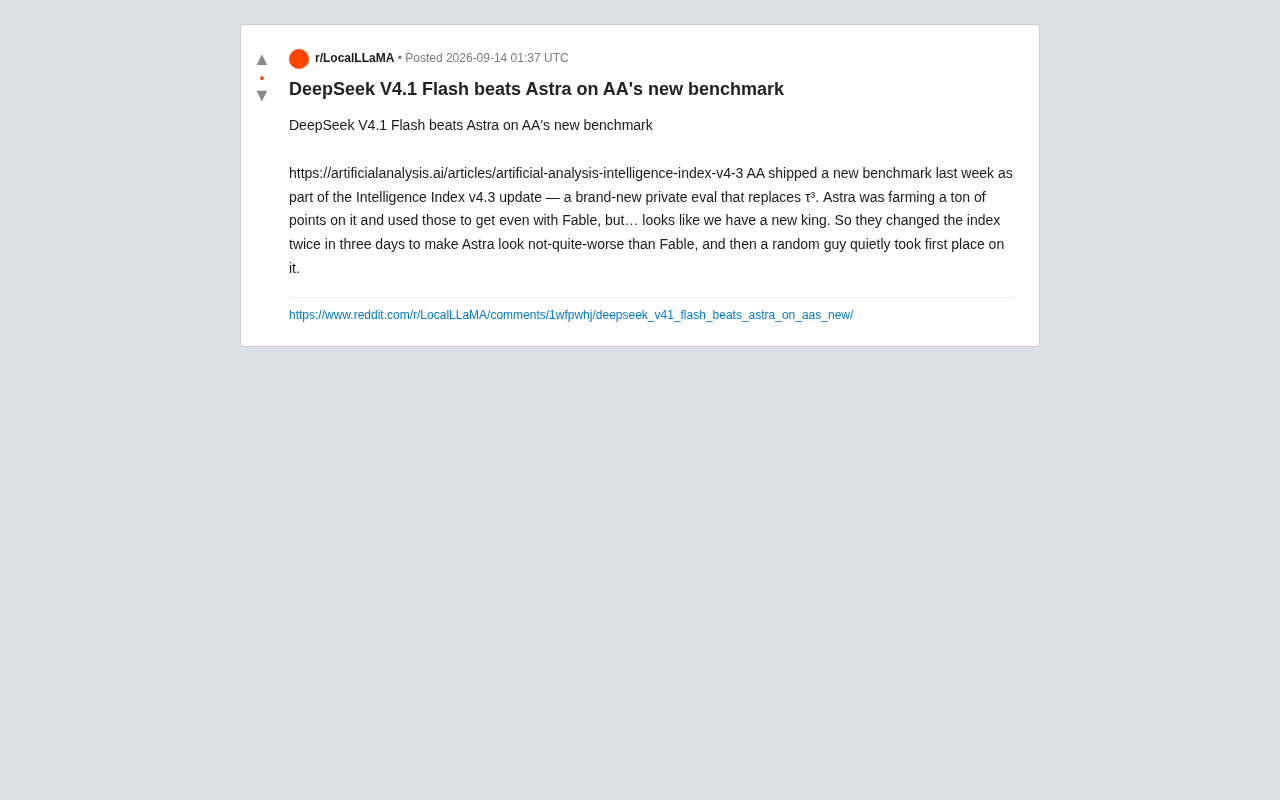
DeepSeek V4.1 Flash tops AA's new private benchmark, beating Astra amid controversy over rapid index changes.
Artificial Analysis introduced a new private benchmark in its Intelligence Index v4.3 update, with DeepSeek V4.1 Flash claiming the top spot over Astra. The result came with controversy: Reddit users noted that Astra had been farming points on the benchmark, and AA then made two index adjustments within three days — leading to accusations of bias. Private benchmarks are considered more credible due to lower contamination risk, making DeepSeek Flash's win more notable. However, details remain based on a single Reddit post and should be verified against AA's official release.
DeepSeek V4.1 Flash Takes the Top Spot on New Benchmark
According to discussions in the Reddit community, Artificial Analysis (AA) introduced a brand-new private evaluation benchmark as part of its Intelligence Index v4.3 update — and DeepSeek V4.1 Flash has claimed the top position on it, surpassing Astra.
This result has drawn significant attention because it comes amid a backdrop of rapid and repeated changes to the evaluation framework. According to community members, this new private benchmark replaced the previous τ³ (tau-cubed) benchmark as a key component in measuring a model's overall intelligence.
The Controversy: Two Index Changes in Three Days
The Reddit post highlighted a particularly contentious detail: Astra had previously been "farming a ton of points" on this new benchmark, which allowed it to draw level with Fable on the overall leaderboard. Within just three days, AA made two separate adjustments to the Intelligence Index.
The post's author expressed clear skepticism, suggesting that these adjustments had the effect of making Astra look less obviously behind Fable. At its core, this is a challenge to the neutrality of the evaluation body — when benchmarks and weightings shift repeatedly in a very short timeframe, the credibility of the leaderboard naturally comes under scrutiny.
It's worth noting that the above reflects the perspective of a single community source. AA has not officially responded to questions about the motivation behind these adjustments, and readers should approach such speculation with a critical eye.
Why Private Benchmarks Matter More
A notable aspect of this update is that AA used a "brand-new private eval." The key advantage of private evaluations is that the test questions are not publicly available, meaning models cannot game their scores by memorizing answers from training data. This makes private benchmarks a better reflection of genuine generalization capability.
Public benchmarks, by contrast, have long suffered from data contamination — once evaluation questions make their way into training corpora, model scores can become inflated. This is precisely why the community is especially sensitive when models appear to be "farming points" on specific benchmarks: if a model's score spikes unusually on a particular test, the first question people ask is whether it was specifically optimized for that test rather than genuinely improving in general capability.
If confirmed, DeepSeek V4.1 Flash's first-place finish on a private benchmark carries more weight, as it rules out the possibility of the model having been trained on the test questions.
What It Means for a Flash Model to Lead
By naming convention, "Flash" typically refers to a lighter, lower-latency, and more cost-efficient model variant. These models generally make trade-offs in favor of speed and affordability, and are not usually expected to top overall intelligence rankings.
For a Flash variant from DeepSeek to outperform competitors like Astra on a comprehensive intelligence benchmark suggests it has reached the top tier of capability while maintaining its efficiency advantages. This is particularly meaningful for real-world deployment scenarios, where many applications prioritize response speed and cost over raw, maximum performance.
How to Make Sense of This Leaderboard Battle
This episode reflects two realities in the current AI model evaluation landscape: first, the frequency and manner of benchmark updates directly affect trust among vendors and the community; second, competition among frontier models has become granular enough that individual data points on specific benchmarks can swing rankings meaningfully.
For developers and users tracking model capabilities, rather than fixating on fluctuations in any single leaderboard, the more reliable approach is to cross-reference multiple benchmarks and validate against real-world tasks. Leaderboards provide a reference point — not a definitive verdict.
Since the source material for this article is primarily drawn from a single Reddit discussion thread, specific details such as score breakdowns and the magnitude of index adjustments should be verified against AA's official Intelligence Index v4.3 release.
Related articles
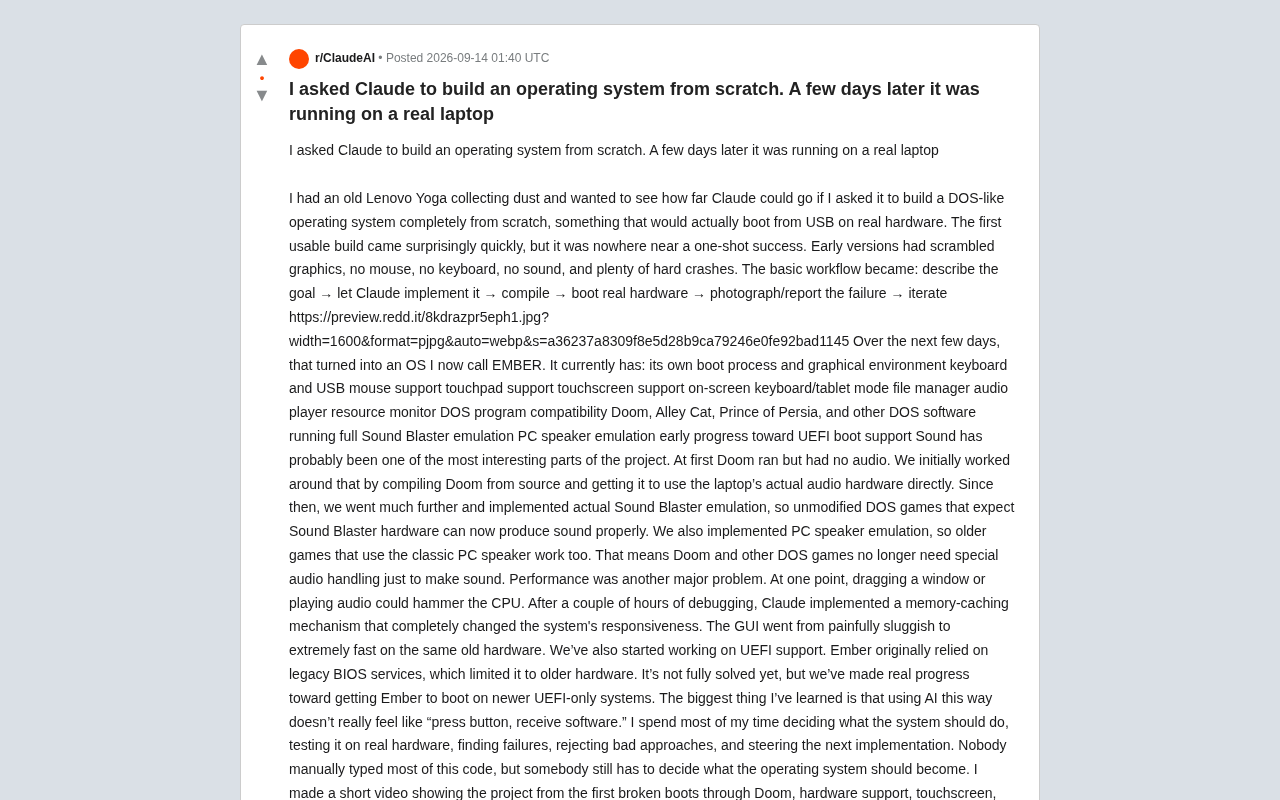
Building an Operating System from Scratch with Claude: How EMBER Ran on a Real Laptop
A developer built EMBER, a DOS-like OS, from scratch using Claude in just days. It runs Doom, emulates Sound Blaster audio, supports touchscreens, and boots on real hardware.
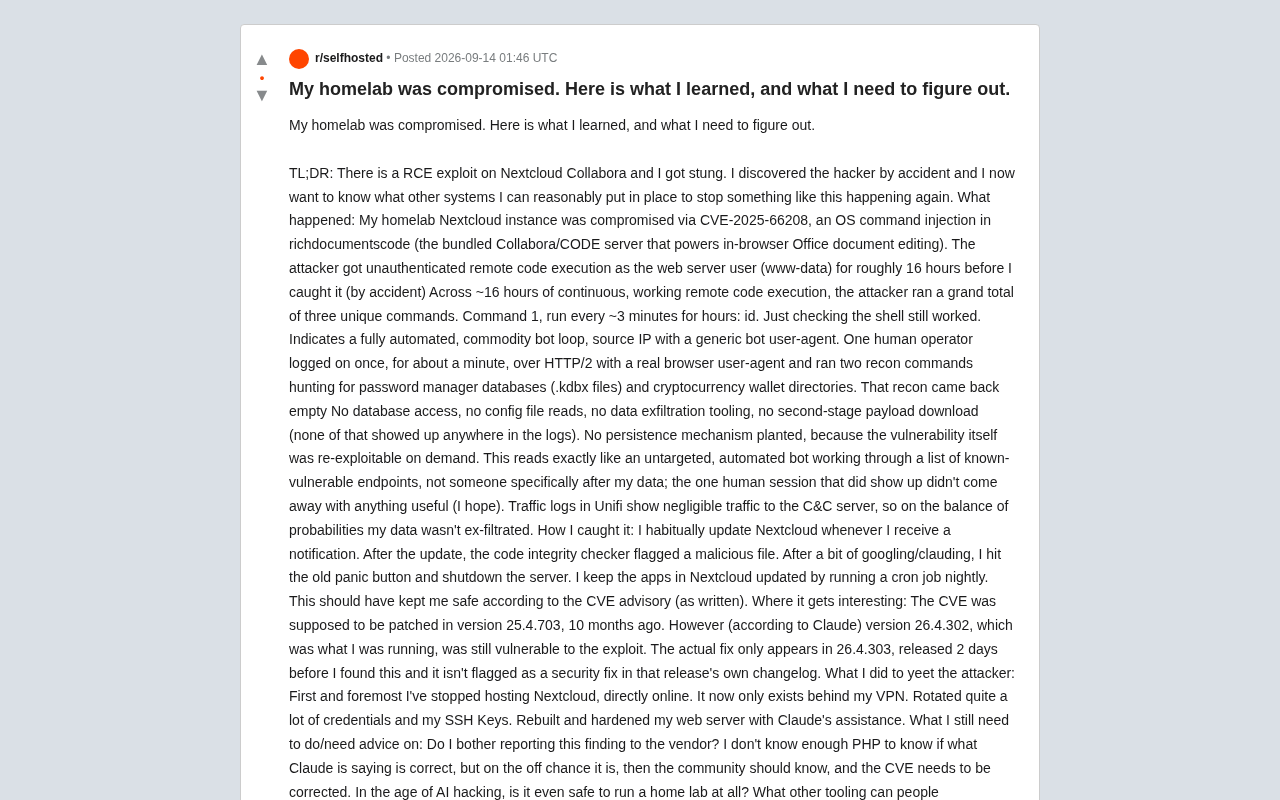
Homelab Compromised: A Nextcloud RCE Incident and Lessons for Home Server Security
A homelab user's Nextcloud instance was breached via CVE-2025-66208. The attacker lurked 16 hours while the official patch advisory was misleading. Key lessons for home server security.
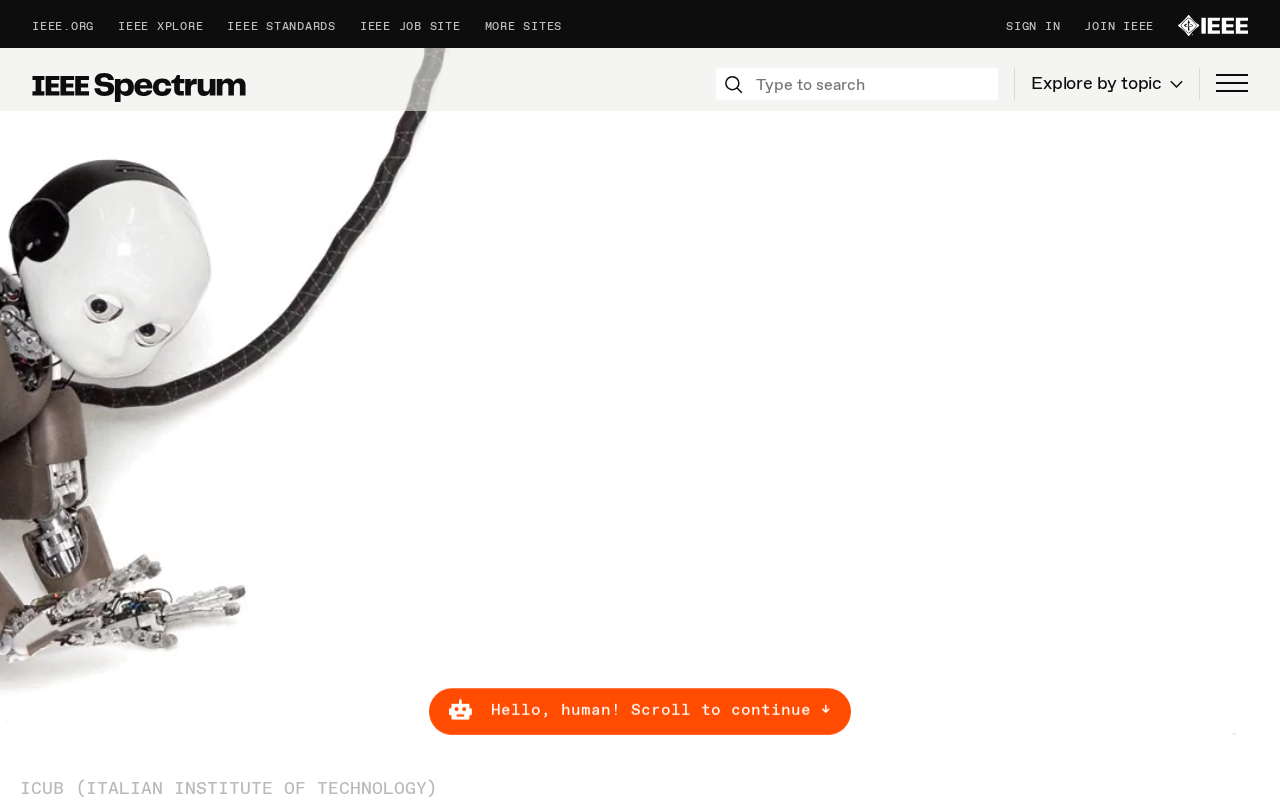
How Far Away Are Home AI Robots? Technical Bottlenecks and Timeline Predictions
When will home AI robots reach ordinary households? We analyze core technical bottlenecks, timeline predictions, and the realistic path from single-function devices to general-purpose assistants.