DeepSeek V4.1 Flash Update: The Parameter Truth, Benchmark Controversy, and Cost Revolution

DeepSeek releases V4.1 Flash: benchmarks up, costs down, but self-reported scores need verification.
DeepSeek released V4.1 Flash 1017 and a search API on October 17. Officially a minor update, all 11 benchmarks rose, with Terminal Bench 4.0 up 11.1 points to 42.3. The 552B-to-763B jump is a reporting-scope change, not expansion. Costs improved: 2.5x fewer output tokens, half the time, under 2 cents per task. But scores are self-reported and unverified, and nine legacy benchmarks are missing. Local deployment remains impractical; the API is the mainstream choice.
DeepSeek made two moves in quick succession on October 17: opening a search API in the morning, and releasing the new model V4.1 Flash 1017 in the afternoon. Officially, it's characterized as a "minor update" to the September version, but the jump in benchmark scores and the community reaction both suggest this update carries far more weight than the literal description implies.
Report Card: All 11 Benchmarks Up, Terminal Agent Improvement Stands Out
The official release published results for 11 benchmarks, all improved over the September version, with gains ranging from 2 to 11.1 points. Most notable are three items directly tied to agent capabilities:
- Terminal Bench 4.0: Tests the ability to execute real tasks in a terminal environment, rising from 31.2 to 42.3, an 11.1-point gain.
- Program Bench: Meta's whole-software-reconstruction benchmark, rising from 20.3 to 29.1, an 8.8-point gain.
- Deep SWE: Long-horizon real-repository engineering tests, rising from 74.2 to 77, a 2.8-point gain.
On training methodology, the official release discloses the use of reinforcement learning with self-feedback, and demonstrates a complete project workflow from game to 3D modeling. Chinese media have dubbed it "wish-driven programming." Note that the old scores used for comparison all come from the September version — this is a self-iteration comparison under the same model name.
According to multi-source discussions from Bilibili creators and the Hacker News and Reddit communities, a Hugging Face co-founder posted a wry comment about the "minor update" framing; the Hacker News thread scored 700+, and the Reddit post got 900+ upvotes. Community attention far exceeds the official framing.
Terminal Bench is a benchmark evaluating a large model's ability to execute multi-step tasks in a real terminal (shell) environment — file operations, software installation, script debugging — requiring the model to autonomously complete and verify results from natural-language instructions. Program Bench, proposed by Meta, requires the model to rebuild an entire software project from scratch, testing code generation, architecture design, and debugging in combination. Deep SWE focuses on long-cycle engineering tasks in real code repositories, simulating a developer's daily issue fixes and feature iterations. Together, these three benchmarks point to "agent" capability — whether a model can plan, execute, and self-correct in an open environment like a human engineer, rather than merely completing single-turn Q&A.
Parameter Analysis: 763B Isn't Expansion, It's a Change in Statistical Scope
Many people see the parameter count go from 552 billion to 763 billion and immediately assume the model was expanded. That reading needs correcting.
Comparing the two model cards reveals: the September version's page sidebar already explicitly listed "Model Size 763B Params" — meaning the September version's total weights were already 763 billion. It comprises three parts: a 552B backbone, a memory module of roughly 196B, and a vision encoder. The September promotional page said "552B Backbone Parameters," emphasizing the backbone parameters.
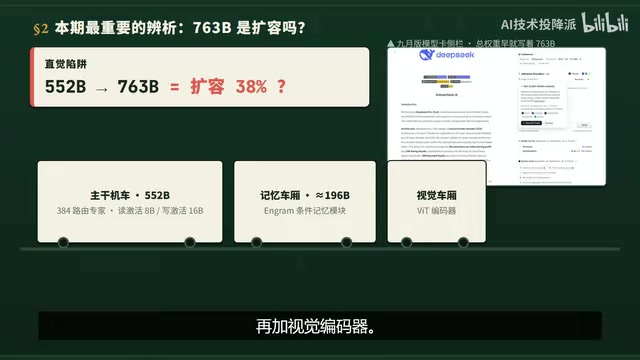
So 763B isn't an expansion — it's a switch in framing from "backbone parameters" to "all weights." The architecture itself is unchanged; this is essentially a new post-training checkpoint, with weights continuing to be open-sourced under the MIT license.
Differences in model parameter reporting scope often lead to misunderstandings. Typically "parameter count" refers to the total number of trainable weights in a model, but vendors may emphasize only the backbone network parameters in marketing while omitting add-on components like memory modules and vision encoders. DeepSeekAd's September "552B Backbone Parameters" referred only to the backbone, while the model card sidebar's "763B Params" reflects all weights. This shift in scope is not architectural expansion but a change in the dimension of disclosure. A post-training checkpoint refers to a version obtained by subjecting a pretrained model to post-training stages such as instruction fine-tuning and reinforcement learning — the weight structure is unchanged, but the behavioral policy has been updated.
A Cool-Headed Look: Self-Reported Scores, Scope Differences, and Vanished Legacy Items
Despite the impressive numbers, several issues warrant a cooler assessment.
First, no third-party verification. All three core scores are DeepSeek's own, and the release is only a day old — no independent institution has reproduced them yet.
Second, scope differences affect cross-comparison. Terminal Bench 4.0's 42.3 beats GPT5.6 Soul and GLM5.3, but still trails Claude Opus 5.5's 64.8 by 22 points. Program Bench's 29.1 uses the "Almost" criterion — 5 of 9 attempts passing counts as a pass; when the benchmark was released, all models scored zero. When a third party tested the September version under the strictest "Fully" criterion, the pass rate was only 0.5%. Deep SWE's 77 only ranks first after excluding Meta's self-reported 79 from MuseWonder.
Third, legacy strengths have collectively vanished. Nine items from the September report card — Codeforces, TB2.1, GPQA, Cybergym, and others — are all absent from this update. Does this mean agent specialization caused regressions on traditional benchmarks? The official release says nothing, so it can only be flagged as something to watch.
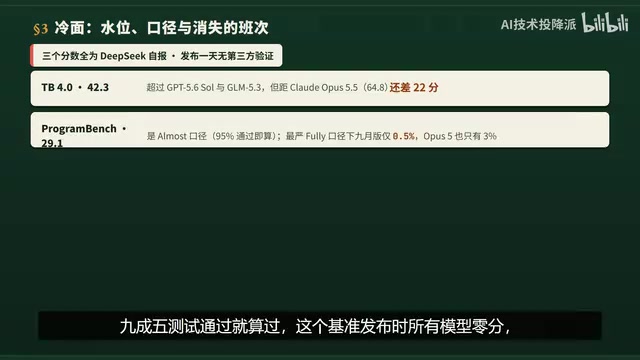
The "Almost" vs. "Fully" criteria in benchmarks represent differences in evaluation strictness. The "Almost" criterion allows a model to count as successful if it partially passes across multiple attempts (e.g., 5 of 9), while the "Fully" criterion requires every attempt to pass. This difference can significantly affect the fairness of cross-comparisons. Third-party reproduction is key to the credibility of AI benchmarks, referring to independent institutions verifying vendor-reported scores using the same test sets and evaluation scripts. Without third-party verification, self-reported scores may be inflated by test environment, prompt engineering, or data leakage. The absence of legacy benchmark strengths may indicate that capability specialization caused regressions in general abilities, or that the vendor selectively disclosed favorable results; subsequent independent evaluations are needed to judge.
The Cost Ledger: Double the Speed, Lower Token Consumption
The most tangible improvement in this update is on the cost side. The official wording is "shortening task execution time and output length." Independent testing shows the same task produces 2.5x fewer output tokens than the old version, for 20% overall savings.
Specific numbers: running a task takes 7.4 seconds and costs less than 2 cents; the old version needed 16.8 seconds — more than double the time — at a slightly higher cost. And the lowest reasoning effort setting has finally become usable.

The API name is unchanged — still DeepSeek Flash — and so is the price: 0.15 yuan per million input tokens and 0.6 yuan per million output tokens during off-peak hours, doubled at peak. The official release calls this a "Pareto improvement in performance and cost."
Local Deployment: Open Source Doesn't Mean a Free Lunch
The full 763B FP8 weights are split into 48 shards totaling about 510GB — the download alone takes considerable time. Community consensus is that consumer hardware struggles to carry it. For quantization strategy, the September version's experience is a useful reference: 4-bit quantization is relatively stable, while 3-bit leads to infinite loops. A maxed-out 64GB Mac running 2-bit quantization still only manages a few tokens per second.

Local enthusiasts are currently waiting on Unsloth's quantization package. For the vast majority of users, using the API remains the more practical choice.
FP8 quantization is a technique that compresses model weights from high precision (such as FP16/BF16) to 8-bit floating point, greatly reducing VRAM usage and transmission bandwidth, though it may bring slight precision loss. 4-bit/3-bit quantization compresses weights further; 4-bit usually remains usable on consumer hardware, while 3-bit can cause inference degradation (e.g., infinite loops, repeated output). Sharded download refers to splitting large model weights into multiple files (e.g., 48 shards) for distributed downloading and loading, though total size still determines storage and memory thresholds. The full 763B FP8 weights are about 510GB, far exceeding consumer GPU VRAM, so local deployment must rely on quantization compression or cloud APIs.
Cadence as a Weapon: The Search API and Model Update Combo
On the same morning, DeepSeek also opened its search API: 5 yuan per 1,000 calls, free until November 1. The model is faster and cheaper, and the cost of web search has come down too — the utilities an Agent needs are being assembled all at once.
First release in September, tuning in October — same name, same lineup, same price, a new brain every month. Writing the date directly into the version number is itself a signal: release cadence has become a competitive weapon. When does the next train arrive? Judging by the timetable, the wait won't be long.
One-line Summary
DeepSeek releases V4.1 Flash with across-the-board benchmark gains and big cost cuts, but self-reported scores and scope differences await verification.
Paragraph Summary
DeepSeek released the V4.1 Flash 1017 model and opened a search API on October 17. Officially a minor update to the September version, all 11 benchmarks rose, with Terminal Bench 4.0 up 11.1 points to 42.3 and agent capabilities markedly stronger. The jump from 552B to 763B isn't expansion but a switch from backbone to all-weights reporting. Cost improvements are real: 2.5x fewer output tokens on the same task, half the time, under 2 cents per task. Yet core scores are self-reported and unverified, and nine legacy benchmarks are absent — whether agent specialization caused regressions remains to be seen. Local deployment barriers are high; the API remains the mainstream choice.
Related articles

Chain of Thought Isn't Just for AI: How Humans Can Use CoT to Improve Thinking Quality
Chain of Thought isn't just a prompt trick for large models. Starting from a Hacker News discussion, this article analyzes why CoT works for human thinking too, breaks down actionable ways to transfer it, and highlights the key differences between human CoT and machine CoT.
Cloudflare Teams Up with OpenAI: Closi…
Cloudflare Teams Up with OpenAI: Closing the Loop from Vulnerability Discovery to Defense with AI
Cloudflare uses OpenAI Daybreak to investigate security vulnerabilities and generate reviewable remediation plans, while developers use Codex to boost coding efficiency and quality.

Orca Multi-Agent Orchestration in Practice: A Guide to Parallel Collaboration with Claude and Codex
Orca is Stable AI's free open-source agent workbench supporting 34 agents like Claude Code and Codex in parallel. Learn its Git worktree isolation, multi-model orchestration, and mobile management.