DeepSeek V4 Deep Dive: A Trillion-Parameter Open-Source Model Crushing Closed-Source Rivals

DeepSeek V4's trillion-parameter open-source model surpasses closed-source giants across multiple dimensions
DeepSeek V4 is a trillion-parameter open-source model that matches or exceeds closed-source models like GPT, Claude, and Gemini in coding, million-token long context processing, agent capabilities, and mathematical reasoning. Key technical breakthroughs include Hybrid Compressed Attention enabling million-token context windows, the MUON optimizer for improved training stability, and MoE architecture delivering exceptional cost-effectiveness — offering enterprises a powerful open-source alternative for AI applications.
Introduction: Open-Source Models Shake Up the AI Landscape Once Again
The timing of DeepSeek V4's release is quite telling — just one or two days after GPT launched its new version, this trillion-parameter open-source model burst onto the scene. This isn't the first time DeepSeek has employed this "fast-follow" strategy, and each time, it proves with real results that open-source models can not only keep pace with closed-source giants but even surpass them across multiple dimensions.
This article provides a comprehensive breakdown of DeepSeek V4 from four perspectives: performance benchmarks, technical architecture, cost advantages, and practical application value.
DeepSeek V4 Performance Benchmarks: A Full-Spectrum Showdown with GPT, Claude, and Gemini
According to benchmark evaluation data from the DeepSeek V4 paper, the model was compared against top closed-source models including Claude 4.6, GPT 5.4, and Gemini 3.1 across seven core dimensions such as Knowledge and Reasoning.
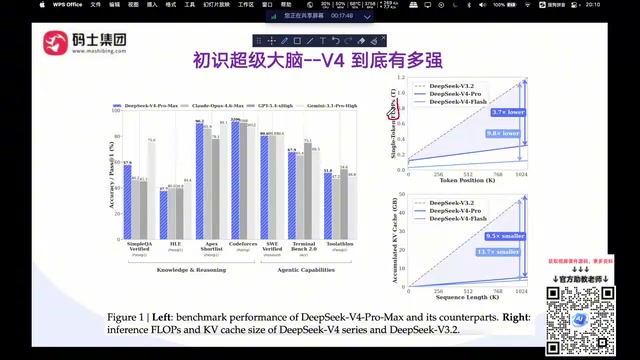
Core Areas Where DeepSeek V4 Leads
- Coding Capability: DeepSeek V4 Pro leads GPT 5.4, Claude 4.6, and Gemini 3.1 Pro in code generation — a highly practical advantage for developers who use AI-assisted programming daily.
- Context Length: Supports a million-token context window, ranking first in long-text processing capability.
- Agent Capabilities: Ranks in the top three for agentic capabilities evaluation, which is critical for enterprise-level intelligent automation development.
- Mathematical Reasoning: Also performs strongly, firmly in the first tier.
Relative Weaknesses
In knowledge reasoning, DeepSeek V4 trails top closed-source models by roughly three to six months. However, this gap has limited impact in practice — enterprises can typically bridge specific knowledge gaps through domain-specific fine-tuning.
Million-Token Long Context Breakthrough: DeepSeek V4's Efficiency Revolution
One of DeepSeek V4's most eye-catching technical breakthroughs is pushing the context window directly to 1 million tokens (1M). Previously, mainstream models typically offered context lengths between 8K and 128K, while V4 achieves an order-of-magnitude leap.
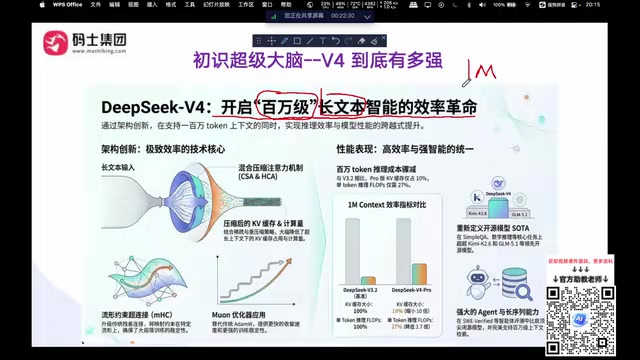
What Does a Million-Token Context Mean?
Here's an intuitive example: a 500-page report can be fed entirely into DeepSeek V4 for analysis in one shot, without manually splitting it into multiple segments.
Behind this breakthrough lies a long-standing technical debate in AI applications. RAG (Retrieval-Augmented Generation) is currently the most mainstream knowledge augmentation approach in enterprise AI: relevant document fragments are retrieved via vector databases and concatenated into prompts for the model's reference. However, RAG has inherent limitations including unstable retrieval recall rates and weak multi-hop reasoning capabilities. As context windows expand, the industry has seen an alternative approach emerge — directly stuffing entire knowledge bases into the context (the Long Context approach). DeepSeek V4's million-token window makes this technically feasible: all internal documents of a mid-sized enterprise could theoretically be input directly as context, completely bypassing the retrieval step. For RAG application developers, the ultra-long prompts assembled through concatenation can also be processed efficiently, greatly simplifying engineering complexity. These two approaches are not mutually exclusive, but V4's arrival significantly expands the feasibility boundary of the Long Context approach.
The Technical Architecture Behind It
DeepSeek V4 introduces several architectural innovations:
- Hybrid Compressed Attention (HCA): Through the combination of CSA and HCA, it dramatically reduces computational overhead while maintaining inference quality. Notably, KV Cache (Key-Value Cache) is a core mechanism in the Transformer architecture for accelerating autoregressive generation — during inference, the model caches each token's Key and Value vectors to avoid redundant computation. However, the longer the context, the more GPU memory the KV Cache consumes. For million-token contexts, traditional architectures might require hundreds of GB of memory for KV Cache alone, far exceeding the capacity of a single GPU. DeepSeek V4 uses compression techniques like MLA (Multi-head Latent Attention) to reduce KV Cache memory usage to less than 10% of previous generations, making million-token contexts truly feasible in engineering terms.
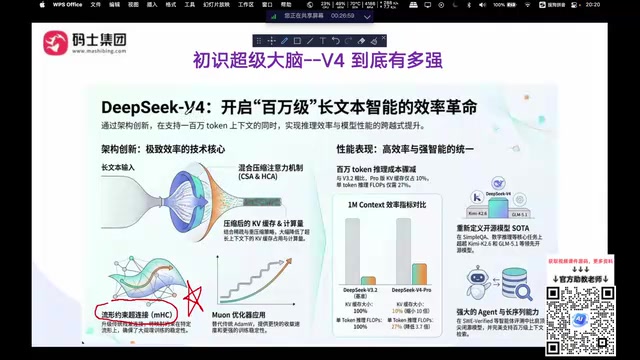
- MHC (Popularity-Constrained Hyperlinks): This isn't a V4 original — DeepSeek had previously published related papers, and V4 further optimizes and applies it to trillion-parameter-scale training.
- MUON Optimizer: This optimizer was first publicly proposed by the Moonshot (Kimi) team in their k1.5 technical report, replacing the long-standing AdamW. MUON (Momentum + Nesterov + Orthogonalization) introduces a matrix orthogonalization step that normalizes gradient update directions and produces smoother training curves, solving AdamW's tendency toward loss spikes and even divergence during ultra-large-scale training. DeepSeek incorporated it into V4 training and further validated its effectiveness at the trillion-parameter scale, demonstrating the mutual exchange and advancement of technical achievements among Chinese AI research institutions.
DeepSeek V4 Cost Comparison: Powerful Yet Affordable — The Ultimate Price-Performance Ratio
The DeepSeek series has always been built around the core philosophy of "lower cost, stronger model," and V4 takes this to new heights.
The MoE Architecture Logic Behind Trillion Parameters
To understand V4's cost advantage, you first need to understand the architectural foundation behind its trillion-parameter scale — Mixture of Experts (MoE). The core idea of MoE is to split the model into multiple "experts"
Related articles
 Product Reviews
The Programmer's Desk Setup Guide: Building a Workspace That Feels Like Home
Discover how programmers build productive, comfortable workspaces. From multi-monitor setups to ergonomic design, explore the desk philosophy that drives focus and flow.
 Product Reviews
Qoder vs Cursor Real-World Comparison: Which $20/Month AI IDE Is Better?
Hands-on comparison of Qoder vs Cursor AI IDEs: Agent autonomy, human interaction count, and architecture decisions. Qoder needed only 2 interactions vs Cursor's 8.
 Product Reviews
Cursor Cloud Agent Demo: Eliminating Bottlenecks Across the Entire Software Development Lifecycle
Deep analysis of Cursor's Cloud Agent demo showing how cloud VMs, automated test artifacts, and a full-chain control plane systematically eliminate human bottlenecks across the software development lifecycle.